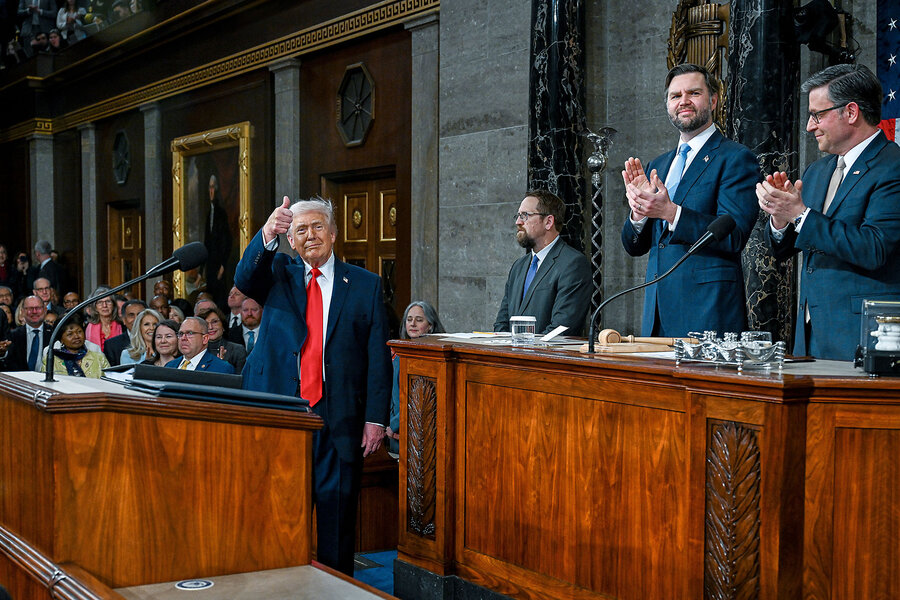
President Donald Trump emphasized domestic issues – starting with the economy and immigration – in a State of the Union address that cast America as successfully recovering from a series of crises and approaching its 250th anniversary stronger than ever.
The impetus Tuesday night was clear: November’s midterm elections loom large, with President Trump’s Republican Party in serious danger of losing its slim majority in the House of Representatives and possibly even the Senate. Polls show Mr. Trump’s overall approval rating averaging in the low 40s, with his handling of the economy underwater by 15 percentage points.
But in his opening remarks, the president was undaunted, asserting that he had inherited “a nation in crisis, with a stagnant economy, inflation at record levels,” and a “wide open border.”
Why We Wrote This
This State of the Union speech offered relatively few new policy proposals. But the goal was clear: To convince voters that they’re better off now than when President Donald Trump returned to office 13 months ago.
“After just one year,” Mr. Trump continued, “I can say with dignity and pride that we have achieved a transformation like no one has ever seen before, a turnaround for the ages.”
The theme of the president’s speech was “America at 250: Strong, Prosperous, and Respected” – a reference to the nation’s semiquincentennial this coming July 4. And while he sharply attacked his Democratic opponents and promoted his own record, he also hit some unifying notes of patriotism, honoring Americans who have served their country in various ways, and awarding a series of medals – including a Medal of Honor to 100 year-old Korean War fighter pilot Royce Williams.

Twelve minutes into his speech, the president invited the gold-medal-winning U.S. Olympic men’s hockey team to enter the House chamber to roaring applause and chants of “USA, USA.” He also made a point of noting that the U.S. Olympic women’s hockey team – which also won gold – would be coming to the White House. The women’s team had declined the president’s invitation to attend the State of the Union.
As promised, Mr. Trump went long Tuesday night – speaking for 1 hour and 47 minutes, a record for a State of the Union address. He seemed to stick largely to his script, a departure from his habit at rallies and other events of “weaving” through various topics off the top of his head.
The speech offered relatively few new policy proposals. But the goal was clear: To convince voters that they’re better off now than when Mr. Trump returned to office 13 months ago. If they’re still struggling, the president asserted, it’s the Democrats’ fault.
The sub-themes were almost as important. Mr. Trump’s devotion to tariffs remains strong, as he emphasized Tuesday, still pushing back against the Supreme Court’s landmark 6-3 ruling last Friday striking down his use of a 1977 law to tax imports. He called it “a very unfortunate ruling.”
Four of the nine justices attended the State of the Union. After Mr. Trump decried the ruling, TV coverage zeroed in on a stone-faced Chief Justice John Roberts.

After his defeat in the high court, the president immediately pivoted to other statutes to impose new global tariffs. Tariffs remain unpopular, with voters seeing them as leading to higher prices and disrupted supply chains.
Overall, the economy is a mixed bag. Employment numbers in January came in higher than expected, with 130,000 jobs created, but net job creation for all of 2025 came in at just 181,000 – far lower than the year before. Inflation has improved, dropping to 2.4% annually last month, down from 3.0% in January 2025. Energy prices are down, but housing affordability remains a sticky issue for many consumers, especially young adults. Health care costs have also skyrocketed, but the president’s proposed “Great Healthcare Plan,” with direct-to-consumer payments instead of payments to insurers, remains an unproven solution.
Immigration is another issue where Mr. Trump’s approval ratings have dropped, after controversial deportation campaigns resulted in the fatal shootings of two U.S. citizens in Minneapolis. Mr. Trump defended his record, saying “the border is secure,” after millions were allowed to enter illegally under his predecessor, President Joe Biden. And he highlighted cases of people murdered or harmed by unauthorized migrants.
“The first duty of the American government is to protect American citizens, not illegal aliens,” he said, calling on lawmakers in the chamber to stand up if they agreed. He then criticized Democrats for refusing to stand.
The president also went after the Somali community of Minnesota, which has been the focus of a massive fraud investigation in that state, and said they should be ashamed. Democratic Rep. Ilhan Omar of Minnesota yelled back, “You should be ashamed!”

On foreign policy, the big issue hanging in the air was Iran, where the U.S. is threatening major military action if the country does not give up its nuclear weapons program. The U.S. bombing of Iranian nuclear facilities last June lends credence to the threats, even as the president’s top military adviser has reportedly warned that a military campaign against Iran could carry risks. The president sought to take credit for having “obliterated” Iran’s nuclear program – while at the same time warning that the country’s nuclear ambitions were once again a serious threat. “We wiped it out, and they want to start all over again,” he said.
Also on the president’s agenda: trying to end the partial government shutdown targeting the Department of Homeland Security. Democrats are blocking funding for Immigration and Customs Enforcement (ICE) and Customs and Border Patrol (CBP) to force reforms.
“They have closed the agency responsible for protecting Americans from terrorists and murderers,” Mr. Trump said of the Democrats. “Tonight, I am demanding the full and immediate restoration of all funding for the Border Security and Homeland Security of the United States.”
One elephant in the chamber was Jeffrey Epstein, the late convicted sex offender and onetime friend of Mr. Trump. More than a dozen House Democrats planned to bring to the speech survivors of Mr. Epstein’s trafficking of underage girls. In the Senate, Democratic leader Chuck Schumer also brought an Epstein survivor as his guest. The recent release by the Justice Department of millions of Epstein documents has only fueled the furor around the matter – including calls for additional unreleased files to be made public.
The days of staid and respectful State of the Union addresses, with displays of bipartisan comity, may be over. In recent years, outbursts by members of the opposition party have become more common. This year, some Democrats boycotted altogether, leaving empty seats sprinkled throughout that side of the chamber. Several dozen House and Senate Democrats planned to attend a “People’s State of the Union” near the Lincoln Memorial, and a handful of other congressional Democrats stayed home.

In another statement of protest, a dozen Democratic women wore “suffragette white” in support of women’s rights, a trend that started in 2017 at Mr. Trump’s first joint address to Congress. Many also wore pins that referred to redactions in the Epstein files.
But the traditional response by an opposition party figure did go on, with Virginia’s newly inaugurated governor, Abigail Spanberger, speaking for the Democrats. She highlighted affordability, the issue that helped her to a landslide victory last November.
“Democrats across the country are laser-focused on affordability in our nation’s capital and in state capitals and communities across America,” Governor Spanberger said. She accused the president of enriching himself while offering “no real solutions.”
A second, Spanish-language response was delivered by Sen. Alex Padilla, Democrat of California. He made headlines last year when he was handcuffed by federal agents and forced from the room when he tried to question Homeland Security Secretary Kristi Noem at a news conference.