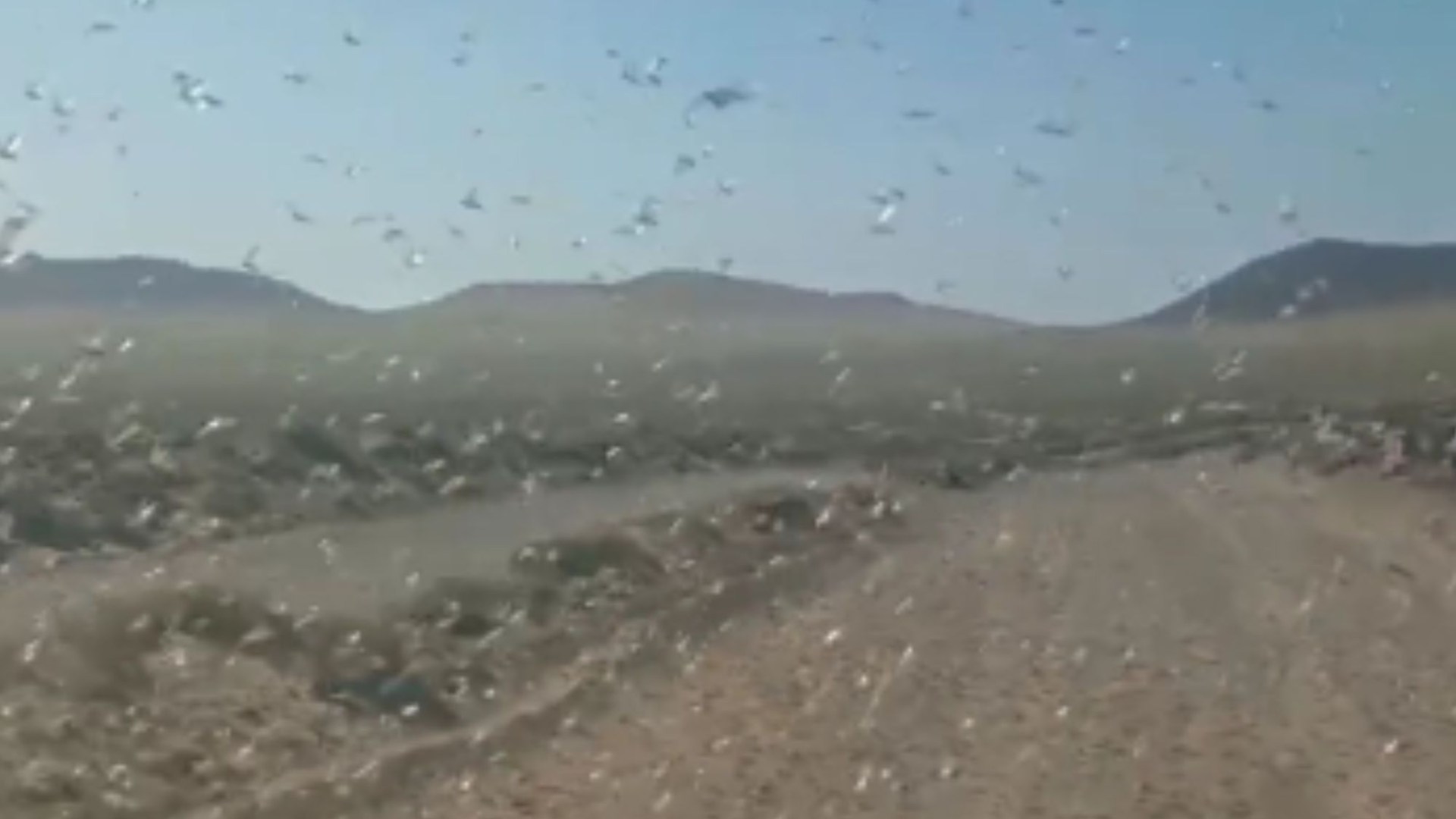
SWARMS of locusts arriving from the Sahara have plagued holidaymakers across the Canary Islands, prompting officials to urge calm.
Leaders in Lanzarote, Tenerife, Gran Canaria and Fuerteventura stress that the insects pose no direct threat to the public, though they acknowledge agriculture could be at risk.
For now, authorities insist there is no reason to panic but the coming days will be critical.
Videos circulating on social media show dense clouds of locusts sweeping across the countryside.
At times, the sky is visibly darkened as thousands of insects patrol rural areas.
A spell of wet and warm weather has attracted the insects to travel from Africa, carried on winds thick with Saharan dust.

The situation is reminiscent of a major infestation two decades ago that wreaked havoc on crops and disrupted daily life.
During that crisis, the invasion was so severe firefighters were called in to help contain the spread.
Authorities in Lanzarote have already placed emergency services on red alert, determined to act swiftly should the situation deteriorate.
Even so, officials remain cautiously optimistic that this will not escalate into a full-scale plague.
Francisco Fabelo, Head of Environment for the island’s government, said: “The next two days are going to be key. If they are adult specimens that have arrived exhausted, they will die and nothing will happen. If we see copulations, that would mean that they are reproducing.
“We would have to see it between this afternoon and tomorrow.
“We already experienced this in 2004 and at the end of the eighties there was another similar episode.”
Theo Hernando, Secretary General of the Association of Farmers and Ranchers of the Canary Islands, sought to reassure famers.
“It is common for episodes of winds from Africa, such as those brought by the haze, to have locust specimens,” he said.
“They are blown by the wind and as long as they are isolated cases there is not problem.
“They arrive very weakened, they are not in a position to settle or reproduce.
“Nature itself takes its course and many times they end up being preyed upon by birds.”
Island authorities have also pointed out that shrubbery burning season is currently under way – and locusts have a natural aversion to fire.
However, experts warn that if the insects are younger rather than older, urgent measures would be required.
A reproducing swarm could devastate crop supplies, leaving fields barren within days.
The Canary Islands have dealt with this threat before.
In 1958, vast swarms from Africa devastated tomato and potato plantations, prompting the Ministry of Agriculture to deploy aircraft to fumigate affected areas.
On the ground, farmers resorted to bonfires, loud noises and poisoned bait to protect their livelihoods.
In 2004, Lanzarote recorded the arrival of up to two million locusts, forcing the island to formally declare a plague.
Locusts have crossed from Africa for centuries, riding easterly and south-easterly winds.
According to the Food and Agriculture Organization, the desert locust is the most destructive migratory pest in the world.
Each locust can consume its own body weight in food every day, and a single square kilometre swarm – containing up to 80 million adults – can devour the same amount of food as 35,000 people.
That staggering capacity has historically increased the risk of famine in parts of Africa and the Middle East.
For Spain’s island communities, however, officials insist on calm as they wait to see if this marks the start of something more serious.