Each day, the Iran-backed Hezbollah militia uses social media channels to trumpet its steady stream of attacks against Israeli military forces now occupying southern Lebanon, and beyond, into northern Israel.
The Hezbollah posts, some accompanied by drone’s-eye videos of its attacks, list precise timings and locations of the strikes, one after another, using a “swarm of loitering drones” or rocket salvos.
Their targets include new Israeli artillery positions, military bulldozers, and armored vehicles, or even clusters of Israeli soldiers that require medical evacuation by helicopter, which are then also attacked.
Why We Wrote This
Since late 2024, and now as part of the U.S.-Israel war against Iran, Lebanon’s Tehran-backed Hezbollah militia has been the target of powerful and persistent Israeli attacks. So, how is it that it keeps on fighting, even intensifying its own attacks on Israel?
Hezbollah’s videos seek to prove the militia’s continued potency, but how does Lebanon’s Shiite “Party of God” maintain any military capacity at all after relentless and unprecedented blows delivered by Israel to Hezbollah fighters and arsenal alike, since 2024?
The answer, in short, appears to be a combination of overestimating the damage Israel inflicted on the militia, and underestimating its ability to rearm and its determination to keep fighting.
In early March, to avenge the killing of Iran’s supreme leader, Ayatollah Ali Khamenei, in the first volley of the U.S.-Israel attack against Iran, Hezbollah ended a 15-month ceasefire with Israel that had been marked by near-daily Israeli strikes.
Israel’s response did not hold back. Its ensuing air campaign in Lebanon has killed more than 2,700 people – combatants and civilians alike – and displaced 1.2 million others. Reuters reported this week that “several thousand” Hezbollah fighters were killed, and only partially accounted for in Health Ministry figures, citing two unnamed Hezbollah officials and another source.
Israel has now occupied a six-plus-mile buffer zone in southern Lebanon – “indefinitely,” it says – and flattened dozens of villages along the border.

Since U.S. President Donald Trump declared a “truce” in Lebanon on April 16, Israel says it has killed an additional 220 Hezbollah operatives. On Wednesday, Israel killed the commander of Hezbollah’s elite Radwan force in a Beirut strike, and claimed the deaths of two other senior commanders.
“Fighting for our existence”
Yet Hezbollah has still mounted an unprecedented response, with attacks more than double their peak frequency in 2024, according to one analysis.
“We are still strong today. Our tactics have changed, we changed everything,” says a Hezbollah special forces officer, a veteran fighter of more than 35 years who spoke in Beirut on the condition of anonymity.
“These days, we have no other choice but to fight; we are fighting for our existence, to be or not to be,” says the officer, who fought Israel in multiple battles.
Though Israel has targeted Iran’s “Axis of Resistance” allies across the region – with a particular focus on Hezbollah – he says the militia “has more [weapons] now than before.”
The officer, a veteran also of the Hezbollah-Iran effort to prop up the regime of former Syrian dictator Bashar al-Assad, says Hezbollah received “a lot, a lot of weapons” via Syria immediately after Mr. al-Assad was ousted in December 2024.
“How can we be weakened, and now we enter a new drone war with [Israelis]? We are going to burn them alive,” he boasts. He acknowledges, however, that severe blows from Israel mean Hezbollah’s past ambitions of victory are not realistic. “It’s not the issue of defeating them or killing them. We are in defensive mode,” he adds.
In late 2024, Israel appeared to have every advantage when incremental exchanges of fire with Hezbollah that dated from the beginning of the Gaza war turned into a no-holds-barred Israeli air campaign, aimed at destroying Hezbollah’s missile arsenal and military and financial infrastructure.
Owing to Israel’s extraordinary intelligence penetration of Hezbollah, it assassinated multiple top layers of the militia’s leadership and commanders, targeted weapons depots and stores of cash, and incapacitated thousands of fighters with walkie-talkies and pagers rigged with explosives. Its technological prowess reportedly included yearslong use of satellite imagery and algorithms to detect even slight changes in soil or ground conditions that would indicate both above- and below-ground military activity.

Scott Peterson/Getty Images/The Christian Science Monitor
Hezbollah not “so badly beaten”
But, as evidenced by the recent round of hostilities, its advantages appear to have only dented Hezbollah’s ability to fight back.
“I don’t know why people always thought that Hezbollah had been so badly beaten in the last round,” says Nicholas Blanford, a Beirut-based expert with the Atlantic Council. “They did take a battering for sure, a loss of leadership and all the rest of it. But I never doubted that they still had the ability to mount a pretty tough fight if they had to. It just wasn’t that debilitating.”
By Mr. Blanford’s count, Hezbollah’s rate of attacks during the 2024 fighting was 30 to 40 targets per day. But despite the scale of Israel’s military efforts, the daily average has been perhaps double that since March, with a peak of 97 separate Hezbollah attacks on March 26 – the most since its founding in 1982, he adds.
On that day, he says, Hezbollah hit 53 Israeli military targets in Lebanon and 27 in Israel; 17 Hezbollah strikes hit Israeli population centers.
“Judging from reports in the Israeli media, they weren’t expecting this level of pushback from Hezbollah. But their intelligence penetration has obviously been very strong, very deep,” says Mr. Blanford, the author of “Warriors of God: Inside Hezbollah’s Thirty-Year Struggle Against Israel.”
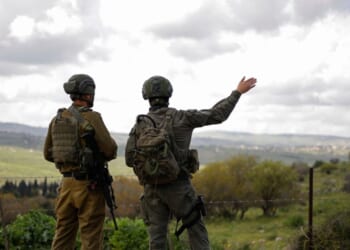
One result is that the Israel Defense Forces appears to have shifted its goals in Lebanon, from attempting to destroy Hezbollah to fighting a war of attrition. An IDF tour for journalists this week, five miles inside Lebanese territory along the Mediterranean coast road, came under a Hezbollah drone attack.
“It really is a challenge,” said Col. “Aleph,” a commander of Israel’s 226th Reserve Paratroopers Brigade, when asked about Hezbollah’s drones, according to the Times of Israel. “It is an operational challenge, like other operational challenges we have here in the area, like the anti-tank and the rockets.”
Reporters were told the IDF had found large weapons stores in houses in coastal villages, and on Tuesday destroyed five Hezbollah tunnels. Hezbollah has attempted to send reinforcements to replace hundreds of operatives killed, the journalists were told.
“There are certain forces that are really trying to get close, but every time they get close, they are hit, and I hear their spirit breaking,” the Israeli colonel said. “I hear it, I know it, and when [their spirit] breaks, they also try to flee.”
That is not a description that Hezbollah would recognize, as the group broadcasts its list of daily attacks.
Shiite voice of dissent
But Hezbollah’s chances of victory at this point do appear slim to one resident of a southern Lebanese village who was displaced last week when Israel destroyed his family’s three-story home – soon after Hezbollah fighters launched rockets from behind the building.

Scott Peterson/Getty Images/The Christian Science Monitor
“I cannot see Hezbollah winning over this high-tech machine,” says Ali Yahya, as he sits beneath a single small tree, with a tarp shelter and a plastic beach chair, near scores of makeshift tents for the displaced in Beirut.
“They [Hezbollah] fire and they hide. The Israelis fire back where the smoke is, and our house is gone. Now, I have a problem with Hezbollah,” says Mr. Yahya, noting that his home would still be standing if Hezbollah had chosen a different firing position.
He vows, when the war is over, to break into and occupy the nearest Hezbollah office until the group rebuilds his house.
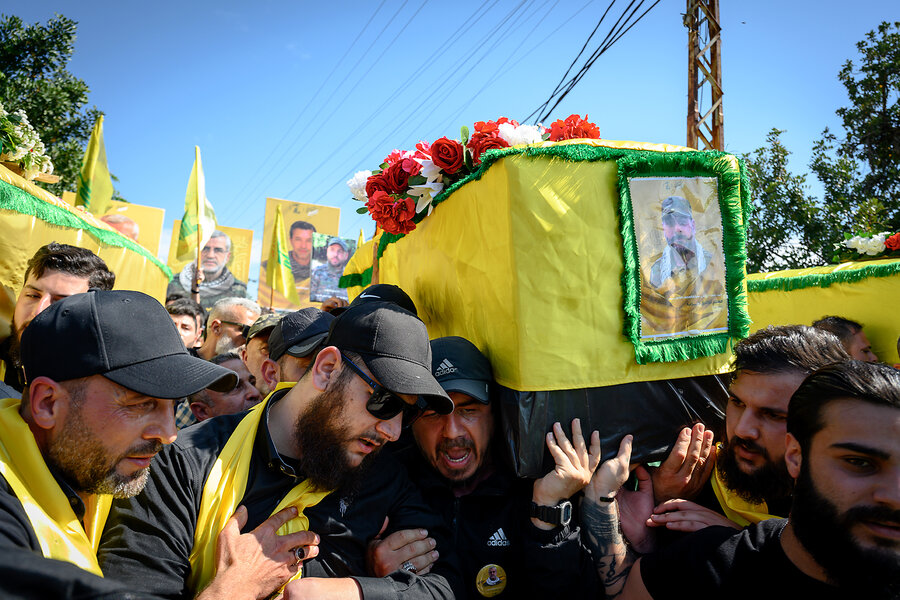
Shiite Lebanese areas have been hit hardest by Israel, with many homes destroyed and regions now inaccessible. Repairs from the 2024 fighting were far from complete when the latest fighting broke out. Still, at recent funerals for Hezbollah fighters, mourners voiced continued devotion to the cause, despite their losses.
“We’re not too happy about it,” says Mr. Yahya, in a rare Shiite voice of dissent. “Trust me, a lot of people lost their homes, they hate [Hezbollah], but they cannot say it. Not everybody is like me.”
Yet for Hezbollah, the top priority now is resisting Israeli occupation – not domestic concerns, or government decisions to disarm the militia.
“When it became clear that Hezbollah was hitting back, that the Israeli goals in south Lebanon were dialed back a little bit, you could see some restoration of [Shiite] communal pride,” says Mr. Blanford of the Atlantic Council.
“Hezbollah had been sitting on its hands for 15 months, being slapped every day by the Israelis, and now they’re fighting back,” he adds. “Now, it’s the Israelis that are going into bomb shelters, it’s Israeli soldiers that are being killed and wounded.”