In 1855, an American by the name of William Walker went to Nicaragua and within a few months, using a band of mercenaries, took over the country and made himself its president. This was an instance of filibustering — the then-popular American hobby of small groups conquering a Latin American country, contrary to the will of the people there.
It is from this violent pastime that we get the legislative term “filibuster.” A single legislator (or a very small cabal thereof) hijacks the process of passing laws. This involves abusing or ignoring rules, often using long irrelevant speeches, frivolous amendments, and violation of convention. Filibustering may work but has the same legitimacy as Walker declaring himself president of Nicaragua (i.e., none).
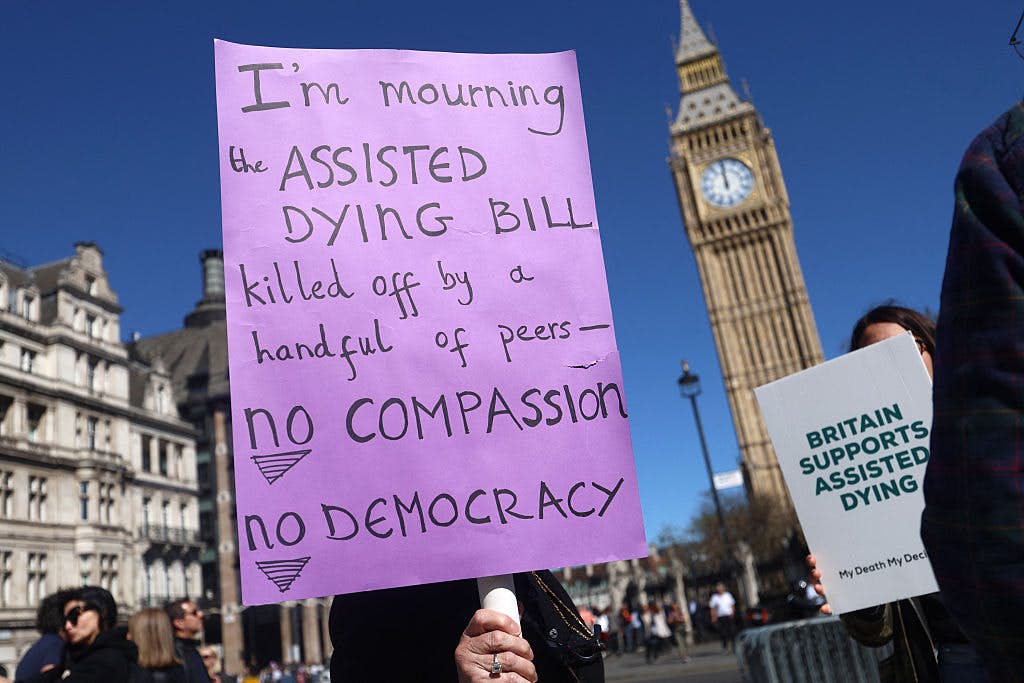
The recent defeat of the assisted dying bill in the House of Lords has brought on allegations that a small cabal of opponents employed this pernicious tactic to run out the clock on the parliamentary session by means of hundreds of amendments and delaying debate, moving glacially through early clauses. The result was that the bill died with the session, never having been voted up or down. The New York Times typified the attitude with the headline “7 Unelected Lords Helped Block an Assisted Dying Bill”.
Let’s examine these claims. First, there is the charge of excessive amendments, particularly from a few prolific amendment tablers (Baroness Grey-Thompson put forward 130, for instance). The cumulative result was over 1,000 amendments. Is this a filibuster?
By the standards of amendment filibusters, a measly 1,000 (which includes sponsor amendments) barely matters. In the past decade, French leftists and Canadian Tories have, faced with bills they disliked, managed to each table roughly 20,000 amendments as blocking measures. That’s still far down the league table. In 2015, a single Italian senator, using an algorithm that caused small changes in punctuation, filed half a million frivolous, near-identical amendments, which would have taken up 80 tonnes of paper if printed.
In content and quantity, the Lords amendments are clearly distinct from these actual filibusters. The quantity certainly pales in comparison, especially when one considers that the rules for amendments prevent global changes to a bill. If a term is mentioned in five clauses, deleting it requires five amendments. The result is seemingly minor amendments can end up with inflated numbers. This requires, for example, Baroness Coffey to file a large number of amendments to propose to remove Wales from the scope of the bill. These could be considered together, without slowing debate.
In content, one can also see that the amendments put forward by the supposed small cabal are substantive, unlike in the case of an actual filibuster. A bad bill requires proportionally more amendments to fix its problems, as even the assisted dying bill’s proponents acknowledged. By the time the bill died, Lord Falconer of Thoroton, its sponsor in the Lords, had promised a number of amendments of his own. The bill was long, torturous in places, and silent on many issues. Amending and proposing changes is the job of an engaged legislator.
There is also the accusation that the debate was deliberately slowed to prevent timely consideration of the whole bill. Once again, let’s look at a real use of debate as filibuster as a benchmark. In 1957, Strom Thurmond spent over a day seizing debate in the US Senate to try to defeat a civil rights bill. His speech occupies 88 pages of the Congressional Record and contains over 140,000 words. Plainly, his point could have been made more concisely.
The entirety of the Lords committee debate on the assisted dying bill took up 607,000 words. Given the bill itself is a complex 15,000-word document, this is hardly unreasonable (roughly 40 words of debate for each word of the bill). That debate contains many rich exchanges, with contributions from peers for, against, and neutral on the bill.
This is a sign of functioning, not hijacking. The purpose of the Lords is deliberative democracy, with serious discussion and debate on serious issues, particularly when a bill deals with fundamental principles. In 1967, considering the mere 1300-word abortion bill, peers generated roughly 140,000 words of debate, or 107 words of debate per word of legislation. This lengthy consideration was praised by the legal scholar Jeremy Waldron as a model of careful and responsible legislative practice.
Careful debate is preferable to legislators closing their eyes and voting things through to beat the buzzer
There is one more claim made by those seeing a mirage of William Walker on the red benches. It is alleged that opponents of the bill were happy to have the clock run out and did not mind that the bill dying without a final vote on it. That’s perfectly true. It’s still not a filibuster. If a lengthy bad bill takes a great deal of time to be analysed and amended, that’s the problem of the drafters rather than the opponents. Careful debate is preferable to legislators closing their eyes and voting things through to beat the buzzer.
A filibuster is, by definition, an abuse of the rules or simply ignoring them, to hijack a legitimate legislative process. The conventions of the upper house required the bill to be carefully considered and debated. Had a small clique of activists pressured peers to drop this duty and simply send the bill onward sans scrutiny, that would have been a filibuster. Fortunately, unlike nineteenth-century Nicaragua, the House of Lords could not be so easily intimidated into surrender.