At first glance, it looked as if President Trump was at last taking seriously the need to prise control of the Strait of Hormuz from Iran, whose continued grip on this strategic sea lane threatens the global economy with recession.
Yes, Sunday’s social media post was rambling and in places incoherent (as his posts increasingly are).
But it did say the US would start ‘guiding’ – his word – commercial ships out of the Strait of Hormuz, where they have been stranded for more than two months since he launched his war on Iran. He even had a name for it: ‘Project Freedom.’
But, as is often the case with Trump, there was confusion rather than clarity. We were quickly briefed that there would be no US Navy escort for vessels prepared to run the gauntlet of Iranian threats by passing through the Strait.
All that was on offer was a so-called ‘co-ordination cell’ involving countries with ships in the Gulf, insurance companies and shipping lines sharing data on what might be the safest way through the Strait. Iran was still threatening to attack any ships which hadn’t coughed up a $2million ‘Tehran Toll’ to secure safe passage.
The UK’s Maritime Trade Operations agency, which works closely with the Royal Navy, said the security threat level in the Strait remained ‘critical’. As long as that stayed the case it was unlikely many ships would risk it – and very few have, especially after Iran claimed yesterday morning to have hit a US frigate with two missiles.
That was quickly and categorically denied by the US military as Iranian disinformation, which it probably was.
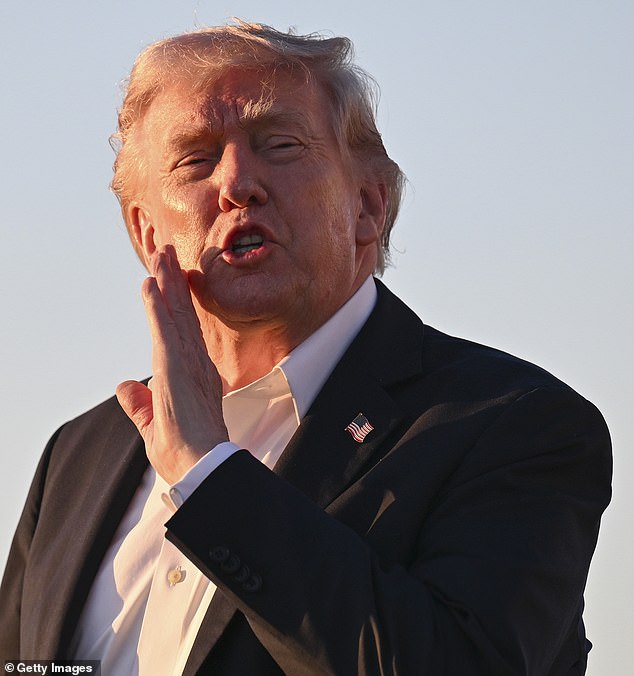
President Trump said the US would start ‘guiding’ – his word – commercial ships out of the Strait of Hormuz, where they have been stranded for more than two months
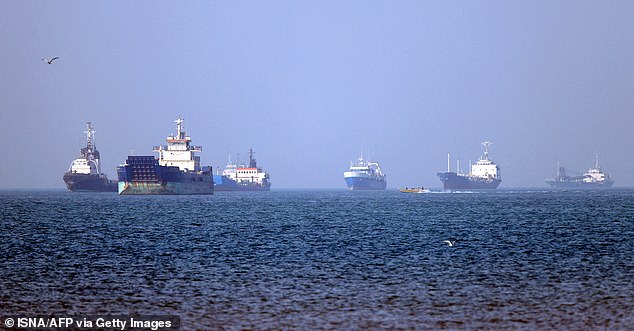
It is now generally accepted in the White House that Trump and those aides closest to him have no credible idea how to restore free navigation in the Strait of Hormuz
But truth from either side is elusive in these murky waters. For later yesterday we were then told by US military command that two American guided-missile destroyers were now operating in what it called the ‘Arabian Gulf’ in support of Project Freedom.
For good measure the American military reported that it had ‘actively assisted’ two US-flagged merchant ships to safely transit the Strait. So much for that earlier briefing that the US Navy would not be providing any escort services.
Though it wasn’t specifically claimed that the US destroyers had provided an escort – just that they had provided a ‘defensive shield’.
The confusion suits the White House, where it is now generally accepted that Trump and those aides closest to him have no credible idea how to restore free navigation to the Strait of Hormuz – or how to bring the war to an acceptable end.
One adviser told me he thought if Iran agreed to relinquish its control of the Strait – a power it has never enjoyed before, even in previous conflicts – then Trump would use that as a pretext for declaring victory and going home.
‘Even if that was only a return to the status quo ante – to what prevailed before Trump’s War?’ I asked. ‘We’d dress that up as victory,’ he replied.
‘Even if it left the Iranian regime with the enriched uranium?’ I pushed.
‘We’d dress that up too,’ he said. ‘We’ve already claimed to have obliterated Iran’s ability to make a nuclear bomb twice [last June and in the current attacks], so it shouldn’t be too difficult to sound convincing.’
In truth, what was a hot war, which Trump claims to have won with over 20,000 devastating strikes in alliance with Israel, is now more of an economic standoff, which the White House fears Iran is in danger of winning.
The tyrants of Tehran are battered and bruised but they’re still standing, with more of an iron grip on the country than ever.
Whereas Trump’s approval ratings are tanking, as petrol prices soar above $4 a gallon and the cost of living, an issue which helped win him re-election, rises up the agenda once more. His overall approval rating has slumped to 37 per cent in the latest Washington Post/Ipsos poll, with 62 per cent disapproving of his second-term record so far.
A mere 23 per cent approve of his handling of the cost of living, with 76 per cent disapproving. On his war with Iran, only a third approve while two-thirds disapprove.
We’re still six months away from America’s crucial mid-term elections in November and a lot could happen between now and then.
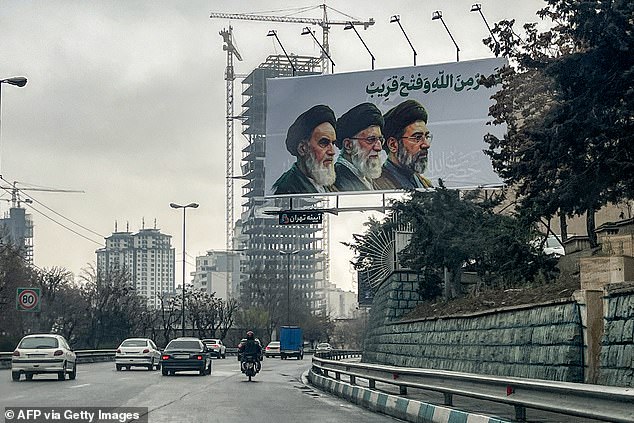
A billboard in Tehran depicting Iran’s supreme leaders since 1979
But Republican strategists fear there’s just too much ground to claw back, especially when cost of living issues are likely to get worse before they get better.
They’ve already accepted the House is a lost cause, which is perhaps no great surprise since parties which hold the presidency regularly lose the House in mid-term elections and the current Republican majority is slight.
But the Senate is now in play too, which was not the case before Trump’s war. Only the lack of easy targets for Democrats among the Republican seats up for grabs might keep it Republican.
If Trump were to lose both then he would truly be a lame-duck president in his final two years. That prospect frustrates and angers him, making him more difficult to handle. Aides complain privately that he has become ever more unpredictable, ever more irascible, ever more a stranger to logic and common sense.
‘We stagger from day to day,’ one told me, ‘never quite knowing what will hit us next.’
Nobody around him, however, is in any doubt that he wants out of his Iran venture, a self-inflicted albatross which threatens to cast a dark shadow over his second term, whatever else he gets right. The inside betting is that he will play for time, as he has in Gaza, then creep away when nobody is looking too closely.
Last year, to great fanfare, he announced peace had broken out on the Strip and reconstruction would begin immediately. Since when, there’s been very little peace and no reconstruction. But our attention has moved on. Gaza makes few headlines these days, even though it’s still grim on the ground and progress is passing slow. But somehow it’s no longer a problem for Trump.
Trump will be hoping the same attention deficit works in his favour for Iran. Economic standoffs generate fewer headlines. Soon it will be ‘nothing to see here, move along’.
His problem is that the Iranian regime is in no rush to ease his departure. Yesterday it provoked a number of skirmishes in the Gulf to deter any rush through the Strait, which forced the US to respond. It has realised that controlling the Strait is a far more powerful weapon than a nuclear bomb. Though it’s not giving up on that either.
The growing fear in Asia and now in Europe is that Trump will scuttle, leaving the Strait to Iran’s tender mercies. This is the stuff of nightmares. Every week the Strait remains closed is a week closer to severe shortages and spiking prices in all manner of vital materials – not just oil and gas – but jet fuel, helium, naphtha, fertilisers, about which we know little but which are vital to normal life.
No jet fuel, no flying. No helium, no microchips. No microchips, no cars or household appliances. No fertilisers, no food. No naphtha, no essential petrochemicals for everything from synthetic textiles to medicines.
If, come June, the Strait is still closed then we will face a summer of misery – and no Trumpian declarations of illusory victory will be able to disguise the scale of the hardships in store. And all, essentially, for nothing.