The Bank of England has held interest rates at 3.75 per cent today, but the base rate is now expected to rise later in the year.
Monetary Policy Committee members voted eight to one to keep the rate on hold, with chief economist Huw Pill voting to increase it by 0.25 percentage points to 4 per cent.
The central bank has cut rates gradually from a high of 5.25 per cent since August 2024, but it was held at the previous two meetings in February and March.
Policy makers are now worried about the inflationary threat posed by the conflict in the Middle East. They want to encourage households to rein in spending and squirrel cash away, so are unlikely to cut the rate further.
Traders no longer expect any interest rate cuts in 2026, with the general consensus being that the central bank will need to raise them later this year.
This is because the situation in the Middle East remains volatile. The rate of inflation rose to 3.3 per cent last week, and is expected to rise further over the coming months.
The MPC sets interest rates to try to keep consumer price inflation at the Bank and Government’s 2 per cent target.
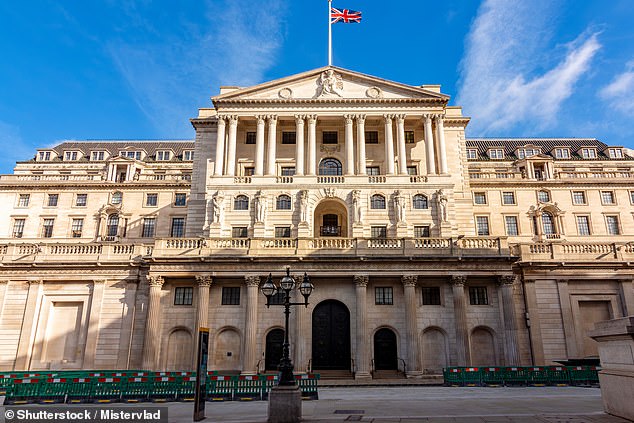
Rates headed up: The Bank of England is no longer expected to cut interest rates this year
What does this mean for mortgage borrowers?
Mortgage rates have been coming down over the past week or two, having previously risen as lenders responded to the economic impact of the conflict in Iran.
A raft of major lenders, including Nationwide, Halifax, TSB and Santander have cut rates, offering some respite to those who need to remortgage or move.
Having been 4.83 per cent at the start of March, the average two-year fix climbed to 5.89 per cent by 13 April. Over the last two weeks, that has fallen to 5.81 per cent.
The lowest fixed rates, which went below 3.5 per cent only as recently as January remain above 4.5 per cent having been above 4.8 per cent only a few weeks ago.
Rather than following base rate, fixed rate mortgage pricing is largely based on Sonia swap rates – the inter-bank lending rate which is based on future interest rate expectations.
Experts believe swap rates should come down on the interest rate hold news and therefore mortgage rates will fall slightly.
Chris Sykes, a mortgage broker at MSP Financial Solutions, says: ‘This base rate hold is positive news for mortgage borrowers.
‘Sonia swap rates should only react positively to this news which should keep rates steady or reduce them slightly.
What if you need to remortgage?
At a time when rates are elevated, it is important to make sure you are on the best mortgage deal possible.
If you need to remortgage soon, this means speaking to a broker or lender and locking in a new rate as soon as possible.
It is possible to reserve a new mortgage rate as early as six months before your current one ends.
Someone with a mortgage deal ending in October or before should try to lock in a rate now. If the situation changes and rates begin to fall again, it is usually possible to abandon it in favour of a new one until just before the new mortgage begins.
Nicholas Mendes of mortgage broker John Charcol said. ‘Anyone coming to the end of a fixed deal should look early, secure a rate where possible, and speak with a broker about the options available.
‘In this kind of market, the better approach is often to lock in an affordable option and then keep it under review, rather than sit on the sidelines waiting for a clearer signal that may not arrive.
‘A broker can help secure what is available now while still monitoring whether a better option appears before completion.’
Should they consider a tracker?
With the lowest fixed rate deals hovering between 4.5 per cent and 5 per cent, some people have been opting for tracker deals, currently the cheapest mortgages on the market.
These deals follow the Bank of England base rate, plus a certain percentage on top.
For example, someone might be given a tracker mortgage at base rate, currently 3.75 per cent, plus 0.25 per cent.

Chris Sykes, mortgage broker at MSP Financial Solutions
This would set the rate they pay at 4 per cent. If the base rate rose to 4 per cent, though, their mortgage rate would immediately rise to 4.25 per cent – so borrowers need to be comfortable with the fact their payments could go up.
Broker L&C Mortgages says it has seen a base rate tracker surge in April, with take-up more than three times that of the previous month.
Trackers tend to come without early repayment charges. This means that, unlike fixed deals, they can often be paid off, overpaid or switched away from without penalty.
At present the lowest two-year tracker rate on the market for someone buying or remortgaging is offered by Halifax. Its 3.96 per cent rate comes with a £1,499 fee.
Sykes added: ‘We have been putting more clients onto tracker rates, as they are quite a lot cheaper than fixed rates at the moment, and many provide the flexibility to switch onto a fixed at a later date if needed.
‘Tracker rates are a higher risk financial product though, as they have the potential to exceed fixed rates.’
What does this mean for your savings?
The base rate affects how much interest savers can earn on their money. In general, savings rates rise when the base rate is rising, and fall when it is falling.
With the base rate held at 3.75 per cent, savers should expect savings rates to remain static for now.
Savings rates had been on a downward trend since the base rate started coming down. Interest rate cuts reduce the amount banks earn on their own cash reserves, and this is passed on to customers.
But for now, half of savings accounts can still beat the 3.75 per cent Bank of England base rate.
However, savers need to be mindful of inflation and the fact that what they earn from their savings interest could be all but nullified by rising living costs.
If their money is earning interest at a rate of less than the rate of consumer price inflation, 3.3 per cent, they should consider moving it to an account paying a better rate.
You can find the best easy-access savings rates using This is Money’s savings rate tables, which are updated daily.
What should savers do now?
Savers should keep a close eye on their rate, and strongly consider using a cash Isa if they are not already to protect the interest they earn from being taxed.
Isa accounts are an area of the savings market with some of the highest rates as providers battle it out for customers in the run up to the end of the tax year.
The annual tax-free allowance will be cut to £12,000 from April 2027, apart from for over-65s, under plans announced at the November Budget.
Fixed-rate deals have held up surprisingly well and the rates have risen since the base rate was held at 3.75 per cent last month.
You can find the leading cash Isa rates using This is Money’s best-buy savings tables.
Rachel Springall, finance expert at rates scrutineer Moneyfacts, says: ‘Savers should not hesitate to chase down a better deal.
‘The best deals are typically offered by challenger banks and mutuals, and they work incredibly hard to entice new business.
‘Building societies are also consistent and offering a fair value, in line with their principles to support their members.’
Best savings rates and how to find them
The best easy-access savings accounts with no restrictions pay 4.27 per cent.
Cynergy Bank has an easy-access deal paying 4.27 per cent. Someone putting £10,000 in this account could expect to earn around £427 in interest after a year, if the rate remained the same.
There is a 2 per cent bonus rate on this account for 12 months, so the overall interest rate will drop to 2.27 per cent after this.
Those with cash they won’t need to access over the next year or more should consider fixed-rate savings.
You can find the top fixed-rate savings accounts using This is Money’s independent best-buy tables.
The best one-year deal is offered by MBNA and pays 4.66 per cent. A saver putting £10,000 in this account will earn a guaranteed £466 interest over one year. It comes with full protection under the Financial Services Compensation Scheme up to £120,000 per person.
Close Brothers and Stream Bank are also offering 4.65 per cent, while Kent Reliance paying 4.61 per cent. All offer FSCS protection.
The best two-year bond pays 4.65 per cent and comes from RCI Bank.
For those who wish to lock their savings away for longer, Kent Reliance also offers the best three-year bond and five year bond paying 4.61 per cent.