As one of the only other places we know where life may have existed in the solar system, Mars has been described as NASA‘s ‘horizon goal for human exploration’.
However, getting humans there is no mean feat.
With current technology, a one–way trip to Mars would take roughly nine months, covering a distance of around 140 million miles.
That means astronauts on a round–trip to the Red Planet could face up to three years away from home.
But that could soon change, thanks to a new study.
Scientists from the State University of Northern Rio de Janeiro have found a ‘shortcut’ to Mars.
And it could shave hundreds of days off a return trip to the Red Planet.
They’ve identified a brief window in which astronauts could get to and from Mars in just 153 days – but there’s not long to prepare for it.

During the Mars opposition in 2031, asteroid 2001 CA21 is perdicted to cross the orbits of both Earth and Mars. Technically, if a spacecraft could stay within five degrees of the asteroid’s tilt, it could make a rapid trip to and from Mars at this time
For missions to Mars, space agencies must factor in a phenomenon known as Mars opposition.
Occurring roughly every 26 months, this happens when Earth passes directly between the sun and Mars.
During the rare alignment, the two planets are on the same side of the sun – bringing Mars to its closest point to us.
In their new study, the team set out to understand whether any of the upcoming Mars oppositions – in 2027, 2029, and 2031 – could offer a shortcut to the Red Planet.
The team focused on 2001 CA21 – an asteroid whose path is predicted to cross the orbits of both Earth and Mars.
According to their calculations, during the Mars opposition in 2031, the asteroid will be on a highly eccentric trajectory with a well–defined sub–ecliptic orbital plane.
Technically, if a spacecraft could stay within five degrees of the asteroid’s tilt, it could make a rapid trip to and from Mars at this time.
However, for this to work, the timings would need to be incredibly precise.
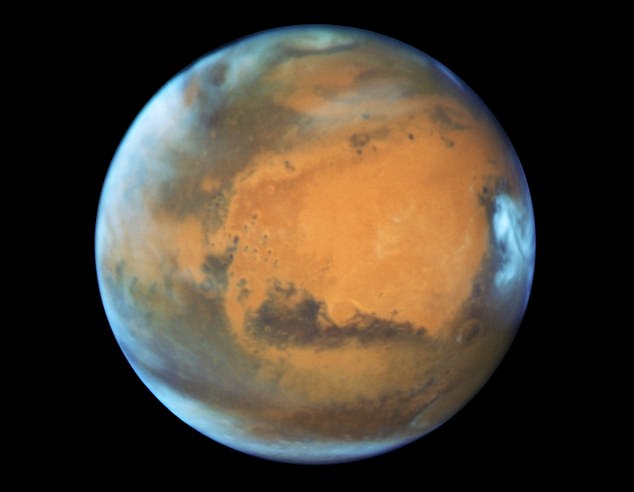
For missions to Mars, space agencies must factor in a phenomenon known as Mars opposition. Occurring roughly every 26 months, this happens when Earth passes directly between the sun and Mars
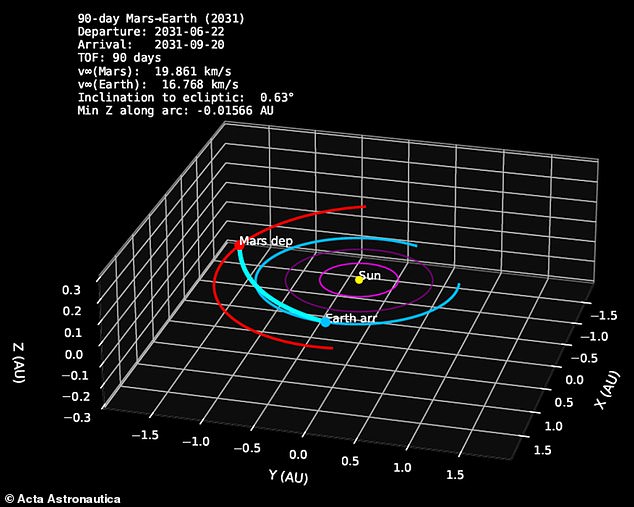
The researchers have also outlined a more realistic option, which would take 226 days to complete
The spacecraft would need to depart from Earth on 20 April, arriving on Mars on 23 May.
It would then have to spend exactly 30 days on the Red Planet, before departing on 22 June.
The crew would arrive back to Earth on 20 September, making the entire mission just 153 days long.
The researchers, led by Marcelo de Oliveira Souza, admit this timeline is ‘extreme’.
‘Extreme 153–day mission: Minimal time but extremely high energy requirements; suitable primarily for conceptual exploration of theoretical limits,’ they explained in their study, published in Acta Astronautica.
However, they’ve also outlined a more realistic option, which would take 226 days to complete.
‘Feasible 226–day mission: Balanced between duration and energy demands, and potentially compatible with projected nuclear–thermal and hybrid propulsion systems,’ they added.
They news will come as welcome news to NASA, which is actively working on technologies to get humans to Mars by as soon as the early–2030s.
‘Mars remains our horizon goal for human exploration because it is one of the only other places we know where life may have existed in the solar system,’ it explains on its website.
‘What we learn about the Red Planet will tell us more about our Earth’s past and future, and may help answer whether life exists beyond our home planet.’