A new law has been introduced to tackle the ongoing issue of keyless car thefts and the hi-tech gadgets criminal gangs commonly used to pinch vehicles rapidly and without detection.
The Crime and Policing Act 2026 – which received royal assent on Wednesday – now makes it a criminal offence to manufacture, import, supply, adapt or possess any electronic device that can be used to steal cars.
This includes signal relay, repeater or amplifier devices that are prominently used by organised and well-funded thieves.
The gadgets pick up the signal from a key fob of a car that has keyless entry and ignition. Criminals can then remotely unlock and start the car without ever needing to break into a premises to access the keys.
The rules also stretch to signal jammers – often used by thieves in car parks to prevent a vehicle’s doors locking when the owner presses the electronic button on the key fob – and illicit tracking devices attached to victim’s cars to monitor their movements.
The new laws come at a time when around three in five motor thefts involve the use of one of these gadgets.
Convictions can result in up to five years in prison, unlimited fines, or both.
Legislation changes as part of the act also grant police additional powers to enter premises to search for and seize stolen cars that have been electronically tracked.

The Crime and Policing Act 2026 has received royal assent, making it a criminal offence to manufacture, import, supply or possess device like remote signal jammers used to steal cars
It also outlaws the latest advancement in motor theft: CAN bus injection devices.
These are devices that are physically wired into a car via one of several external wiring points, such as the headlights, parking sensors and radar systems linked to the cruise control feature.
Criminals can then inject fabricated signals directly into the car’s Electronic Control Unit – or ECU – and wider software systems.
This allows thieves to breach a car’s security system, meaning they can unlock doors and start the engine without raising an alarm.
Most recent data shows there were almost 122,000 cases of car theft reported in England and Wales in the 12 months to March 2025.
Yet, in three quarters of instances, police failed to identify a suspect, let alone achieve a conviction due to the covert ways cars are being stolen with the aid of hi-tech gadgetry.
The Met Police estimates that in London, electronic devices are used in approximately 60 per cent of all motor thefts.
Until now, it has only been a criminal offence if found using one of these devices to steal cars.
Ministers hope that the new laws clamping down on their production and convicting those found in possession with help to tackle the spike in motor crime over the last decade.
These gadgets are readily available.
Our previous investigations have found that many of the devices can be purchased online.
Most recent data shows there were almost 122,000 cases of car theft reported in England and Wales in the 12 months to March 2025. Met Police says 60% of London thefts use gadgets
Join the discussion
Is cracking down on the tools of car thieves a real solution, or just treating the symptoms of a bigger crime problem?
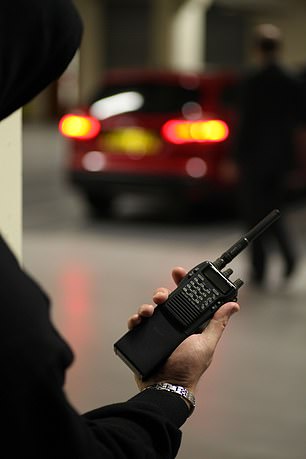
Possession of a variety of different theft gadgets is now illegal, including rudimentary signal blockers like the one shown
When Home Office presented the bill earlier this year, it stated: ‘A significant proportion of vehicle theft is driven by organised crime groups, which costs hundreds of millions of pounds in social and economic harm each year.
‘There is a demand for stolen vehicles, which means this is a highly attractive and lucrative area for criminals to gain profit from selling stolen vehicles and vehicle parts.’
The Home Office did note that there are some legitimate uses for these devices, like boosting mobile phone signals in areas where they’re weak, but very few. So those with valid reasons for possessing them should be able to prove it.
Thatcham Research – an independent safety and security body that’s funded by the motor insurance industry – said the new legislation is a ‘landmark moment’ that will strengthen the police’s resolve to tackle the spike in keyless car crime seen in recent years.
Richard Billyeald, its operations officer, added: ‘The casual theft and joyriding of the 1980s and 1990s has all but disappeared, with manufacturers having succeeded in making it very difficult for amateurs to steal modern vehicles. However, the organised criminal gangs who have replaced them are well-funded and sophisticated in their approach, combining specialist electronic equipment with an international logistics network.
‘Raising vehicle security alone will not prevent thefts and these gangs will adapt their techniques, and we need to be ready for that.
‘We believe that beating these criminals requires cooperation between government agencies, vehicle manufacturers and Thatcham Research to reduce the value of stolen assets and therefore the incentive to steal them. This Act should just be the beginning of a sustained and coordinated effort.’

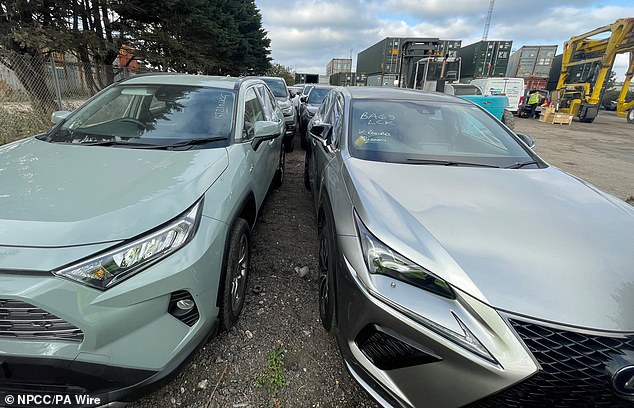
Gadgets have been increasingly used in recent years to steal high-end cars that are rapidly moved into containers at shipping ports to be sent overseas without detection
Under the same act, police also now possess the powers to enter any premises where stolen goods – ranging from mobile phones to cars – have been traced to using an electronic tag or industry-approved tracker device, where it is not practicable to obtain a warrant.
This could see more illegal vehicle chop shops located across the country, where stolen cars are being taken to be broken down into spares to be sold online without a trace.
The Government has also launched an open call for evidence regarding the impact of radiofrequency jammers used by criminals, urging all automotive stakeholders – drivers, car theft victims, manufacturers, dealers and insurance providers – to share their views ahead of the deadline on 8 May.
These are GPS-blocking devices that intercept the signal from a vehicle’s security tracking device, meaning the owner nor the police can identify its location.
These gadgets have allowed criminals to move stolen cars into containers at shipping ports to be sent overseas without detection.
Mark Rose, managing director of motor security product provider Tracker says his team is ‘increasingly finding GPS jammers at recovery sites when we locate Tracker activated stolen vehicles’.
He added: ‘Whether these vehicles are hidden in containers, chop shops or even hidden in underground locations, police are able to track them using our technology.
‘The legislation proposed by the UK government will give frontline police more jurisdiction and have a significant positive impact on the scale of vehicle theft.’