European leaders appear to be slowly moving toward the conclusion that many threats from U.S. President Donald Trump might be best met with a shrug.
Mr. Trump’s announcements on social media that he would withdraw 5,000 American troops – and maybe more – from Germany were meant as a bombshell. Much of the media coverage has treated them as such. But the response from leaders has been notably muted.
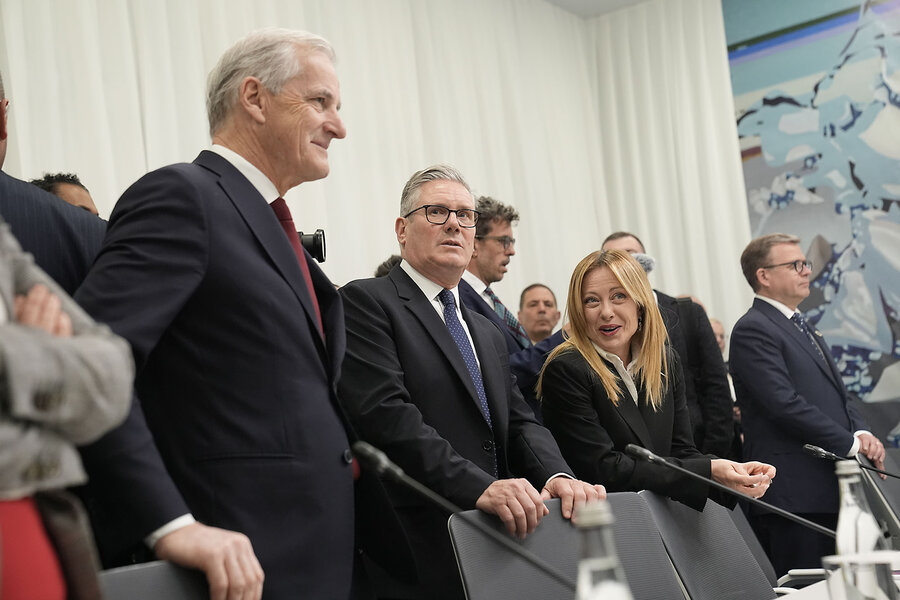
At a summit of European leaders Sunday, Norwegian Prime Minister Jonas Gahr Støre said, “I wouldn’t exaggerate that, because I think we are expecting that Europe is taking more charge of its own security.”
Why We Wrote This
President Donald Trump’s attempts to punish criticism of his governance seem to be delivering diminishing returns among European leadership. The response to his weekend comment about withdrawing troops from U.S. bases in Germany is a case in point.
Earlier in the week, Germany’s defense minister, Boris Pistorius, called the move “foreseeable.”
While unfortunate from a European perspective, the president’s moves don’t change much. Europe is already ramping up its own defenses, and the removal of 5,000 troops from Germany won’t alter the timelines. Other recent promises by Mr. Trump to punish Europe for not supporting the Iran war are largely the same: unwelcome but not critically damaging. And in some ways, the Iran war might have shown that Europe has more leverage than it thought.
“You give Mr. Trump leverage when you get all excited about these things,” says Peter Chase, an analyst at the German Marshall Fund of the United States in Brussels. “There’s a growing awareness of that.”
The recent row began last week when German Chancellor Friedrich Merz told a gathering of schoolchildren that the U.S. has “no truly convincing strategy in the negotiations” with Iran and “is being humiliated by the Iranian leadership.”

Mr. Trump responded on social media, blasting Mr. Merz for “doing a terrible job” and failing to address “problems of all kinds,” such as immigration. The irony is that Mr. Merz has been among Mr. Trump’s strongest supporters in Europe, often at the expense of domestic derision. But his first year as chancellor has seen a variety of verbal missteps, including calling one Brazilian city a “dump.” His latest slipup clearly cost him months of hard-fought goodwill with the Trump administration.
It also gave Mr. Trump cover to take steps he has long been eager to make. In his first term, he tried to remove 12,000 troops from Europe. Congress blocked him. Reports suggest the 5,000 troops to be removed from Germany this time would be a brigade sent to Germany at the start of the Ukraine war and never intended to remain there permanently.
“The planned withdrawal of 5,000 U.S. troops from Germany (and likely more) comes as an unpleasant surprise to Berlin but will not have serious consequences for German and European security. It is more of a symbolic gesture,” says Dmitri Stratievski, chairman of the Eastern Europe Center in Berlin, in an email interview.
Mr. Trump is also threatening to pull back on a Biden-era commitment to send a battalion that includes long-range missiles. If anything, that is a greater blow. But again, it was a measure agreed to in the wake of the Russian invasion of Ukraine but long opposed by the Trump administration.

Top Republicans in Congress have already registered their concern. The chairmen of the Senate and House Armed Services Committees said the moves risk “sending the wrong signal to [Russian President] Vladimir Putin.”
A third threat, to raise tariffs on European carmakers to 25%, also brought a measured response in Europe. “The EU should simply wait and see for now,” Jens Suedekum, the German finance minister’s chief adviser, told Reuters. “It is well known that Trump is quick to suspend or withdraw his grandiose tariff threats.”
“It all seems quite impulsive,” the adviser said.
There’s also the question of whom the tariffs might hurt most. One study suggests they could cost Germany nearly $18 billion. But exports from the European Union to the U.S. went up significantly last year, despite tariffs, notes Mr. Chase, who previously served as the U.S. Chamber of Commerce’s vice president for Europe. Most European carmakers produce their American cars at American factories, he says. That makes the tariffs “a tax on the operation of facilities where a lot of American workers are employed.”
Clearly, if Mr. Trump follows through, it will not be good news for Europe. But the real angst is deeper than any specific item on Mr. Trump’s list. It is the question of whether the U.S. will still stand behind Ukraine now and Europe in the future.
The dawning realization in recent years that the answer might be “no” came as a momentous shock. ”While common to identify points of leverage to shape competitors’ behavior, employing such tactics against treaty allies is a newer and troubling feature of Washington’s foreign policy, further eroding NATO and allied cohesion,” says Laurel Rapp, a U.S. expert at Chatham House, a security think tank in London, in an email interview.
For that reason, Mr. Trump’s continuing threats still tweak Europe’s existential angst, but less and less. He has pushed Europe onto a new path. And while the new Europe still desperately wants to work with the U.S., it is increasingly preparing for worst-case scenarios.
Along the way, it might realize it has leverage, too. The war in Iran, for example, would have been vastly more difficult, if not impossible, without the use of European bases, raising the question of who benefits most from U.S. troops in Europe.
“Mr. Trump doesn’t like to acknowledge that others have leverage, as well,” says Mr. Chase. “But they do, and they should consider using it.”