If you invariably rush home from work with a supermarket ready-meal in your bag, this book is (sadly) not for you. If the thought of what to make for the evening meal bores you stiff, then the delights within these pages will leave you cold. And if you regularly eat out in posh restaurants, then a book about home-cooking won’t be on your radar.
But if you enjoy the sight and taste of a plate of really good food (and really, who doesn’t?), then food writer and journalist Eleanor Steafel, right, is the perfect companion to escort you on a culinary tour. This journey won’t take you to an exotic location like so many rather predictable celebrity-led TV travelogues these days. No, Steafel leads you by the hand into your own kitchen and teaches you how to love it.
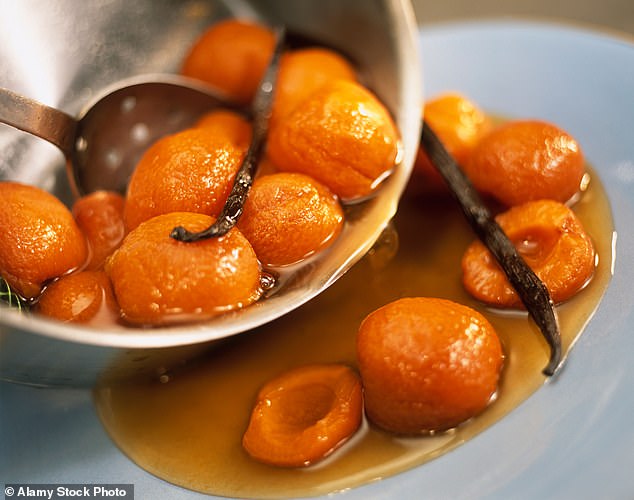
Cooked apricots with vanilla pods
The subtitle, ‘Food for our real lives’ is a hint that this is not a glossy cookbook to display on the coffee table while you scoff takeaway nosh. Not that Steafel is opposed to a fish supper from the chippie. What she wants is for her readers to love thinking about and preparing food. This is a down-to-earth celebration of real people, real lives and good food for every aspect of those lives. It’s as far from food snobbery and chefs’ pretentions as possible – see, for example, her love of crunched-up potato crisps and a big bowl of pasta while sitting on the sofa.
The author’s busy life on a magazine means she might be tired on the way home – remembering what’s in the fridge and wondering what to concoct ‘to bring the pieces of my day, the fragments of my life together, and make sense of them’. The book’s title – But First, Dinner – clearly lays out the author’s priorities. Food matters. She is writing for ‘people who take comfort in kitchens and like to communicate unwieldy emotions through food. It’s for… people who know that a bowl of pasta is never really just a bowl of pasta.’
This delightful book could persuade any lazy cook to beat time with a wooden spoon and dance joyfully to the rhythm. Steafel’s pleasure in the making, eating and sharing of food could be seen as therapeutic – that is, if your mind moves along those lines. First of all, she says, ‘coming home and making a meal’ can give you a sense of achievement: ‘That’s the spooky magic of cooking, isn’t it? You can identify what you’re craving, and then you can satisfy it. You can make something small but significant happen for yourself.’
Then, arguably more important, there is the suggestion that making food for other people and sharing it with them makes the world a better place. Good food does you good and does your friends good, so what’s not to like? Both ideas combine in this: ‘When I gather people I love around the table and feed them, I’m nurturing those relationships. And if I make myself something good tonight, I’ll still feel the benefit tomorrow – in body and soul – of stopping and pulling together a meal.’
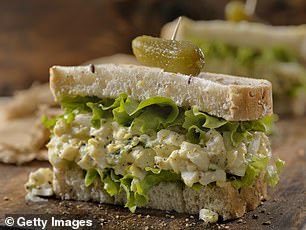
The egg-squisite delights of an simple sandwich
And what meals! It’s irresistible not to share some of the section titles in this recipe-book-with-a-difference. Just reading them is fun. ‘Food for when your body says kale and your soul says spaghetti’ sums up the dilemma so many of us have when we know we need greens but fancy a plate of sausages and chips. But Steafel can make the greenest of greens sound tasty. ‘Food for late nights and rowdy tables’ is certainly my own idea of a perfect evening, while ‘Food for when you’re too busy (or hungry) to cook’ is a chapter of ‘quick fixes and girl dinners’. Like no egg mayonnaise sandwich you have ever had, crumbled salt ‘n’ vinegar crisps and all.
‘Food to sink into’ promises ‘lap dinners, bowl food’ and the promise of ‘cosy’. One of the most beguiling features of this book is the personal element, expressed in both mini-essays and asides.
Endearingly, Steafel gives of herself in an open, generous way you won’t find in Mary Berry or Jamie Oliver. So before her recipe for ‘Very buttery baked tomato curry with pilau rice’, she shares memories of being young in a grotty flat ‘with a rubbish kitchen’ – which so many of us can identify with. Such memories never fade – and the taste of foods you first learned to cook and enjoy will always summon up the past, like the madeleine cakes that Marcel Proust wrote about.
Similarly, her recipe for ‘vanilla poached apricots’ (which I’m going to make, for sure) begins like this: ‘Of all the comfort puddings, this one might be the most perfect to me. It’s a version of something my grandma used to make . . . I can smell the little pan blipping on her hob and picture the way the Wall’s vanilla would begin to melt in a moat around the edges of the still warm fruit when we ate them from shallow bowls.’
With that recollection she puts her finger on why people are likely to return to old favourites: ‘Mum’s Scouse’ (that’s me), or Nana’s sponge cake, or ‘Crispy bacon the way Dad used to make it’. As well as nutrition, food expresses nurture: heritage, culture, family and love. Eleanor Steafel entices you into her world, where beloved flatmate Rosie is making her perfect roast potatoes, Dad is coming round to help with a mundane task and just hang out with his daughter, Mum is forever on the phone as both culinary inspiration and big heart to lean on, and friends in and outside of work will always be ready to come round for an impromptu supper of ‘ratatouille potato gratin with olive and basil gremolata’, followed by ‘ran out of time’ malted chocolate Guinness pots. Delicious.
This is a happy book, casual, slangy and full of soul – no surprise to learn that ‘if there was a spiritual centre to our family life it was the kitchen.’ It shows.