Three wars later, Israelis are still seeking the truth about Oct. 7.
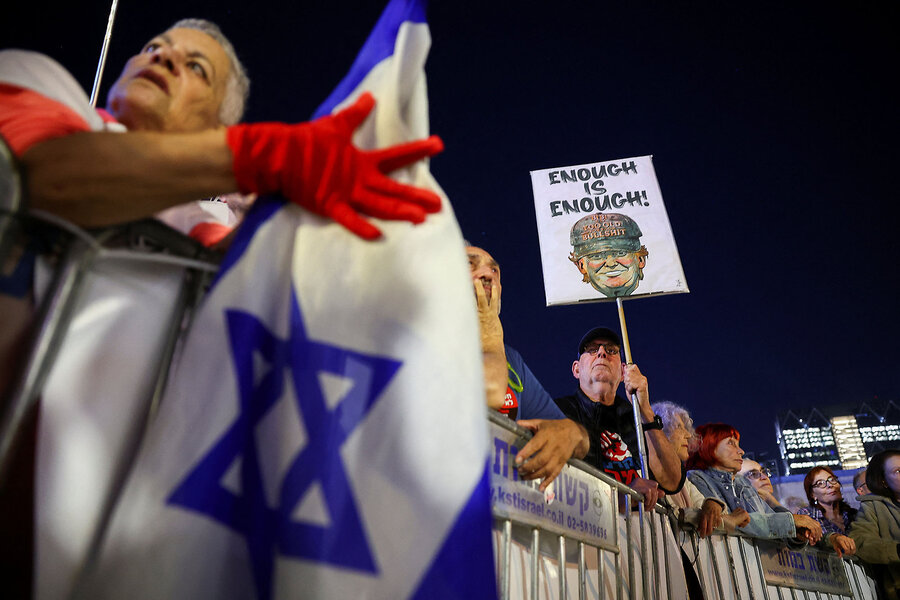
They are anxiously watching the unfolding events in the wars with Iran and Hezbollah. Yet a large majority is still demanding answers regarding the war with Hamas in Gaza, especially the buildup to Oct. 7, 2023, and what failed that day.
In recent days, all eyes have been on the nation’s top court, where justices were weighing petitions that the court instruct the government to establish an independent state commission of inquiry, as has been the practice in previous times of national crisis.
Why We Wrote This
Amid wars with Iran and Hezbollah, Israelis still very much want an independent state commission of inquiry to learn the truth about the failure to prevent the Hamas attack that sparked the Gaza war. Israel’s top court has given the Netanyahu government more time.
On Monday, the hopes among bereaved families and other Israelis for such an order were put on hold, as the panel of seven Supreme Court justices gave Prime Minister Benjamin Netanyahu’s government until July 1 to set up a “suitable” investigative framework.
“We deemed it appropriate at this stage to allow the government an additional stay of approximately two months, in the hope that it will soon find a suitable framework for investigating the events, which will gain broad public approval,” the judges wrote in their decision.
For nearly 2 1/2 years, since the early days of the Gaza war, Mr. Netanyahu has resisted calls for such a commission – seen by many as the most credible and authoritative path toward determining truth and accountability – until the war was over.
By contrast, amid reports that warnings of an impending attack had not been taken seriously, senior Israeli military and security leaders did take responsibility publicly for what they called their failure to prevent the Hamas invasion of Oct. 7. The attack that day killed 1,200 people, led to 250 taken hostage, and precipitated a war that has devastated the Gaza Strip and killed several tens of thousands of Palestinians.
A matter of public trust
Public support for an independent commission is strong. In a Hebrew University poll of Israelis published April 26, 72% of respondents said they favor an inquiry into the failures of Oct. 7. Supporters see it as essential for political accountability and public trust, while opponents argue that political bias, institutional distrust, and wartime realities make such an investigation difficult.

Critics of the government say its delay tactics reflect a reluctance to confront political responsibility for decisions leading up to the attack and the war that followed. As time passes, meanwhile, concerns are growing that the search for the truth will be hampered by fading memories and eroding evidence.
The time extension given the government is “an escape from responsibility,” wrote Eyal Eshel, one of the petitioners, whose soldier-daughter Roni was killed when Hamas stormed and torched the army base where she was stationed. “When the entire nation is bleeding and demanding truth,” he wrote on X, postponing the decision till July “is another nail in the coffin of public trust.”
A commission of inquiry’s members are appointed by the president of Israel’s Supreme Court. The investigative body holds broad authority to summon witnesses, access documents, and recommend accountability – including naming individuals responsible for failures and advising whether they should remain in office. Its purpose is not only to establish facts but also to restore public trust.
Mr. Netanyahu wants to “avoid establishing this kind of a committee … because he is concerned that this committee will find major failures in his decision-making,” says Professor Barak Medina of the Faculty of Law at the Hebrew University of Jerusalem.
Early in the war, the prime minister and his allies argued that a commission would distract from military efforts. Later they proposed an alternative: a politically appointed investigative body whose scope and methods would be determined by a ministerial team led by Mr. Netanyahu.
Allegations of bias
His supporters also have questioned the neutrality of the judiciary, arguing that the Supreme Court and Israel’s legal system are biased against the government and that therefore the findings of a state commission would lack legitimacy.
That hostility toward the judiciary was evident last Thursday as the judges, sitting as the High Court of Justice to review government actions, heard the petitions.
Outside and inside the courtroom, tensions ran high. Bereaved families – divided over how the events should be investigated – shouted across political lines. Some pro-government protesters attempted to force their way into the courtroom, chanting, “Judge the judges.” Proceedings were halted for about 20 minutes as the justices withdrew for safety before resuming.
After hours of deliberation, they signaled reluctance to compel the government to act, particularly in an election year. Some justices suggested that the matter should ultimately be decided by voters, not the judiciary.
The justices seem to want to “avoid a conflict with the government,” says Professor Medina. “I think that setting up a state commission of inquiry is a must, and the court must instruct the government to do so,” he adds. Giving the government until July, he says, is a “decision not to decide. They decided to give the government two more months to reconsider. And by then it will be too close to the elections.”

In Israel to date, 20 state commissions of inquiry have been established, including into the lack of preparedness for the 1973 Middle East war, and into the 1982 massacre of Palestinians in Beirut-area refugee camps carried out by Lebanese Christian militiamen in areas under Israeli military control.
Netanyahu’s unique history
“There has never been a prime minister in Israel that has not set up a commission of inquiry – at least one – because there are always things that need to be investigated,” says Tomer Naor, vice president for legal affairs at the Movement for Quality Government, a nonprofit that is also among the petitioners. “Historically, on average, each prime minister has set up 1.5 commissions of inquiry. Except Mr. Netanyahu, who has been close to 20 years in power.”
Mr. Naor points to several events during Mr. Netanyahu’s tenure – including a forest fire outside Haifa that killed 44 people in 2010 and the death of 45 people crushed by the crowd at a religious festival in 2021 – for which he did not set up a state commission.
“Part of his world view is that he needs to be in control,” says Mr. Naor, “because he is afraid of the personal recommendations regarding his responsibility for the events.”
While government officials argue that judicial involvement would undermine confidence in the findings, polling suggests otherwise. According to surveys by the Israel Democracy Institute, public trust in the Supreme Court has consistently exceeded trust in government over the past two decades.
To argue that a politically appointed body would inspire greater confidence is “unreasonable,” says Dana Blander, a research fellow at the institute. It is also “incorrect,” she adds, to claim that most Israelis oppose a state commission.
“There is no question that a state commission of inquiry has to be set up,” says retired Maj. Gen. Matan Vilnai, a former army deputy chief of staff and former government minister.
Because of Mr. Netanyahu’s hubris and the government’s arrogance, he says, “we paid the price of Oct. 7.”
“Mistakes,” he says, “must be investigated all the time. This is true for any institution and certainly after such a major catastrophe like Oct. 7. Otherwise, it will happen again.”