
This article is taken from the March 2026 issue of The Critic. To get the full magazine why not subscribe? Get five issues for just £25.
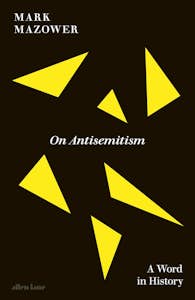
History, Mark Mazower
(Allen Lane, £25)
Mark Mazower’s new book, On Antisemitism, is subtitled “A Word in History”. His core argument is that we should “view antisemitism in its historical context as a term that has been used to mean different things at different times”. But it is soon apparent that his main concern is “general uncertainty over what one may say about Israel without being accused of antisemitism”.
Reminding us that Antisemitismus was first coined in Germany in 1879, Mazower claims that it was “literally an expression of the times”. He then argues that antisemitism never differed particularly from other bigotries and that “for many centuries … the Jews had arguably not mattered very much from the perspective of world history”, adding rather mysteriously, “Not unlike the Parsis or the Jains.”
Mazower recommends that “we view antisemitism in its historical context as a term that has been used to mean different things at different times”, denying Jew-hatred continuity or any particular roots.
Mazower references David Nirenberg’s seminal masterpiece Anti-Judaism in a footnote but appears not to have learnt one of the book’s key lessons, that neither Enlightenment nor modernity overthrew the Christian theologies of Judaism. Instead, they translated them into new terms, embedding them in the philosophies and sciences with which they claimed to make a new and more critical sense of the cosmos.
In other words, antisemitism has a long intellectual lineage.
Nirenberg also demonstrates how necessary the Jew was as a symbol of the material, carnal and venal, in contrast to the spiritual, when Christianity began to define itself in the writings of Paul and the early church fathers (from which derive tropes of Jewish avarice and even the blood libel).
Mazower is keen to downplay left-wing Jewish antisemitism, claiming, “A thread of antisemitism could be discerned in some socialist writings … but there were few socialists for whom this was a major part of their thought.” An odd assertion.
Karl Marx, arguing a line that can be traced back to Pauline thinking, wrote, “Money is the jealous God of Israel” and “The god of the Jews has become secularised and has become the god of the world.” Elsewhere, confusingly, Mazower himself supplies instances of leftist antisemitism: “Post-war communism had not only failed to vanquish antisemitism, it had evolved its own form of antisemitism … what remained was what one analyst called ‘anti-Semitism without Jews’.” (According to Nirenberg, Jews never had to be present for antisemitism to occur as long as the symbolism was understood.) Mazower also references “the Stalinist precedent for using anti-Zionism as a thinly disguised way of talking nastily about Jews”.
Mazower questions the IHRA’s controversial fusion of antisemitism with criticism of Israel but references three decades of data that “clearly show huge per centage spikes in anti-Jewish hate crime in the US when there is war in the Holy Land”, bizarrely concluding, “When attitudes toward the Middle East produce bigotry, prejudice, and antisemitic violence, the spur is often less eternal hatred of Jews than what is happening in Israel.”
Whether it is “eternal hatred” or not is surely irrelevant. It is still antisemitism. Mazower asks rhetorically whether calls for intifada were an incitement to genocide or encouragements to Palestinians to stand up for their rights, but one would imagine the murderous viciousness of the Second Intifada, in particular, shouldn’t be enough to support the first alternative.
Mazower has similar issues with the notorious “From the river to the sea” slogan. Is he being naive or disingenuous when he writes, “I thought what they meant was probably not always evident even to those using them … I saw the arguments around me as a form of education, unruly but also admirable.”
Mazower claims, “No other form of racial or religious prejudice enjoys [my italics] comparable international attention,” a bizarre choice of verb, betraying the emotion and confusion often informing a book which seems to be the product of a febrile American political climate that has, amongst other things, set fires in the form of protests and encampments at Ivy League schools such as Mazower’s.
The rigour and clear-sightedness distinguishing his excellent previous books have deserted him in his attempts to come to terms with an ancient subject that has once again become a hot topic.

Jake Wallis Simons, who occupies the territory on the other side of the divide, demonstrates the direct connection Mazower would deny (or overlook?) between Arab anti-Zionism and antisemitism, tracing its origins to the Muslim Brotherhood, founded in 1928, and, in particular, the writings of Sayyid Qutb. Central to Qutb’s theology “was a loathing of the Jews, whom Qutb figured as the principal antagonists in his cosmology” — in much the same way as Marx and Paul did.
Simons quotes the historian Serge Trifkovic who argued that the most potent heirs to the Nazi worldview in our own time as regards the Jews are not skinheads and Aryan Nation survivalists. They are schools, religious leaders and mainstream intellectuals in the Muslim, meaning primarily Arab, world.
Simons shows how the writings of Qutb have inspired militant Islamic fundamentalists who are often more familiar with his writings than the Quran “of which they often know only those parts selectively quoted by Qutb”. By extension the West, and the Muslim world itself, is as much at threat as the Jews, though Simons is either being naive or calculating when he suggests, quoting his Brink podcast guest Ed Husain, that benign Sufi mysticism had been the dominant force in Islam until the 20th century. (Spanish Jews living under the 12th century Almohads and 800 Otranto martyrs beheaded by Ottomans in 1480 would testify otherwise.)
Simons is good on Soviet Russia’s exploitation of the Palestinians as a lever against the West and its demonisation of Zionism as a colonial enterprise (rather than the anti-colonial struggle against Britain it in fact was), something that has influenced the way the Israel-Palestine situation is perceived, particularly by the left.
Simons is lenient on Israel’s occupation of Gaza, accepting Israeli versions of events unquestioningly. Though he is right to question the 98 per cent of the media using Hamas statistics, it would be wrong to accept the accounts of either side unchallenged. Simons also acknowledges “a 50 per cent rise in Israelis leaving the country, (some) in despair at Israel’s chauvinist political insurgency”. Might there be something rotten in the state of Denmark?
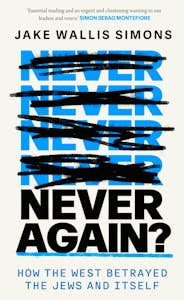
(Constable, £20)
“Ever since 2023, Gaza has ascended to replace race as the primary cause for progressives of all stripes.” Never Again is not only an analysis of contemporary antisemitism but a polemic against “woke”, though Simons prefers a phrase he has coined himself, “centrist fundamentalism”, one of whose chief tenets is anti-Zionism. He attributes the “explosive overreaction of Trumpism” to “mass frustration with the failures of centrist fundamentalism, and the disdain of the human fondness for faith, flag and family”.
On the other side of the Pond, the rise of right-wing fundamentalism, is perceived as a reaction to myopic centrist fundamentalism that has denigrated the European culture from which it has evolved with self-flagellating down-with-us rhetoric and the belief that in order to be “inclusive” we must be “diverse”, which is code for undoing what is ours.
Simons castigates the “suite of positions” associated with centrist fundamentalism: “Show me a fanatical transgender campaigner, climate change campaigner or decolonisation campaigner, and chances are I’ll show you an antisemite.” But he is guilty of his own right-leaning version, denigrating “self-indulgent climate change dogma”, castigating (rightly) the absurdity of denying biological sex and applauding the Brexit vote as the people “thumb[ing] their noses at the elites”.
That antisemitism will disappear in the West with the demise of centrist fundamentalism, as Simons hopes, seems unlikely, but he is right to suggest that we need to reclaim our self-belief in an essentially decent liberal society, quoting Karl Popper’s warning in The Open Society and Its Enemies, that “if we are not prepared to defend a tolerant society against the onslaught of the intolerant, then the tolerant will be destroyed, and tolerance with them”. A 50 per cent increase in church attendance between 2018 and 2024 (tellingly in Catholic and Pentecostal rather than Anglican congregations) seems encouraging.
Amongst the worthies called on to promote Simons’s book is one Nigel Farage: “A compelling and timely call to fight for our Western values,” the Reform leader tells us. Doubtless Simons and his publisher were unaware of the charges of youthful antisemitism that have come to haunt Farage since the time his imprimatur was solicited, but such is the nature of chronicling developing stories which cannot benefit from the perspective of hindsight given to historians. Most of us will not be around to enjoy whatever future Tacitus emerges to write the history of these strange times.