This article is taken from the May 2026 issue of The Critic. To get the full magazine why not subscribe? Get five issues for just £5.
“So this is just a money-saving exercise?” If a single statement encapsulated the sorry position of both the government and the nation, this would be it. It might, someone on X suggested, go on our national tombstone. Yet when Mike Tapp, the migration and citizenship minister, appeared last month before the House of Lords Justice and Home Affairs Committee, that was the question put to him.
The whole session (which you can find online) was an exhibition of absurdities, not least that their lordships affected to be unconvinced that poor people would, if given access to the welfare system, actually use it. (This would presumably come as a surprise to the campaigners demanding that access to alleviate poverty.)
But it’s the presence of the word “just” that really cuts to the heart of the problem. Given the condition of the public finances, one might expect serious politicians to recognise the urgent need for cost-saving exercises, even if they disputed a particular scheme. Yet many of their lordships clearly found the whole prospect inherently distasteful.
In that, they are not alone. There is in British politics a profound aversion to the idea of living within our means. Not necessarily at the abstract level, where ministers can play games with five-year forecasts and demand that departments find nebulous efficiencies. But when it comes to specific spending items, especially on the big-ticket revenue spending accounts such as welfare and pensions, such logic is verboten.
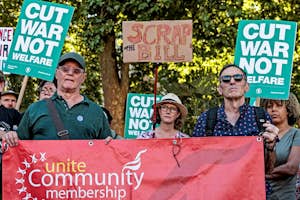
Even on the right, any discussion of welfare reform concentrates on waste or cheats, rather than dwelling on the idea that we simply cannot afford our current outlay. But at least that leaves room for reform. As seen during the revolt last year against Rachel Reeves’ attempt to cut the welfare bill, Labour MPs won’t wear anything about which they cannot tell a “Labour story”, which in practice means no cuts at all.
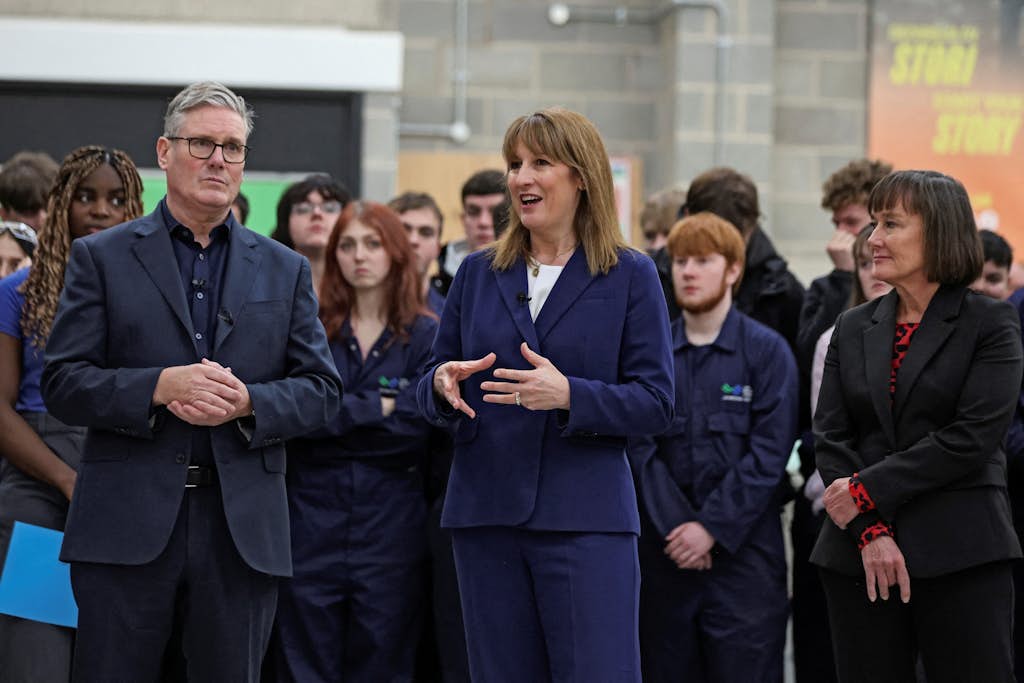
That revolt broke both the Prime Minister’s authority and that of his Chancellor, and with that went any semblance of coherent policy on public spending. Instead, the words and deeds of this government are increasingly divorced from one another; Starmer talks on the one hand about putting Britain on a “war footing”, whilst on the other Reeves demands the armed forces find billions of pounds in new efficiencies to fund the reversal of the two-child welfare cap.
The root of the problem is simply described. The state of the public finances posed the Labour Party a profound question: “What does a Labour government look like when there isn’t money to spend?” And the last two years have made it clear that there is no answer to it.
Why is this, and who is to blame for not confronting it? Whilst Labour’s mutinous backbenchers must take their share of the blame for their sense of entitlement to vote for things without regard to the bill, the buck stops at the top. Despite it being clear for over a year that they were going to win the election, neither Sir Keir Starmer nor Reeves made any effort to prepare the ground for unpalatable decisions with either their MPs or the electorate.
The predictable result of this was that they let down both groups almost at once — and since Labour MPs can make life difficult immediately and the voters not until the next election, tax rises have won out over spending restraint.
But that still leaves the question: why were they so extraordinarily complacent? The answer appears to be that Starmer and Reeves assumed that they could deliver economic growth.
A return to sustained growth is certainly the key to unlocking the politics-on-easy-mode that characterised the New Labour years. It typically means rising incomes and general prosperity, which always disposes voters well to an incumbent government.
But more importantly, it allows for feel-good spending politics with minimal difficult decisions; growth means more tax revenue both now (which you can spend) and in the future (against which you can borrow), without having to formally raise taxes.
Here again we see the Starmer government’s gulf between word and deed. Rhetorically, the Prime Minister clearly grasps the central importance of economic growth. But this urgency is nowhere apparent in his policy agenda, the balance of which points in the opposite direction. From employment rights and the minimum wage to housing and energy, Labour MPs have defaulted to dialling up rights, regulations and spending, which Reeves pays for by hiking taxes and pulling yet more disposable income out of the consumer economy.
There are a few bright spots, such as the promised overhaul of nuclear regulation. But Starmer seems happiest talking about growth when it provides a convenient justification for things he wanted to do anyway, such as aligning with EU rules. It isn’t obvious why this would deliver anything other than marginal economic benefits; the British economy was stagnant for a decade before we left, which makes his efforts to blame Brexit difficult to sustain. But it’s definitely the bit he’s happiest talking about.
According to people I spoke to at the time, the root of Starmer and Reeves’ complacency was a genuine belief that getting the Conservatives out would be sufficient to boost Britain’s economic fortunes; as Ben Judah, a former advisor, put it recently in the Spectator: “When Labour came to power, I truly believed the country had been suffering mainly from Tory problems.”
Politicians promise unsustainable spending because unsustainable spending gets them elected
Doubtless this view was sincerely — and apparently widely — held. But it is nonetheless an extremely strange view. The actual Conservative Party, as opposed to the one that might live in Labour activists’ imaginations, was before the last election very keen indeed both on spending and on not asking voters to pay for things. The idea that Rishi Sunak spent more than a year staring down the barrel of an extinction-level election and refused to press some magical growth button for ideological reasons is, if nothing else, a tribute to a strength of character the man did not possess.
That it could be so widely believed at all illustrates just how little policy and the realities of government intrude on the imaginations of our politicians. Before the election this could be explained — if not excused — by lazy partisanship. But the government’s conduct since then suggests that none of its key decision-makers have any coherent theory of economic growth at all.
Perhaps this sounds like something any right-winger would say about a left-wing government. But in the 20th century the Labour Party had several grand theories of growth, from Clement Attlee’s wholesale nationalisation of the “commanding heights of the economy” to Harold Wilson’s grand concert with the unions. They were wrong, but they definitely existed; they were the product of serious thought by serious people, who could defend them in serious terms.
The same is not true today. If there is a grand theory of the economy guiding the hand of this government, even a bad one, then it is a very well kept secret. Instead, ministers are trapped palliating the results of their own decisions — for example, hiking the cost of employing young people and then subsidising employers who take them on. All spending is reflexively badged “investment”, but that serves primarily to make it easier for actual capital investment to be cut and delayed.
It would be a comfort, albeit at this moment a very cold one, if all this were a specifically Labour problem arising from particularly Labour dysfunction. But even a cursory glance at the rest of the political landscape reveals that this is not so. Both the Greens and Reform UK peddle different flavours of fantasy economics; the Liberal Democrats’ economic plan (such as it is) consists almost entirely of spending proposals.
The Conservatives have at least struck a bit of a posture on fiscal responsibility, as is their wont. But despite some individually sensible policies, such as Kemi Badenoch’s plan to abolish stamp duty on primary residences, on the big picture they are as unreconciled to reality as the rest, committed to the pension triple lock and fiercely opposed to means-testing the Winter Fuel Allowance, perhaps the most defensible cut of which it is possible conceive.
And that points to the ultimate problem. If the buck stops at the top, then in a democracy that means it stops with the voters. Whatever their private beliefs, politicians promise unsustainable spending because unsustainable spending is what gets them elected.
Voters have no grasp of the limits of the nation’s resources and grossly overestimate its wealth. According to new research from the Institute of Economic Affairs, the public estimated that the UK would be the seventh-richest US state; it would actually be the poorest of the lot. (Politicians certainly don’t help matters with boosterish talk about Britain being the world’s sixth-largest economy, which unless you grasp the difference between GDP and per-capita GDP sounds a lot like “sixth-richest”.)
An economically struggling electorate that believes their country is rich is a recipe for dangerous politics. Such voters will be more inclined to believe that there remain plenty of richer people who can be safely taxed to pay for spending — it would be interesting to ask voters to guess where they fall on the national income distribution, versus their real position — and may be more receptive to demagogues blaming the miserable combination of high taxes, ailing public services and a decaying public realm on malice, corruption or an easy scapegoat.
Today’s politicians thus face an increasingly sharp dilemma. Irresponsible promises remain the currency that purchases office, but voters’ patience with the consequences is now so short that Downing Street is fast becoming a device for the destruction of its occupant. It isn’t hard to see why so many choose instead to put it out of their mind and hope the growth comes back.