This article is taken from the April 2026 issue of The Critic. To get the full magazine why not subscribe? Get five issues for just £5.
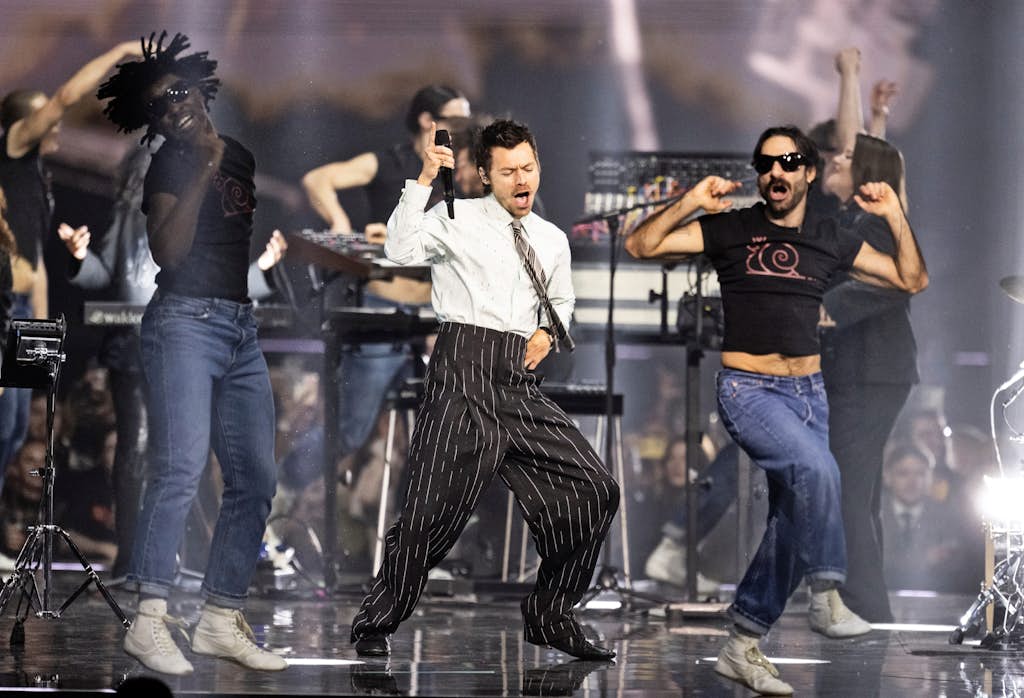
Harry Styles has terrible stage patter. In the Netflix live special released for the launch of his new album (titled Kiss All the Time. Disco, Occasionally) it’s as though there are two different versions of him taking turns on stage. When he’s performing he is charismatic and connected to his audience, his face flooded with that beautiful smile.
But when he’s talking between songs, he becomes a different — and drabber — person. He looks down; he mumbles; he repeats the same platitudes, about how glad he is to be back (it’s been four years since his last album) and how grateful he is to the fans who “make all this possible”. The girls in the crowd keep screaming, but it feels improbable that they could be screaming for this.
It’s as though he’s in a bodyswap movie and an awkward adolescent has taken possession of his adult frame. It reminds me of an observation from Robbie Williams, another boyband survivor (Styles came out of One Direction, whilst Williams was a member of Take That). “They say you stop growing the day you get famous and I kind of get it,” said Williams back in 2022. “I’m like a 16-year-old inside a 48-year-old.”
Styles was also 16 when celebrity came for him — he auditioned for the talent show The X Factor as a solo artist, and though he was knocked out of the competition, impresario Simon Cowell gave him a second chance by putting him in a band with four other nearly-ran contestants. The fivesome didn’t come first in the end, but they took a bigger prize.
One Direction became a global phenomenon, even breaking the notoriously tough US market (something Take That never managed). But all boybands, however great, have a lifespan. Williams left Take That in 1995, after five years. One Direction had been together for the same amount of time when Styles’s bandmate Zayn Malik quit, claiming he wanted privacy but almost immediately setting to work on solo material.
Williams’s first post-Take That summer is legendary in the annals of flame-outs: I can still remember the shock of seeing the pictures of him at Glastonbury, his hair bleached to a brittle yellow-blond, an ominous black gap where one of his front teeth should have been, arm wrapped incongruously around Liam Gallagher from Oasis.
This was a time when musical scenes stringently policed their boundaries. At my school, it was understood that the teenybopper girls might sometimes embrace an indie song if it made the top 40, but the Britpop girls in Adidas Gazelles and A-line skirts kept their distance from boybands. Seeing Gallagher and Williams together seemed to break the laws of nature.
Williams was gleefully throwing off all the constraints of boyband good behaviour, though he was also sinking into a pit of drink and drug abuse from which it would take him years to recover. But he didn’t just want to rebel. He also wanted to be taken seriously, and that was something that the music press of the time was reluctant to afford him.
Williams wasn’t even regarded as “the talented one” in Take That (that title went to Gary Barlow, who was the band’s main songwriter). How was he going to stand by himself? But a writing partnership with Guy Chambers led to a run of incredible songs, capped with the heart-tugging number one single “Angels”, and eventually — begrudgingly — people began to accept Williams as an artist in his own right.
If Styles had an easier time, it’s partly because Williams had mapped the path before him. (The other significant role model here is George Michael, who went from the joyful fluff of Wham! to becoming a transatlantic soul sensation.) In 2017, no one needed to ask whether a boyband escapee could evolve into a credible act, because that was the year that Williams was officially anointed an Icon by the Brit Awards.
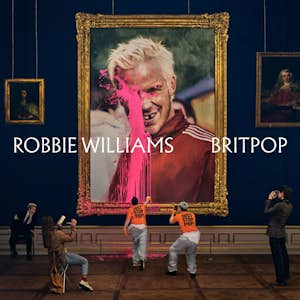
Williams released a new album earlier this year, too. Britpop is explicitly nostalgic (the clue is in the name): Williams has described it as an effort to “create the album that I wanted to write and release after I left Take That”. It includes collaborations that would never have been on the cards in the nineties: Black Sabbath’s Tommy Iommi appears on the opener, “Rocket”, and Gaz Coombes of Britpop cool kids Supergrass pops up on “Cocky”.
The most gratifying cameo, though, is on the song “Morrissey” — an unsettlingly romantic song from the perspective of someone stalking the former Smiths frontman, co-written with Gary Barlow, who also provides backing vocals.
It’s something that would have been impossible for Williams to make in 1995, because back then he and Barlow were bitterly at odds.
Styles’s kattdo is a more forward-looking record. It replaces some of Styles’s previous classic rock references with an edgier dance sound (he was especially inspired by LCD Soundsystem), reflecting the fact that he spent the last couple of years clubbing around European cities. It’s an album that’s full of longing to escape the “squeaky clean fantasy”, as he sings on “Pop”.
That suggests that, like Williams, he’s still fighting the self trapped in amber when he became famous. For Williams, that battle has fuelled one of the most interesting careers in pop over the last 30 years. It’s hard to grow up in public, but sometimes, that struggle can become the art.