‘I’m sure that people walk past me, thinking, “Who’s the crazy woman that says hi to everybody?”,’ laughs Ruthie Rogers, as we sit down to lunch at The River Cafe. She’s being modest: everybody here knows Rogers. Of course they do. Because ever since the chef (who is entirely self-taught) first opened the place 39 years back, with her friend, the late Rose Gray, in an old warehouse on the banks of the Thames (it was originally a canteen for her architect husband, the late Sir Richard Rogers), The River Cafe has become so much more than a mere restaurant. With its soaring ceiling, open kitchen, neon-pink wood oven and vast plate-glass windows, it’s a bona fide London institution, as famous for the consistent excellence of its regional Italian food (it was awarded a Michelin star in 1997), as it is for the warmth of the service. Not forgetting the dazzling, 24-carat gleam of its A-list devotees – most of them regulars from the start.
On any given day, you might find Sir Paul McCartney on a table next to Tracey Emin, or Nigella Lawson across the room from Francis Ford Coppola; Sir Elton John tucking into spaghetti alla vongole, or Sir Michael Caine sitting at Table 4. Is 4 the top table?
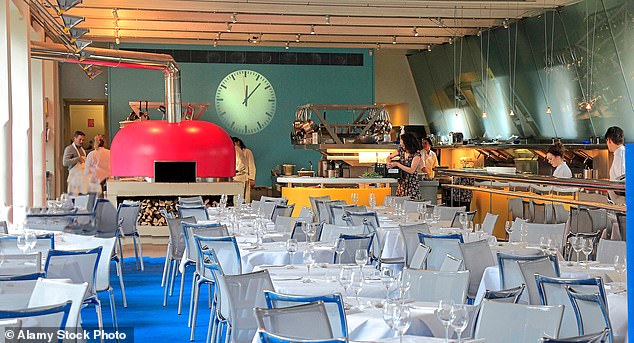
The River Cafe is a ‘democratic room’
‘People ask,’ replies Rogers, ‘and I’ll say, Lucien Freud used to like the table down there, Richard always loved being right by the kitchen. Somebody else prefers the window. It’s quite a democratic room. I’ve sat at every table and there isn’t a bad one.’ What is noticeable is the lack of influencers hauling in film crews and arc lights to document their vapid self-obsession. ‘I don’t know why they don’t come here. Perhaps we’re not glamorous enough,’ says Rogers.
Many of her famous guests became good friends, and in 2021 she started a podcast, Ruthie’s Table 4, where the likes of Gwyneth Paltrow, David Beckham and Sarah Jessica Parker talk cooking, family and comfort food. Some of those conversations have now been turned into a book, her 14th, called Table 4 At The River Cafe. ‘Tell me what you eat,’ wrote French gourmand Jean Anthelme Brillat-Savarin, ‘and I’ll tell you who you are.’ It’s utterly riveting: life seen through the prism of food. Sir Michael Caine recalls rationing, Tracey Emin remembers egg and chips, and Mel Brooks tries to forget his mother’s awful dinners.
Do the megastars all behave, I ask? ‘We treat everybody in exactly the same way,’ says Rogers firmly. ‘That’s what The River Cafe is about. You never know who’s on a table. They may have saved up for months to come here, or their mother may just have died. Our aim is to make them feel looked after. We’re here for you.’ Rogers is frustratingly discreet about her famous friends. In fact, she makes the sphinx look loose-lipped and, try as I might, her lips remain firmly sealed. Whenever I delve too deep, she turns the questions back on to me. She’s funny, warm, wise and endlessly inquisitive. But tough, too. You don’t last this long at the top without serious backbone.
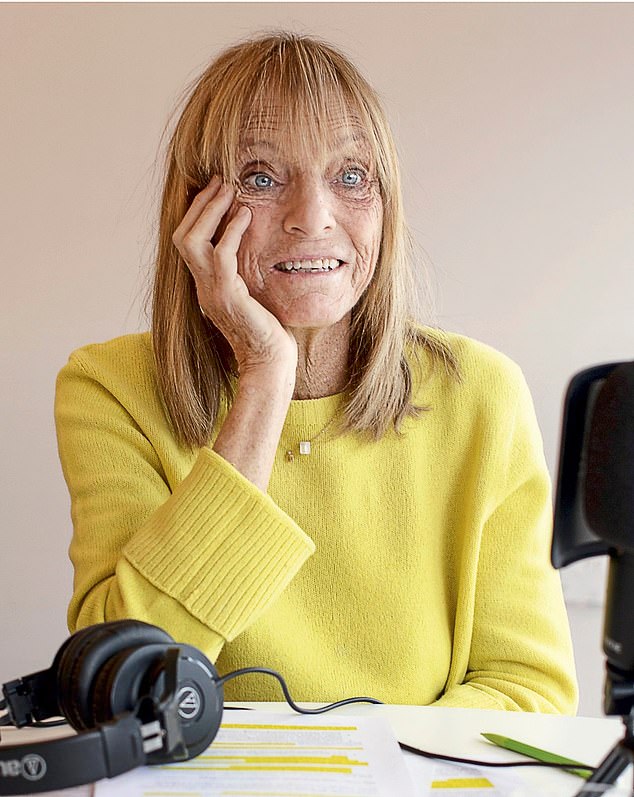
Ruthie recording her podcast
Surely, I ask, you must have had some diva-like requests? You know: turn down the wind outside, or bring me a Fray Bentos pie… Rogers shakes her head. ‘I always tell the waiter that, within reason, your job is to say yes. And let me say no.’ She shrugs. ‘When I’m sitting around the table with other restaurateurs, and they talk about difficult guests, I don’t have much to add. Because The River Cafe is not that sort of place.’ The only time she asked someone to leave was when she overheard them being rude to a member of her staff. ‘I don’t care who you are. That will never be acceptable.’
Having eaten here for many years, I try to work out exactly why I love it so. The food is always exceptional (‘we never compromise on ingredients’) and the service sublime. If you could bottle that atmosphere, you’d make a killing.
I once heard the story of Bono coming for lunch, going for a stroll down the river before returning for dinner. It’s that sort of place. But don’t for a second believe that success at this level comes without drive, hard work and exacting standards.
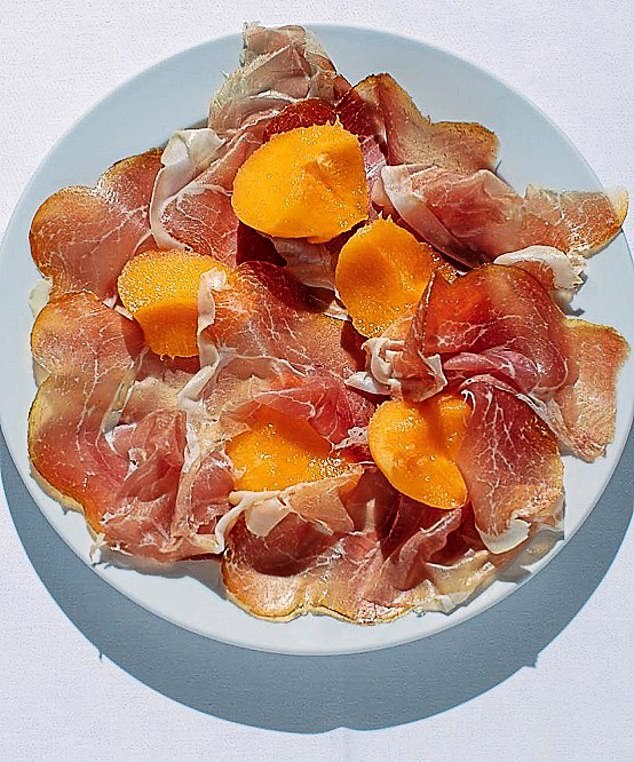
A River Cafe starter: prosciutto di Parma with charentais melon
‘People talk about The River Cafe being a family restaurant,’ she says, ‘but it also has a rigour. The curtain has to come up at 12.30 and 7pm every day. And if we’re sitting here, and that floor hadn’t been cleaned, or the salt hadn’t been filled, that’s simply not good enough. Like families, we grow our children with love, but there has to be a structure, too.’
Rogers does inspire genuine loyalty. Sian Wyn Owen, one of her two excellent head chefs, arrived in 2000, while Joseph Trivelli came a year later. Both never left. The same is true of her legendary managers Charles Pullan and Vashti Armit who have been there since the 90s. ‘Working here is like being part of a big family,’ she says. Customers are equally loyal. ‘It’s nice to see the third generation coming here. We have tables with the kids of people I knew as children 35 years ago.’
We talk about the current economic climate. ‘It’s tough out there,’ Rogers admits. ‘If you want to get into a career to make money, you wouldn’t necessarily go into restaurants.’ Lunch is nearly over, and, at a very youthful 77, she has a pass to run tonight. Did she ever imagine sitting here, nearly four decades on? ‘Rose and I always talked about success and ambition, and how you measure that in your life. We had the ambition, even with six tables and no proper entrance. And wanted a restaurant that would serve the kind of food we ate in Italy, in a room designed with beauty and care.’ What, then, is the secret of her success? She pauses and looks around her room. Lunch service is in full swing, waiters weaving around tables, the room entirely abuzz. ‘Seriously, I have no idea. We just do what we do, every day, as well as we possibly can.’
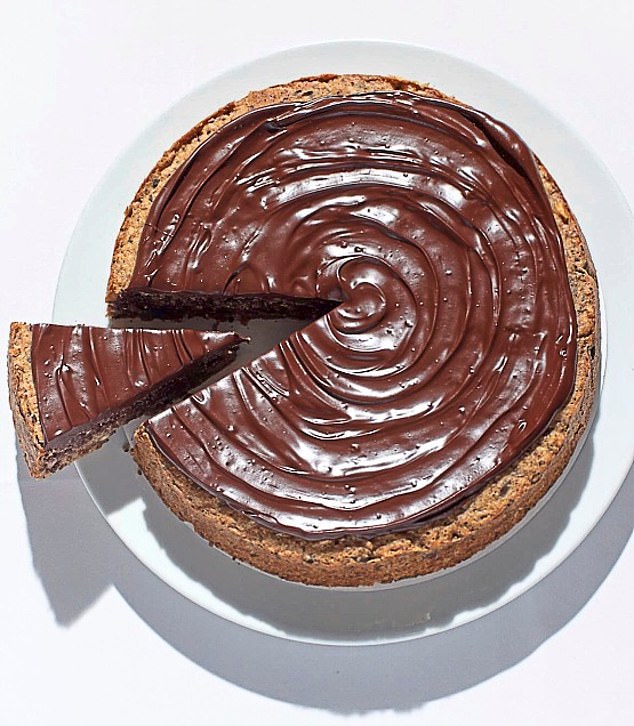
The restaurant’s chocolate, walnut and amaretto cake
TRACEY EMIN: ‘Mum wrote a note to school saying, “My daughter will not learn to cook”’
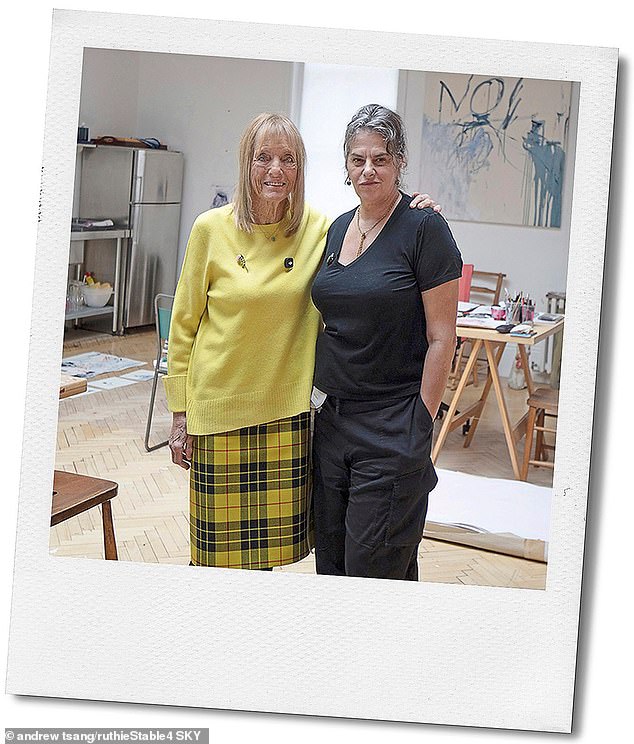
Tracey was a guest on Ruthie’s podcast last month
My mum, I hate to say, was a terrible cook. (Though I did like it when she made me egg and chips.) She was completely against my cooking – which was pretty radical for the 1970s. When we were being taught it at school, she wrote a note saying, ‘My daughter will not learn to cook. She is not going to be a slave to any man.’ She had very strong ambitions for me. She put me on the pill when I was 14 to make sure I didn’t get pregnant. She considered the idea of me having children to be a complete failure, not a positive thing, so she did everything she could to stop me from being a young single mother. She wasn’t home-based. It wasn’t her strong point.
But my dad was a fantastic cook. So the food I grew up with was a strange mixture of amazing food that my dad made and terrible food that my mum made.
My dad came to England by boat in 1948 on a £10 ticket from Cyprus. We were Turkish Cypriot and, up until we were about six, my twin brother Paul and I went to Turkey regularly. We used to drive to Turkey, from England. Dad had a brand-new Ford Zodiac, and in the back were these tiny wooden chairs with raffia seats. He stuck a hole through the roof, put bungee-type elastic things around the chairs, and then just sat us in the back of the car, two twins bouncing up and down in these chairs.
We’d stop along the way. Dad would get the Calor gas stove out and fry eggs. And we’d go to fields and take watermelons. They were really exciting and adventurous, those drives. I’m romanticising it, but it was romantic – so different from the upbringing of everyone else I knew.
My dad never properly lived with us. He was married [to another woman] so he’d spend three days with his wife, three days with my mum, and, we’d always say, ‘one day somewhere else’. When he was around, it felt like a big treat. Dad left us when Paul and I were seven. We were wealthy until I was seven, and then he lost everything. We went from trips to Turkey to squatting in a cottage in Margate, with my mum working in a hotel as a waitress and chambermaid.
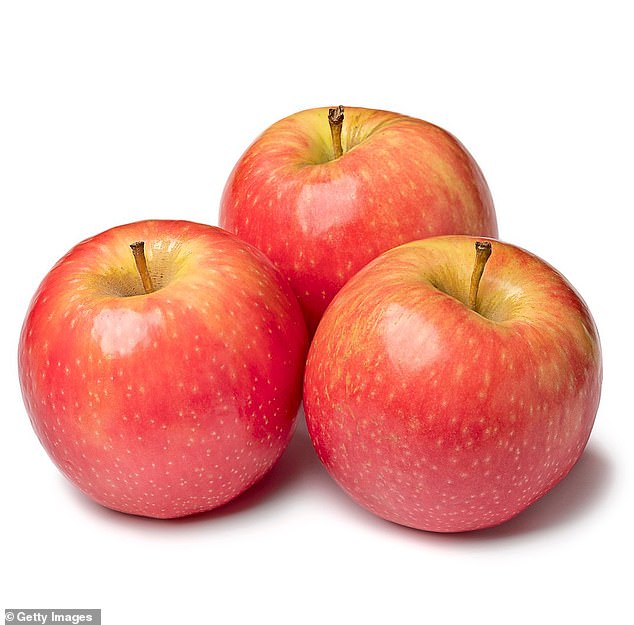
Apples are Tracey’s comfort food
My mum was out most of the time, working. And at weekends she’d be out until three in the morning, so we were on our own. Often she’d leave us sandwiches. If my mum didn’t have work, we had nothing. This is one of the most shameful things I can talk about but, in a way, I’m sort of proud of her: when the hotel went derelict, she climbed up on the roof, took some lead off of it and sold it so we could afford to eat. You hear about women shoplifting to get their babies food and it seems unimaginable. But it’s not when you’ve been that poor.
I was brought up with no rules. If I didn’t want to go to school, I didn’t go to school. If I didn’t want to brush my teeth, I didn’t brush my teeth. If I wanted to have sex, I could have sex – as long as I didn’t get pregnant.
I left home when I was 15, the first day I could leave school. I came straight to London with two David Bowie albums and some clothes. I stayed in different places, including a squat in Warren Street. That was very educational. I stayed with different friends. I stayed in a cupboard in Clapham for a time. It’s a mystery how I never got in trouble. But I was sassy and streetwise.
For a long time back then, I didn’t eat. I used to be so thin. For years, I didn’t care about food at all; it just wasn’t on my list of priorities. But after I left art school, one of the first things I did, as soon as I started to have money, was eat oysters. All of my excess income was spent on oysters. I used to try all different restaurants, different oysters, figuring out what I liked.
For a moment, I was on about a hundred oysters a week. I used to cycle everywhere. I was so fit! Lean, like a ballerina.
I underwent surgery for bladder cancer a few years ago. While it was a success, it has affected the way that I eat. Now, I eat vast amounts of fish, and I eat fruit all day long. I also eat cold food much more than hot. I don’t know why. But I eat quite healthily; when I eat something bad, it’s because I really want to.
My comfort food is apples. I probably eat about six to eight a day. I like Pink Lady ones. I don’t cut them evenly. I just slice all sorts of bits off until I get to the core. I’ll make a big pile of apple pieces, on a beautiful blue Delft plate, and then I sit, anywhere, and just slowly eat, three apples at a time, in different bits, shapes and pieces. It makes me feel so good.
PAUL McCARTNEY: ‘We named our beer after a phallic-shaped fungus’
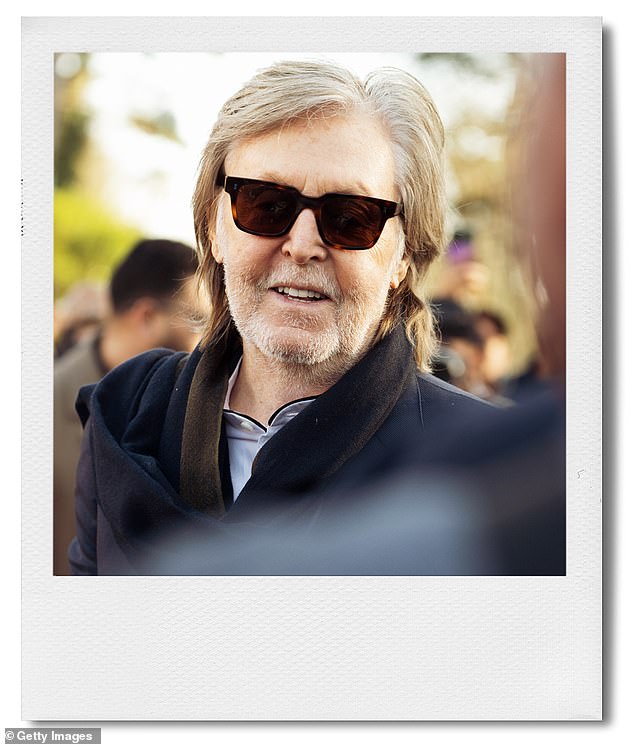
Paul last month at Stella McCartney’s Paris Fashion Week show
My mum was a nurse. I think she enjoyed cooking, but in those days there was really no question about it: it was the woman’s role. But she was a proper cook, a good one. The only time I didn’t eat what she had prepared was when she presented a bloody big cow’s tongue on a plate.
The sadness of my life was the death of my mother when I was 14. My dad, me and my younger brother, Mike, were left to look after ourselves. Sometimes I’d get home from school before Dad was home from work at the port, where he was a cotton salesman. I’d have to knock up a meal. I became very good at mashed potatoes. I mashed the potatoes with a fork – we didn’t have many cooking implements – until I got all the lumps out. Then I would pile in a lot of butter, a little bit of milk, and whip that sucker up. (These days, my recipe would need to be a little bit health-erised.) Sometimes, if I was trying to be exotic, I’d put in some finely chopped onions, raw. Then Dad would buy either some sausages or some chops to go with it.
It was only when I went to London, when the Beatles came down to make records, that I started going to fine restaurants and tried to navigate my way through their menus. Food had pretty much been fuel until then.
Also, I hated wine. We never had it at home; the nearest we came to alcoholic beverages was when we had a glass of cider with Sunday lunch. One time, John and I hitchhiked to Paris. He’d been given a fabulous birthday present by his rich relatives in Scotland: £100. We thought, ‘Oh, we’re in France, we’ve got to have a wine experience!’ So we went into a corner café, sidled up to the bar, and said, ‘Deux verres vin ordinaire, s’il vous plaît.’ They gave us two glasses of red wine. We took a sip, and John and I were like: ‘This is terrible, it’s like vinegar! What is the fuss about? All these people going on about wine – they’re crazy and we’re sane.’
We are a vegetarian family, all of us. The way it started was that Linda and I were at our farm in Scotland. The farm was in a place called Campbeltown, south of Glasgow. The Beatles’ break-up got a bit heavy and I just couldn’t deal with it, so we escaped there.
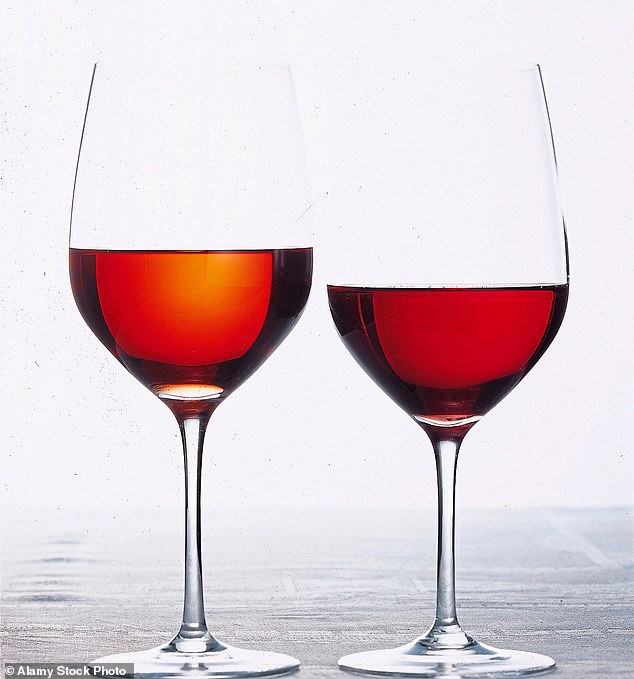
Paul wasn’t impressed by his first taste of wine
One day, we were looking out the kitchen window and it was lambing season, early in spring. The lambs were gambolling around, so full of life. There was a pack of about 20 of them. They’d start at one end of the field and then – as if one them had said, ‘Let’s go!’ – they’d all run to the other side of the field. And then back again. Linda and I were watching them and saying, ‘Isn’t this cute and great?’ Then we suddenly realised what we were eating… a leg of lamb.
We had a conversation: ‘Should we try and not eat meat? Should we try and go veggie?’ In those days, it was difficult. At Christmas I had always loved carving the turkey. (And Linda did cook a great turkey.) But suddenly, here we were without anything for me to carve. Linda had the brilliant idea of making macaroni and cheese. She let it cool and go solid, and then we put it in the fridge overnight. The next day, I had this big block that I could carve into turkey-sized portions.
We got another farm in East Sussex in 1979, and we took it organic. We grow all sorts of things: spelt wheat, rye, peas – and we make our own ale. The ale started because, through the years, I would hear of neighbours who were looking to sell some of their land adjacent to ours. One of them had a hops garden and, long story short, I bought it. I went to a local brewer in the village near us and asked if he would make beer for me. I said, ‘I’ll grow the hops and you put it all together. And it must be organic.’ And so he did.
We were looking for a name for the beer – you know how it is with artisanal beers, they have to have crazy names. One day I was riding with Linda through our woods. She was behind me, and I stopped and said to her, ‘You’re not going to believe what you’re about to see.’ It was a fungus that was white and very phallic – it looked like an erect penis. Beside it was another one that looked like a limp penis. When I tell this story, I say, ‘Don’t blame me, this is nature – it’s not me being dirty.’ We found out that this mushroom is called a stinkhorn. So that’s what we called our beer: Old Stinkhorn.
VICTORIA BECKHAM: ‘As a student I ate Super Noodles and bowls and bowls of Frosties’
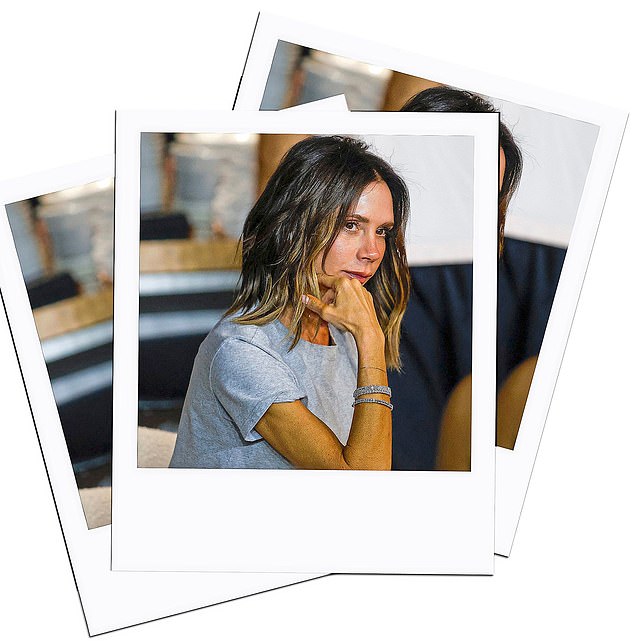
Victoria Beckham at The River Cafe
You know what my mother used her oven for? A filing cabinet. This was the 80s; if it didn’t go in the microwave, Mrs Adams wasn’t interested in cooking it. She was a great mum and a great wife, but cooking was never really her thing.
For her, food was about being super, super quick. Mum was so busy driving us around, running me and my brother and sister to all of our activities. That’s part of the reason why she loved the microwave meals. But mealtime was important. We always sat together, the five of us, in the kitchen. That’s something we still do now with our kids, unless I’m travelling or David is.
I stopped eating red meat when I was about seven years old. I was at school, in a home economics lesson, and they were telling us about what goes into making sausages or hamburgers, something like that. I was absolutely horrified and haven’t eaten meat since that day.
When I was 16, I moved to Surrey to take a place at Laine Theatre Arts college in Epsom. I ate very, very student-style food: Super Noodles (there we go again, the microwave), bowls and bowls of Frosties with skimmed milk, and those yogurts where you peel the wrapping off a corner of the container and dump a whole load of sugary god-knows-what into it. This was the 90s, when the phrase ‘fat-free’ was rammed down our throats. We used to eat a lot of fat-free food without realising how much sugar we were eating.
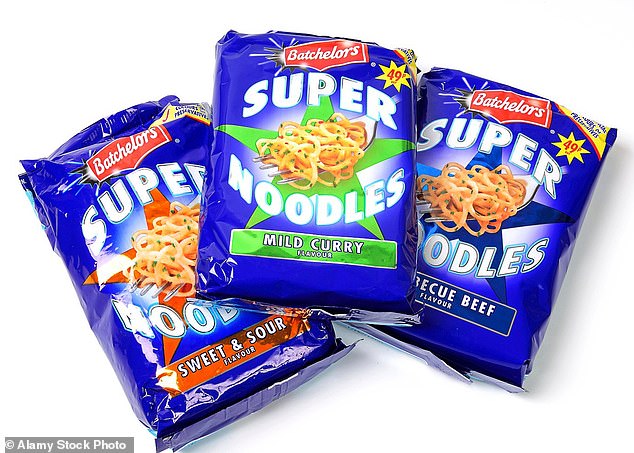
Super Noodles were her staple back in the day
When I joined the Spice Girls, we lived in a house together and still ate like students, fighting over the food in the fridge. When we signed our record deal with Virgin, they took us to a lovely restaurant and opened a bottle of Cristal champagne. I’d never had anything like that in my life. It was insanity. And I was supposed to be the posh one.
From then on, we were always going to wonderful restaurants and eating wonderful food, not just in England but all over the world. Initially I was inclined to eat the entire contents of the bread basket. But very quickly, I came to the conclusion that I needed to adopt healthier ways. I became more conscious of what I was eating; I was demanding a lot of myself.
I’d walk into the stadium in a pencil skirt and a blouse, carrying a Birkin, and then have to change into a PVC catsuit. I had to really try and eat in a clean way: lots of fresh vegetables, lots of fish. Growing up, I had really bad skin. I went to see numerous dermatologists and no one could ever figure out what was wrong. But that cleared up when I started eating in this healthy, clean way.
I still don’t have any dairy at all and I like things to be cooked in a very simple way. I don’t like oils and butters and sauces. I don’t deny myself anything. If I want something, I’ll have it. I like to have a drink with dinner. But I am the way I am: very, very disciplined.
MICHAEL CAINE: ‘There was caviar all over the place. It was wonderful’
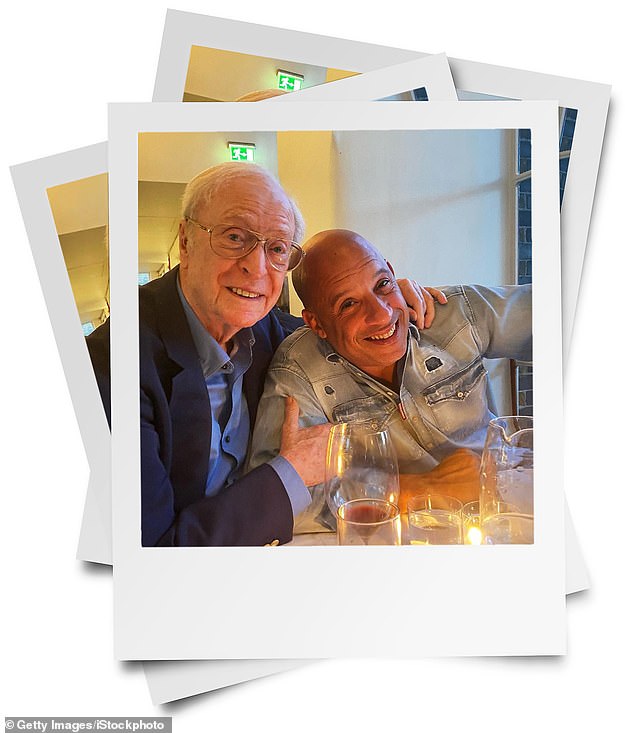
Michael Caine dining at The River Cafe last year with Vin Diesel
My father was a Billingsgate Fish Market porter and a big gambler. So he never brought home steak, it was too dear. But he used to nick a lot of fish. So, for 15 years as a child, I ate fish – every kind you could imagine. I later realised it was a very healthy thing. Another accidental healthy thing for me was the Second World War. Because of rationing, you couldn’t get any sugar. Then we were evacuated to the country and I lived on a farm for six years. So I went from the smog, which was terrible in London as everyone had coal fires, to fresh air.
The food in the country was wonderful. I caught some of it myself, because I could outrun a rabbit. I used to catch rabbits with sticks and give them to my mother to cook for dinner. (We also used to nick cabbages.) Anyway, pheasant, partridge, fresh vegetables – we had all those things. And, on top of that, my mother insisted I have porridge for breakfast for 15 years! So, thinking back on it, health-wise I was very lucky.
Eventually we came back to London, and the council gave us a prefabricated house in Elephant and Castle. They were made with asbestos and put up in a few weeks. People sympathised with families like ours, who had to live in these little prefab houses. What they didn’t know was what life was like for us before. In the flat we’d lived in when I was a little boy, there was no toilet. You had to go down to the garden. We used to have baths in the kitchen, with hot water poured from a kettle.
When my brother Stanley and I walked into the prefab for the first time, we were stunned. We were in a place that had electric light and an indoor toilet. It had a little garden! And the kitchen was lovely. It had an electric stove and a refrigerator, which we’d never seen before. It was fabulous for my mother because it cut out masses of work. She was so happy and her food got even better.
When my dad died, he left me a bit of money, about £100. I was 17 and so sad. I thought, ‘I’m gonna get on a train and go to Paris.’ So, I got on a train, on my own, to Paris and I stayed there for about seven months. I didn’t do it all on the £100; I worked. I sold frites for a franc on the street.
At 17 he sold frites on the street in Paris
I adored the food in Paris. I had a French mate who had a café, so I ate there. Then I had an American friend who worked in the air terminal, so I used to go in there and get free food from him. I’d also bring an empty suitcase and, if I didn’t have enough money to stay somewhere, I’d sleep on a sofa in the terminal – as if I was waiting for a plane.
Back in London, when I was starting out as an actor, I used to go to the cheapest restaurant I could find. There was an Italian one in Soho that served a three-course meal for half a crown. By 1965, Harry Saltzman had given me a part in The Ipcress File, and that was the first time I had luxury food. Harry took me to the White Elephant, in Curzon Street, and there was caviar all over the place. I’d never eaten it before. (I obviously couldn’t afford it.) It was wonderful. And I suddenly realised, ‘This is what my life is going to be’: having enough money to have great food.
Now, my life is spent with 150 people all day. And when I go home, I love to write, I love to garden and I love to cook. All on my own. I don’t do desserts because I’m afraid I’ll eat them, and I’m the one in the house who’s responsible for Sunday lunch. I make what are allegedly the best roast potatoes that anybody who has come over has ever eaten. The trick is, when they’re cooked, mash them a little bit: just crack them open and put oil on them. Then bake them again, so the oil gets baked inside.
NIGELLA LAWSON: ‘Growing up, our kitchen was a source of great tension ’
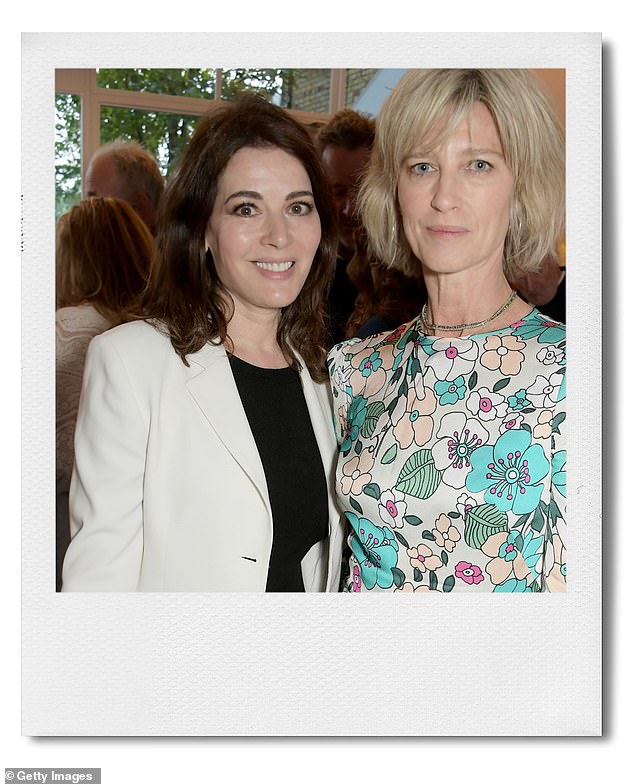
Nigella with journalist Nicola Formby at The River Cafe, 2019
My mother married very young, at 19, and had her first child, my older brother, at 20. She felt things very deeply but didn’t always express them. So she would erupt quite a bit. She was a very good cook – and fantastically impatient.
One of the jobs that my sister Thomasina and I used to have was to make mayonnaise together. One of us would whisk and the other would pour the oil. Whoever was whisking, you weren’t whisking fast enough. And whoever was pouring, you weren’t pouring slowly enough. I remember being in the kitchen with fondness and gratitude, yet it would be so unfaithful to the truth if I didn’t say it was also a source of great tension. It was frightening, but I did learn a lot.
I associate my mother with food, yet she had a very troubled relationship with it. She had eating disorders, which I didn’t really take on board until I was in my teens. It was difficult, because it was a repudiation of something that gave her pleasure.
The heartbreaking thing is, she died when she was 48. I was told by the doctor that she was terminally ill just three weeks before she died. I didn’t tell her until two weeks before, because I was waiting a bit, just to get more tests and things. When I told her, she said that it was the first time she could eat without anxiety or guilt.
My father didn’t cook, except to make his own breakfast, which I think is quite an old-fashioned male thing to do. Somehow, they don’t feel that cooking eggs is too much of a dent to their dignity.
As a family, we went out to dinner only on special occasions, like birthdays or the occasional treat. I found family meals difficult. It’s an odd thing. I was clumsy and I’d always knock something over. Also, I found myself slightly inhibited within a family group – I came into my own later.
I went to Italy the year before I started university at Oxford, and it made such an impression on me. I just turned up in Florence with a friend. We had a one-room pensione and worked as chambermaids. All I can say is, if anyone ever stays in a hotel and wonders whether people try on your clothes and put your scent on – yes, we do.
Our pensione was run by a married couple who came from Arezzo. They had a son called Leonardo. And his grandmother, la nonna, lived there. Every now and then, they would go to their farm and she would be left there. We weren’t normally allowed in the kitchen, but the minute they were gone, I was let in because the nonna wanted company. She wanted to chat and I watched her cook.
The thing I remember most is that wonderful Italian way of making rosbif which is almost a pot roast. I would watch her put the oil and garlic in and then remove the garlic when it was brown; in the north of Italy, the idea of leaving in lots of garlic is odd. Then she’d put in a very small amount of meat, which she browned, and rosemary and a teeny bit of wine. She’d cook it so it was not quite fried but not really poached, either. She also made mashed potatoes. And whenever people say, ‘Italians don’t use butter,’ I think, ‘You should have seen her mashed potatoes.’
I didn’t really want to go back to Oxford. I’d been very shy at home but, when I had to speak Italian, because I was speaking a different language, I was a different person. I was more voluble. I found my voice.
To go into a place and not to have all these connections is freeing: being completely independent, earning your own living, fending for yourself. It was as if I had decided at a young age that I wanted to be Italian. And then I proceeded.
These are edited extracts from Table 4 At The River Cafe by Ruthie Rodgers, which will be published on 14 May by Ebury, £25. To order a copy for £21.25 until 17 May, go to mailshop.co.uk/books or call 020 3176 2937. Free UK delivery on orders over £25