
This article is taken from the April 2026 issue of The Critic. To get the full magazine why not subscribe? Get five issues for just £5.
The title of Andy Weir’s breakout novel, The Martian, was deliberately misleading: it was about a human stranded on the red planet and trying to get home, rather than an alien invader. But in Project Hail Mary, the next of Weir’s books to make it to the big screen, we do meet extra-terrestrial life: two kinds, in fact.

Neither is the classic space invader, although the first (a microbe that eats stars) threatens to end life on Earth. It is destroying not just the Sun but every star we can see, except one.
The film is the story of the mission to study that star to see if it offers a way to save our home.
Ryan Gosling plays an astronaut waking up from hibernation on that spaceship to find that the rest of the crew is dead, and he has no memory of who he is or why he’s there.
He gradually recalls that he’s Ryland Grace, a microbiologist who became a teacher after the collapse of his research career. Through flashbacks we see him recruited to the effort to understand the organism that’s attacking the Sun.
Weir is an unabashed admirer of science, and part of the appeal of his books is that they don’t wish away tricky problems. The scientists are the heroes of this film, led by a deadpan Sandra Hüller, who comes close to walking off with the whole movie.
The second extraterrestrial we meet is, as it turns out, also a scientist. It has come from its own planet for the same reason as Grace, and it too is alone. After some initial awkwardness, the pair find a way to communicate and make an alliance. “He’s growing on me,” Grace tells his video diary. “At least he’s not growing in me. Which was a concern.”
This is the secret sauce of this film: it’s a laugh. The blossoming relationship between two life forms turns this into a buddy movie. If you wanted to quibble, you’d say that James Ortiz, voicing the alien, is allowed rather more emotion in his voice than someone speaking through a computer interpreter should strictly have, but the result works.
Alien encounter films have tended to be loaded with portent — think Close Encounters of the Third Kind or 2001: A Space Odyssey. Perhaps the makers of those feared that if they allowed anyone to laugh in the cinema, the whole thing would suddenly seem ridiculous. Project Hail Mary has more self-confidence, and is at once exciting, dramatic and funny. It’s a surprisingly rare combination, and the result is a film everyone can enjoy.

Less of a laugh is Rose of Nevada. The first 15 minutes featured so many still shots and moody looks that I considered walking out. I’m very glad I didn’t. Once this ghost story gets going, it draws you in, and by the end I was gripped.
The Rose is a fishing trawler, missing for 30 years, that reappears one day in the Cornish harbour from which it set out. In its absence, the once-flourishing fishing village has run out of money and out of luck. So Nick, played by George MacKay — of 1917 fame — and Liam, played by Callum Turner, agree to join her crew in the hope of a quick payday.
The voyage goes well, but when they return to port, the men find themselves back in the 1990s. Everyone seems to know them: one woman thinks Liam is her partner, the father of her little girl. A couple believe Nick to be their son.
Nick is desperate to return to his family. But does Liam, whose 1990s life is better than his 2020s one, even want to get home? After another voyage, Nick realises that the health of the entire town is somehow tied to this trawler. So long as it keeps fishing, everyone has work. Perhaps he should sacrifice himself for his community? It’s a story that is, in every sense, haunting.
Back with the jokes, one of the challenges of making a romantic comedy these days is that it’s very hard to come up with obstacles in a couple’s way. A solution is to set the story in a place where a girl’s father can still object, such as a village in Macedonia.
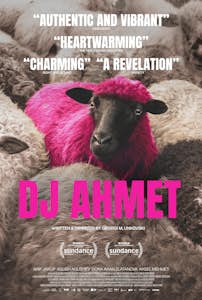
DJ Ahmet isn’t strictly a romantic comedy. Rather it’s a funny and sweet coming-of-age tale, about a boy from a poor family who is more interested in listening to dance music than herding his father’s small flock of sheep. Into his life comes Aya, brought from Germany by her father, who wants to marry her off against her wishes.
The clash of cultures here is an interesting one, as only one culture is ever shown: everyone is a villager, even Aya, who barely refers to her time in Germany. But even as their parents carry on life more or less as it has been for hundreds of years, the teenagers’ phones give them a glimpse of a wider world and other cultures. A running joke is the local imam’s reliance on Ahmet for basic technical support.
I’m a sucker for stories about young love, fathers and sons, and sheep, so I enjoyed every moment. I was particularly struck by the innocent joy that the young cast took in dancing. If parts of their lives felt utterly alien, here was something completely recognisable. The whole film is a delight.