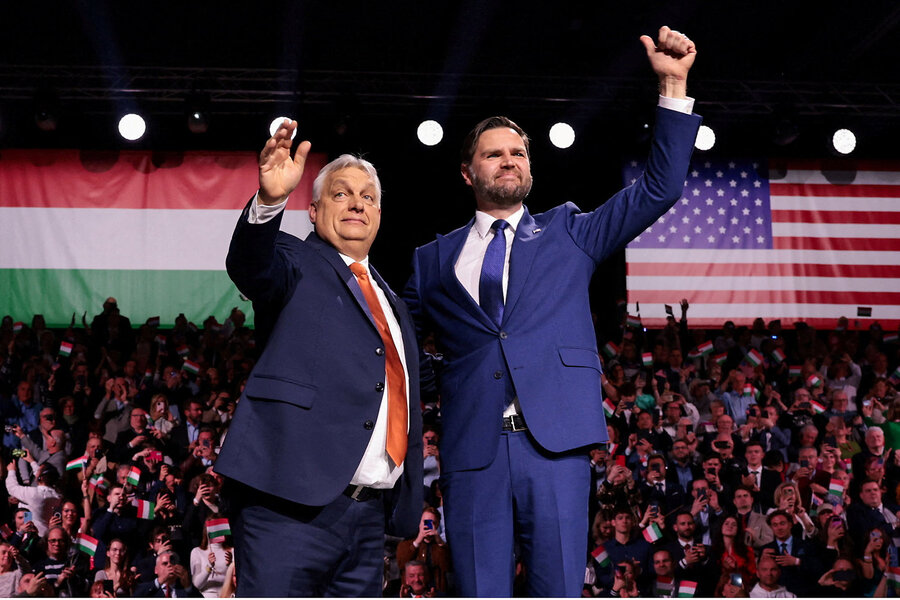
“He was a friend of mine,” President Donald Trump mused this week, just 48 hours after the landslide defeat of his political soulmate, Prime Minister Viktor Orbán, in Hungary. He also appeared eager to distance himself from the result: “It wasn’t my election,” he added.
Yet Hungary’s election is likely to reinforce a contrary trend building across Europe in recent months – even among far-right populist politicians who celebrated Mr. Trump’s return to the White House as a boost for their equivalent of MAGA, “Make Europe Great Again.”
Now, they’ve become increasingly eager to distance themselves from Mr. Trump.
Why We Wrote This
Viktor Orbán’s landslide loss happened despite full-throated backing from the Trump administration. Now, even far-right populists in Europe are beginning to see support from the U.S. president as a political liability.
Part of this is mere election math: Where they initially viewed Mr. Trump as a potentially powerful vote-getter, they’ve come to see him as a potential liability.
The Hungarian vote will reinforce those worries.
Mr. Orbán didn’t lose because of Mr. Trump: Corruption and a slowing economy were key factors.
But he did lose despite an extraordinary campaign by the president to help him win.
The Hungarian leader was more than simply a “friend.” He had been a full-on ally from Mr. Trump’s first term, and was the only European leader to come out in support of him ahead of the 2024 presidential election.
Mr. Orbán took a hard line on immigration. He cultivated close ties with Russian President Vladimir Putin. He waged a “civilizational” campaign against the Hungarian judiciary, universities, journalists, and LGBTQ groups.

“President Trump is deeply committed to your success,” said U.S. Secretary of State Marco Rubio, during a visit this year to Budapest. “It should not be a mystery to anyone here how the president feels about you.”
“I AM WITH HIM ALL THE WAY,” Mr. Trump posted on social media in the weeks leading up to the election, and said he hoped Mr. Orbán would win, and “win big.”
Mr. Orbán lost, and lost big – even with an eleventh-hour visit by U.S. Vice President JD Vance to reinforce the Trump administration’s backing.
Still, even before the election, Mr. Trump’s policies, and the language with which he was delivering them, had ideological allies across the continent growing leery of too close an embrace with him.
First came his announcement of trade tariffs on European countries. Then, his push to take control of the Arctic island of Greenland from Denmark, even suggesting he would be ready to use force to get it.
Most recently came his decision to launch the war against Iran – a conflict on which Europe wasn’t consulted, but whose economic impact European countries are already feeling.
As Mr. Trump ramped up pressure over Greenland in January, leading politicians in a number of the main populist parties – including the Alternative for Germany, or AfD, and the National Rally in France – pushed back publicly. Far-right members of the European Union’s Parliament joined in pausing ratification of the trade agreement the EU had negotiated with Mr. Trump.
Again, electoral math played a part. Polling suggested that even a significant number of their own supporters would support sending European troops to Greenland if Mr. Trump took further action to take over the territory.
But Mr. Trump’s ties with European populists have frayed further since the launch of the Iran war – and even his longtime political allies have pushed back.
Two in particular: Nigel Farage of Britain’s Reform UK party, which has overtaken both the governing Labour Party and the mainstream Conservatives to lead in national opinion polls; and Italy’s Prime Minister Giorgia Meloni, often referred to as Europe’s “Trump whisperer.”
They were the most prominent Europeans on Mr. Trump’s 2025 inauguration guest list.

While Mr. Farage has largely avoided criticism of the war, he declared himself “quite shocked” last week by Mr. Trump’s social media threat of a widened attack on Iran: “A whole civilization will die tonight, never to be brought back again.”
“That is over the top in every single way,” Mr. Farage said. He did suggest that the president was “upset, angry” and wanted to prod Iran to negotiate.
But even so, the words used were “way too far.”
Ms. Meloni has been more forthright in taking issue with Mr. Trump, a distancing that began with his suggestion in January that European NATO troops had avoided the front lines during their support for U.S. forces in Afghanistan.
“Unacceptable,” she said, especially because 53 Italian soldiers had lost their lives there, and hundreds of others had been wounded.

Roberto Monaldo/LaPresse/AP
From the start of the Iran war, she has questioned its legal basis. Italy also refused a landing request by U.S. aircraft at one of its bases.
And after Mr. Trump’s public broadside against Pope Leo XIV last Sunday, she sided with the pontiff. Again using the word “unacceptable,” she said: “The Pope is the head of the Catholic Church, and it is right and normal for him to call for peace and to condemn every form of war.”
Having praised Ms. Meloni in public as recently as a few weeks ago, Mr. Trump said he was now “shocked by her. I thought she was brave, but I was wrong.”
He said she was “no longer the same person.”
Yet a number of longtime MAGA admirers on the European right appear to have come to a similar judgment about Mr. Trump.