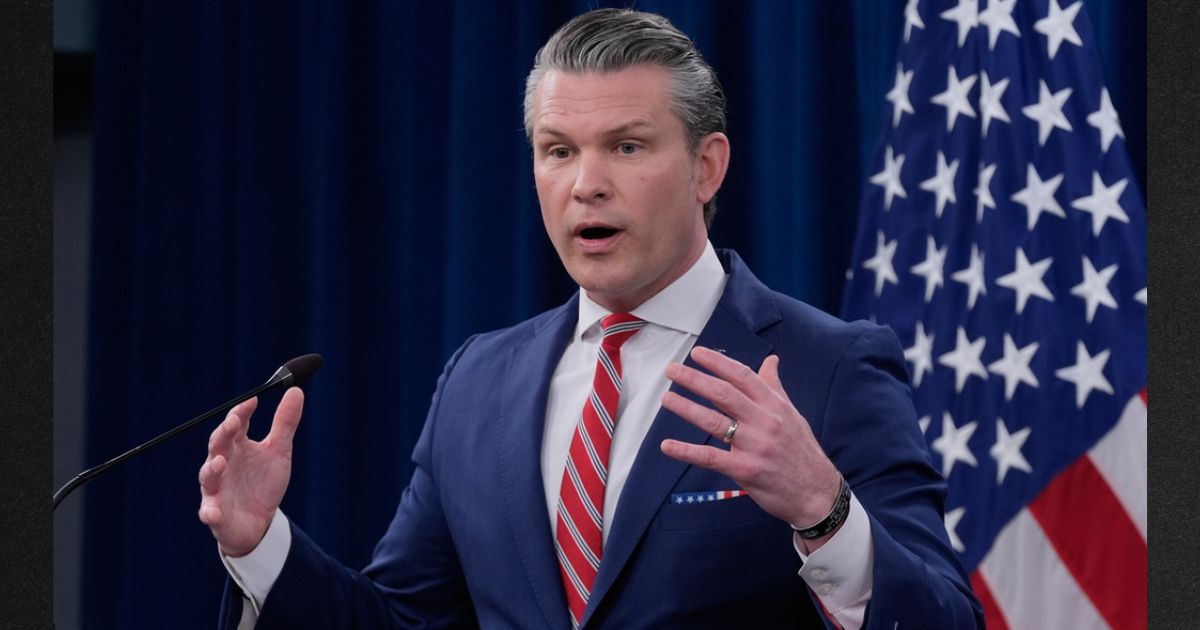
Secretary of War Pete Hegseth said Tuesday that the ceasefire between Iran and the United States is still in place, despite reports of both countries firing upon each other in limited cases.
Reagan Reese, White House correspondent for the Daily Caller, questioned Hegseth about the status of the ceasefire, saying, “In the last 24 hours or so, Iran’s fired at us, we fired at Iran. I’m just going to ask you more directly, is the ceasefire over?”
“No, the ceasefire is not over,” Hegseth shot back. “Ultimately, this is a separate and distinct project. And we expected there would be some — churn at the beginning, which happened. And we said we would defend, and defend aggressively, and we absolutely have. Iran knows that.”
Hegseth was referring to Project Freedom, an operation authorized by President Donald Trump to clear the Strait of Hormuz in an effort to increase shipping and ease rising energy prices.
“Ultimately, the president’s going to make a decision whether anything were to escalate into a violation of a ceasefire,” the secretary continued. “But certainly, we would urge Iran to be prudent in the actions that they take to keep that underneath this threshold.”
Hegseth added, “This is about the straits, this is about freedom of navigation, this is about international waterways. This is about free flow of commerce, all the things that happened before, and only Iran is contesting. So right now, the ceasefire certainly holds, but we’re going to be watching very, very closely.”
“No, the ceasefire is not over,” @SecWar tells me.
He adds to @DailyCaller that Project Freedom is a “separate and distinct project” and they expected some “churn” in the beginning. pic.twitter.com/IlOhviJZPk
— Reagan Reese (@reaganreese_) May 5, 2026
Iran opened fire on American warships in the Middle East Monday, and the U.S. quickly hit back, destroying six Iranian small boats, according to U.S. Central Command leader Adm. Brad Cooper.
“My operational assessment overall is that the U.S. military has the clear advantage,” he said during a media conference call Monday.
“We have an enormous amount of capability and firepower concentrated in and around the Strait, including AH-64 Apache and MH-60 Seahawk helicopters used just this morning to eliminate six Iranian small boats threatening commercial shipping.”
Cooper concluded, “We’re backing up commitment with action.”
Hegseth’s comments come just one day after Trump said Iran will be “blown off the face of the earth” if it attempts to fire on American ships within the Strait of Hormuz.
It also comes just days after U.S. Navy guided-missile destroyers were sent to the Arabian Gulf after transiting the Strait of Hormuz in support of Project Freedom.
A Sunday news release from U.S. CENTCOM said that destroyers, drones, over 100 aircraft, and 15,000 service members are supporting the mission.
The final result of Project Freedom will likely play a large role in what kind of peace deal is negotiated between the United States and Iran.
If the U.S. fails to speedily secure the strait, it could embolden radical elements within what’s left of Iran’s government and cause the peace process to drag out.
If the strait is rapidly secured, on the other hand, it leaves Iran with few options and could force the country to finally accept an agreement that would be highly beneficial to the United States.
Advertise with The Western Journal and reach millions of highly engaged readers, while supporting our work. Advertise Today.