Resetting Britain’s relations with the EU should not mean being beholden to France and Germany
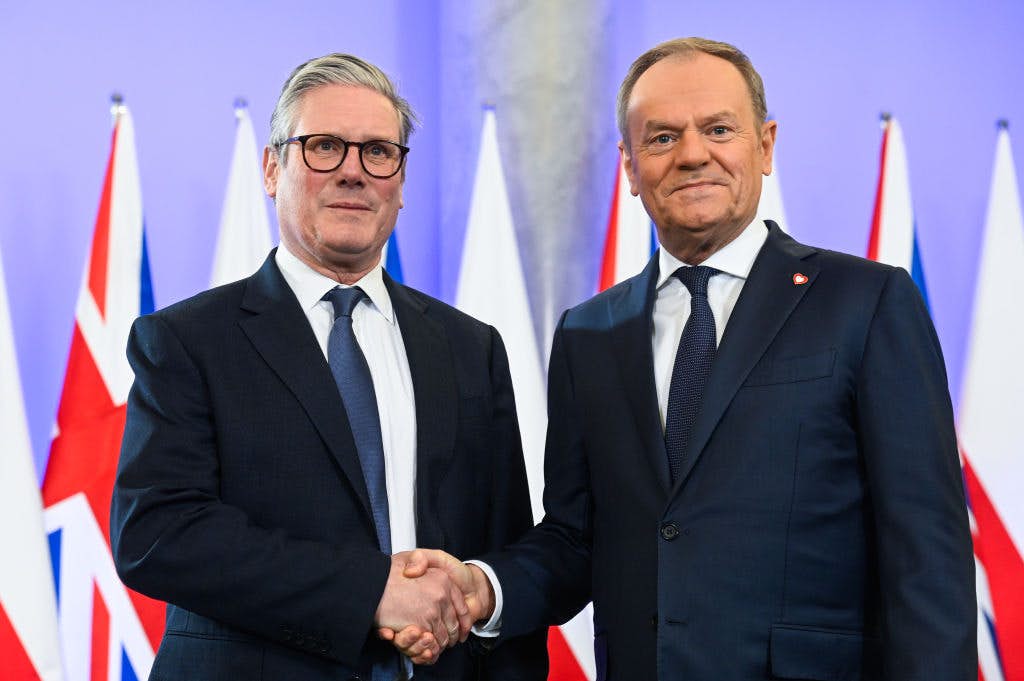
Ten years on from Brexit, Sir Keir Starmer is resetting Britain’s relations with the EU — and true to form, he’s doing it in the least imaginative way possible.
For a British government more courageous and inventive than the current one, this is a once-in-a-generation opportunity to build new alliances around a decentralised vision of Europe for the 21st century. Péter Magyar’s election in Hungary has shown that the future direction of Europe is both conservative and pro-European. This is exactly the mode in which Cameron-era Britain used to operate as part of the European Conservatives and Reformists, founded in 2009 to promote a decentralised vision of Europe, and currently led by Poland’s former Prime Minister Mateusz Morawiecki. Britain’s re-engagement with Europe should proceed in the same spirit — strengthening ties with Poland, the Nordics, and Central Europe as a counterweight to the influence of the Franco-German EU core. Sir Keir, meanwhile, is proposing to use Henry VIII powers to adopt “dynamic alignment” with the single market (otherwise known as following rules without having a say in them), side-stepping a parliamentary vote on precisely the sort of issue where Britain needs to be innovating.
The EU was built around an East-West axis designed to bind France and Germany together after the Second World War, and Britain does not fit neatly within such a structure — but times have changed, and today the continent needs a North-South axis to bolster it against the threat of Russia, as well as an East-West one. It just so happens that a North-South Axis favours Britain’s interests considerably more. The Franco-German EU, as envisaged by Charles de Gaulle, repeatedly rejected Britain’s attempts to join in 1963 and 1967, due to de Gaulle’s belief that Britain’s close relationship with the USA would weaken the European Project — a project which was explicitly set up to further the economic interests of the France/Germany/Benelux bloc.
Further alliances may be drawn by Britain becoming a Strategic Partner to the Three Seas Initiative
Britain’s struggles to join the SAFE defence fund in 2026 mirror its struggles to join the EU under Harold Macmillan and Harold Wilson, and Sir Keir’s eventual capitulation to Third Country status under SAFE shows that Europe is still reluctant to accept British investment on its own terms. With the British Navy now actively having to stop Russian submarines from monitoring UK undersea cables, it is becoming obvious that the closest partnerships in defence should be established with other EU nations on the front lines — such as Poland, which is expert at counteracting Russian hybrid measures, and Sweden, which is a leader in Baltic submarine production. Britain’s joint statement on defence financing and procurement with Finland and the Netherlands from March 2026 is exactly the right direction to take on regional cooperation.
Further alliances may be drawn by Britain becoming a Strategic Partner to the Three Seas Initiative. Named for the Baltic, Black Sea, and Adriatic/Mediterranean, the 3SI is a structure of regional cooperation for countries from the Baltics in the north, through Central Europe, Austria, Hungary, the Czech Republic, Slovakia, and Slovenia, to Romania, Bulgaria, Greece and Croatia in the south. It was designed by the previous conservative government in Poland precisely as a bulwark against both potential aggression from the East, and undue economic pressure from both the Russian energy sector, and the EU core. It is a North-South axis of Europe, it communicates in English, and it is designed to link maritime trading communities — particularly those with LNG terminals — by a network of inland roads and railways to develop the economies of the region. The United States is already a Strategic Partner — Britain joining at this level would signal deepening strategic alignment between Central and Eastern Europe and the Anglosphere, further linking this community with Atlanticism, and providing a viable alternative to over-reliance on the Gaullist vision of the EU core, which has historically been critical of Britain’s non-European ties — unlike Central Europe, which celebrated their role in the fall of communism. Insofar as the North-South Axis should have an East-West tie-in, it should be a maritime one, focused on the Baltic, the North Sea, and the Atlantic Ocean, and Britain’s role should be to build up the Royal Navy and pull its weight within it.
Britain left the EU not because there was something wrong with Britain, but because there was something about Britain which was not quite compatible with the EU’s current structure. With a little effort however, this structure can be balanced — and there are several countries which share Britain’s stance on this balancing without wanting to leave the EU. A Union of 27 states, now contemplating the addition of Ukraine cannot keep running as a Franco-German economic project without eventually giving rise to the creation of a rival regional bloc within Europe — one led by countries for whom taking the Euro fundamentally does not work — countries like Poland and Britain, but also Sweden, Denmark, the Czech Republic, and Hungary. These countries may rightly wish to form a united front on some global issues, while also advocating for regional interests on others. Poland’s record-breaking economic growth over the past decade (which outpaces that of the Eurozone) is closely tied to its refusal to take the Euro, which would have caused prices of everyday goods to skyrocket, as they did in Lithuania, which, in the decade following Euro adoption in 2015 ranked among the top four EU countries for average price growth.
In the 2010s, Poland and Britain, together with Sweden, opposed the European Commission’s proposal for the Financial Transaction Tax (colloquially known as the “Robin Hood Tax”) in 2011, arguing that it would push financial services out of Europe, while Germany, France, and Italy supported it. Poland and the UK were also aligned on questioning European labour standards, supporting an opt-out clause which would allow individuals to work more than 48 hours a week — because Poland and Britain know that outworking the competition is the only way to succeed against non-European powers. Both countries respect national laws first and foremost, so they made sure Protocol No. 30 was written into the Lisbon Treaty, limiting the ability of EU courts to strike down national laws. The global realignment happening right now makes a return to this type of strategic cooperation over economic and industrial sovereignty, agricultural and energy-sector self-sufficiency, and defence and technology supremacy even more urgent.
Poland’s former Prime Minister Mateusz Morawiecki, who presided over much of the country’s growth, has devised a new blueprint for economic sovereignty in a strategy called “Powered by Poland”, supported by his newly-launched “Development Plus” Parliamentary Association. The plan is to build out domestic industries in parallel to foreign investment by prioritising Polish companies in public procurement contracts for large-scale critical infrastructure, granting tax relief to startups to build a local tech ecosystem, and developing dual use technologies for the defence sector. To power this economic transition, the plan envisages reforms to the EU Emissions Trading System, which has raised the cost of energy production in Europe, and further development of the nuclear energy sector. As Poland prepares for parliamentary elections in 2027, this conservative vision for keeping capital at home hints at a future in which Poland will unabashedly secure its own national interest, while also working with the EU. Britain should adopt a similar approach, and a future UK government willing to deepen bilateral engagement with Poland would put itself in a significantly stronger negotiating position vis-à-vis Brussels than the present one.
Britain currently has no preferential procurement for UK companies under the Procurement Act 2023, which favours non-discrimination and transparency, meaning that the UK is not currently building domestic industries — a missed opportunity, considering the topic was hotly debated as part of the EU-UK Withdrawal Agreement in 2017. Labour won’t fix Britain by aligning more perfectly with EU rules which weren’t made to fit the country in the first place: to really succeed, the UK needs to strip back national sovereignty to a few core ideas; self-sufficiency in agriculture and energy, lower welfare spending, increased defence spending, and clear commitment to supporting British industries and producers, combined with an openness to building alliances in unexpected places.
A future conservative-minded government (of any political party) must prioritise domestic ownership and strategic control over key assets and industries
The downfall of the previous Conservative government was selling off British land, industry, and expertise to the highest bidder no matter whether they came from a country openly hostile to Britain or not. A future conservative-minded government (of any political party) must prioritise domestic ownership and strategic control over key assets and industries. Both sides of the political spectrum understood this when the government intervened to prevent the closure of the last two blast furnaces at Scunthorpe in April 2025. One year on, British Steel will have to be brought into public ownership by the summer, if a deal between the government and Chinese-owned Jingye cannot be concluded. A delay of more than a year in the current geopolitical climate plainly shows that continued foreign ownership of crucial UK strategic assets is unsustainable.
If the Labour Party understands the need for domestic decision-making in the context of Steel, then surely it can also understand why slipping dynamic alignment in by stealth removes some of the very decision-making power that Britain must win back. Yes, working with Europe keeps Britain safe in a rapidly-changing world — but true cooperation can only happen between sovereign equals. The only way to engage with the industrial base of the EU core on an equal footing is to build new technological and industrial bases from the ground up — in Britain and Poland — and to cooperate strategically about how resources are deployed to secure leverage. Otherwise, both Britain and Poland, countries on the EU periphery, will remain the rule-takers of Europe, serving those who produce tangible value abroad; Britain will become a permanent butler, and Poland a permanent back office. Avoiding this fate requires the courage, discipline, and self-confidence to choose a different path. Poland has shown through 30 years of economic growth that it has what it takes to break the mould and build something new — the question is whether Britain has the courage to stop playing small and join it.