A year ago, Caitlin Tulloch was working out of her spare room with little more than a laptop and a list of 22,724 names.
The list was every project the U.S. Agency for International Development, or USAID, had been funding – from efforts to get clean water to communities in northern Nigeria to an initiative for tuberculosis prevention in Myanmar. That is, until President Donald Trump signed an executive order on his first day back in office last year that froze all foreign assistance.
Ms. Tulloch, an economist who had spent years inside USAID evaluating which of its programs saved the most lives per dollar, understood what that meant.
Why We Wrote This
When the U.S. Agency for International Development shut down, the projects it funded were left in limbo. Project Resource Optimization matches as many as it can with new donors.
So, she and a group of former colleagues decided to build what she calls a “lifeboat.” They would try to match the most effective of those stranded programs with new funders able to keep them afloat.
A year later, Project Resource Optimization (PRO) has connected about $110 million in donor funding to almost 80 projects in 30 countries, according to the group. Meanwhile, government data shows that between 2024 and 2025, U.S. foreign aid fell by nearly 50%, from $70 billion to $38 billion.
“For us, PRO was a lifeline,” says Hadiza Marcus, director of programs at Helen Keller International Nigeria. A $1.5 million grant the organization got through PRO’s matchmaking saved a program to help malnourished children.
“Without that support, we would have had to walk away from children who cannot afford for the help to stop,” Ms. Marcus says.
Bringing back hope
At the start, even Ms. Tulloch, a serial optimist, wasn’t sure it would work. Members of the team first whittled the nearly 23,000 programs down to about 80 of the most urgent and cost-effective. They then started looking for donors to fund them.
What they got, at first, was modest: small family foundations in the United States with no prior experience in international development and “grandmothers sending what they could,” Ms. Tulloch says.
None of it was the kind of money that moves the needle on a global humanitarian crisis, but for the projects on PRO’s list, it was lifesaving.
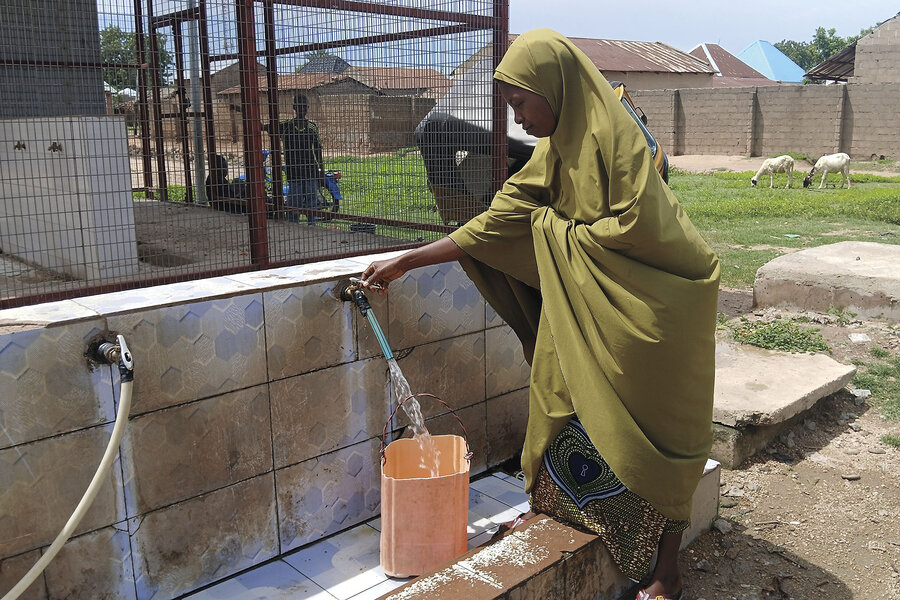
Among them was a Mercy Corps project getting clean water to communities in northeastern Nigeria. When The Christian Science Monitor visited last July, a private donor had just pledged $128,000 to cover some of what the organization lost to USAID cuts.
“It brought back hope,” said Harun Kobia, infrastructure adviser for the project, during an interview at the time.
By August 2025, PRO had connected $50 million in donor money to projects on its list, according to the organization, about half of what was required.
“At that point, we suspected we were going to be tapering off,” Ms. Tulloch says, “and that we had made most of the matches we would be able to make.”
What happened next surprised everyone – including her.
“In August and September, several really large and unexpected donations came through,” she says. In the space of roughly 60 days, PRO mobilized another $60 million, enough to fund the rest of the programs on its list.
One was Helen Keller International Nigeria’s grant to screen and treat children for malnutrition, and to train health workers and caregivers. Mercy Corps also received another $1.8 million to complete another clean water project in Nigeria’s southeast.
“This will allow us to reach communities that have gone years without safe water,” Mr. Kobia says.
In the cases of projects run by global organizations like Helen Keller International and Mercy Corps, getting the money to recipients was relatively straightforward. But many donors had legal and financial concerns about routing money to local organizations that weren’t registered as nonprofits in the U.S. So, PRO began working with the crowdfunding platform GlobalGiving to vet and transfer about $7 million to locally organized projects. These ranged from support for victims of gender-based violence in Ivory Coast to HIV treatment in Congo.
“The emergency is not over”
For all that PRO has pulled off, Ms. Tulloch and her colleagues are aware of the huge gap yet to be filled.
The money PRO has marshaled averages out to about $1.4 million for each of its 80 projects. That’s enough, in most cases, to keep the lights on for a year. “What it cannot do is replace the scale or the decades of institutional muscle that USAID represented,” says Grace Morgan, a senior analyst at the organization.
The gap is starkest at the local level. The $1.5 million Helen Keller International Nigeria received via PRO’s matchmaking efforts was a fraction of the $7 million annually that USAID provided for the first phase of its childhood malnutrition project.
“What we have now keeps the program alive, but at a reduced scale,” says Ms. Marcus. The organization is now working with state governments in Nigeria to get malnutrition services directly into their budgets, hoping that public financing can eventually replace what came from Washington.
With USAID no longer operating, most American development assistance now goes through the State Department, which has pledged to make aid more conditional.
“U.S. foreign assistance is not charity, rather it is strategic capital to be wisely invested to advance U.S. interests,” said Nick Checker, who leads the State Department’s Bureau of African Affairs, in a recent speech.
Meanwhile, after wrapping up the paperwork to transfer the $110 million it matched to projects last year, PRO vetted another 30 former USAID projects and is looking again for funders.
The organization also recently became part of the DIV Fund. The privately funded American organization is attempting to do the work once done by the USAID division responsible for testing innovative new aid projects. Multiple members of PRO’s team are now on the payroll there.
Others, including Ms. Tulloch, have picked up day jobs elsewhere. But they are still part of PRO, and Ms. Morgan says the organization has no plans to wind down.
“The emergency is not over,” she says.