13,000 flights are cut in just one month: Airlines take axe to May schedules over fears jet fuel may hit ‘critically low levels’

Airlines have cut two million seats from May’s schedules within the past two weeks as concerns build that the Iran war could cut jet fuel supplies to ‘critically low levels’.

The total number of seats available across all carriers this month fell from 132,619,704 in mid April to 130,674,864 in late April, according to analytics firm Cirium.

The number of flights fell by more than 13,000 over the same period – from 859,167 to 846,162.

Gulf airlines such as Qatar, Etihad and Emirates have been worst hit by Middle East airspace closures and airport disruption since the conflict began on February 28, as well as by rising fuel costs.

German carrier Lufthansa had the most seat cancellations after cutting 20,000 flights between May and October, with Air China axing almost 500,000 including internal services, the Financial Times reported.

European operators Air France-KLM and SAS have also cut schedules in recent weeks, while US airline Spirit has collapsed, which it blamed on rising oil prices.

Ryanair boss Michael O’Leary has warned rivals that Europe’s biggest airlines are now ‘desperately’ searching for flights to cancel and are expected to do so within weeks.

It comes as a fragile truce in the Middle East remains under strain after the US and Iran exchanged fire in the Gulf in the tussle over the Strait of Hormuz, via which 20 per cent of global crude supply passes.
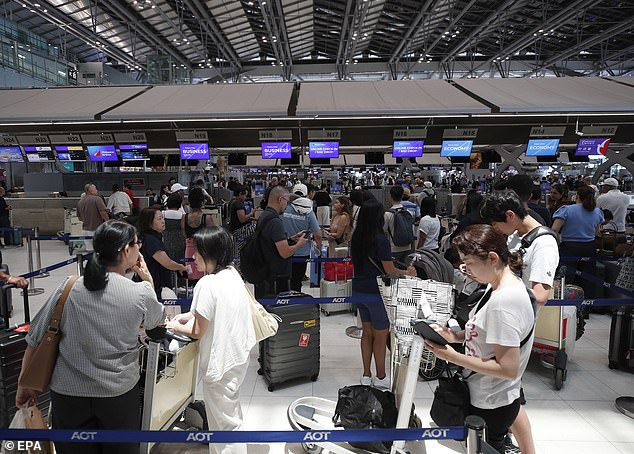
Passengers for international flights at Bangkok Suvarnabhumi Airport in Thailandon Monday
Passengers for international flights at Bangkok Suvarnabhumi Airport in Thailandon Monday

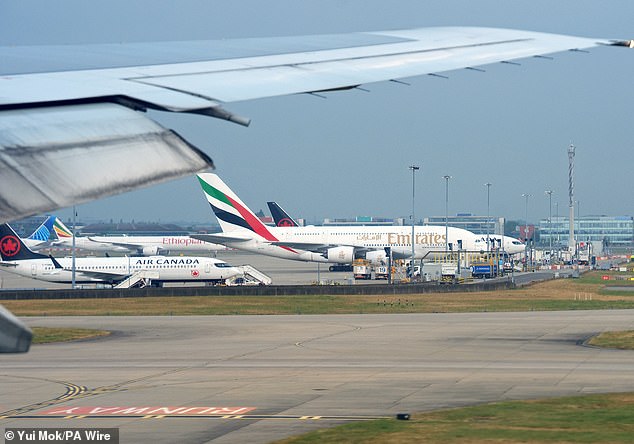
Planes on the ground at London Heathrow Airport's Terminal Five on Sunday

Planes on the ground at London Heathrow Airport’s Terminal Five on Sunday

How European airlines are responding to the jet fuel crisis 

AEGEAN AIRLINES: The Greek airline expects suspended Middle East flights and a spike in fuel prices to have a ‘notable impact’ on its first-quarter results.

AIR FRANCE-KLM: The airline group said it expected a $2.4billion (£1.8billion) increase in its fuel bill this year and downgraded its capacity outlook to an increase of 2 per cent to 4 per cent from 2025. It previously expected an increase of 3 per cent to 5 per cent. The group previously announced plans to increase long-haul ticket prices to address surging fuel costs, with cabin fares set to rise by €50 (£43) per round trip. The group’s Dutch arm KLM said on April 16 it would cancel 160 flights in Europe in the coming month due to rising fuel costs.

EASYJET: EasyJet warned of a bigger half-year pre-tax loss of between £540million and £560million, including £25million in extra fuel costs in March.

IAG: British Airways owner IAG said it would raise ticket prices to reflect higher jet fuel costs, as, despite its fuel hedges, it was ‘not immune’ to the broader fallout from fuel cost volatility.

LUFTHANSA: The German airline group unveiled a new ‘Economy Basic’ low-cost fare option for short- and medium-haul flights, which will limit free carry-on bags to only a ‘laptop bag or a small backpack’. The group previously said 20,000 short-haul flights would be removed from its schedule through October, equivalent to about 40,000 metric tons of jet fuel.

SAS: The Scandinavian airline said it would cancel 1,000 flights in April because of high oil and jet fuel prices, after cancelling a ‘couple hundred’ flights in March.

TAP: The Portuguese airline said its price hikes would partially mitigate the impact of fuel price changes on its revenue.

TUI: The European airline and tour operator cut its full-year underlying profit outlook and suspended revenue guidance, saying it had incurred about €40million (£35million) in extra costs due to the war in March, including repatriation efforts and operational disruptions.

TURKISH AIRLINES, LUFTHANSA: SunExpress, a joint venture between Turkish Airlines and Lufthansa, said it would impose a temporary fuel surcharge of €10 (£9) per passenger on routes between Turkey and mainland Europe. The surcharge will apply to bookings made on or after April 1 for departures on or after May 1. Turkish Airlines said on April 10 it had decided not to distribute any dividend from its 2025 net profit, opting to retain earnings to preserve cash.

VIRGIN ATLANTIC: The airline is adding fuel surcharges to fares but will still struggle to return to profitability this year, its CEO Corneel Koster said.

VOLOTEA: The Spanish low-cost airline introduced a new pricing policy linking ticket prices to fuel costs, which could potentially add a post-purchase surcharge of up to €14 (£12) per passenger, per flight.

The US military claimed that it had destroyed six Iranian small boats on Monday as well as cruise missiles and drones, after President Donald Trump sent the US Navy to escort stranded tankers through the strait in a campaign dubbed ‘Project Freedom’.

The average global jet fuel price increased for the first time in a month last week to $181 (£134) per barrel, according to International Air Transport Association data.

This 1 per cent week-on-week rise followed three consecutive weeks of decline after a peak of $209 (£155) at the start of April – up from $99 (£73) at the end of February. 

Meanwhile, investment bank Goldman Sachs warned Britain is particularly vulnerable to jet fuel shortages amid a rationing risk as supplies could fall to ‘critically low levels’.

A note seen by The Times claimed the European jet fuel supply was facing ‘extreme tightness’ because of the Strait of Hormuz’s closure – with the UK ‘most exposed’ to the crisis because of high reliance on imports, poor refining capacity and low stocks.

Goldman Sachs said: ‘The UK is the largest net importer of jet fuel in Europe, and it holds no strategic reserves, leaving commercial inventories as the primary buffer.

‘As a result, inventories in some countries, especially the UK, could fall to critically low levels, increasing the likelihood of rationing measures.’

Meanwhile, Britain now has only four operating oil refineries – Fawley in Hampshire, Stanlow in Cheshire, Humber in Lincolnshire and Pembroke in Wales – after the closure of Grangemouth in Scotland in April 2025 and Lindsey in Lincolnshire last August.

Several merchant ships in the Gulf reported explosions or fires and an oil port in the UAE, which hosts a large US military base, was set ablaze by Iranian missiles.

Iran’s Islamic Revolutionary Guard Corps has effectively closed the strait with threats of mines, drones, missiles and fast attack craft, while the US has responded by blockading Iranian ports.

The UK Government has now introduced a temporary rule change allowing airlines to group passengers from different flights together on to fewer planes as part of plans to save fuel.

This could see passengers moved from the service they originally booked to a similar one in a bid to reduce the amount of wasted fuel from flying planes that have not sold out and might have otherwise been cancelled.

When asked about two million flights being axed in May, the Prime Minister’s spokesman referred to Transport Secretary Heidi Alexander’s announcement earlier this week. 

He added that she had acted to allow airlines to consolidate routes out of the UK to ensure ‘fewer surprises for people planning their holidays’.

‘She also spoke about contingency planning. As you would expect that work continues … we are very clear that the impact of the conflict in Iran has a direct bearing on the UK’s economic situation and that is why we continue to push for a lasting peace in the region,’ he said.

It comes after the European Commission warned that airlines and member countries should prepare for all scenarios as uncertainty continues over supplies.

Spokesman Anna-Kaisa Itkonen told a briefing in Brussels: ‘I don’t think anyone knows how long this situation will last, so the best we can do and the most effective thing that we can do – and that we are doing – is to prepare for all eventualities.’


Q&A  

What are my rights if my holiday flight is cancelled?

You are entitled to an alternative flight at the earliest opportunity, or at a later date – or to cancel altogether.

If your airline can’t reroute you via a suitable alternative, you can ask to be booked on a flight with a competitor.

My flight has been merged, can I claim compensation?

The Government has granted airlines the power to merge flights without penalty, as they would in normal times. Usually, passengers are owed compensation if the airline cancels or significantly moves the timing of a flight that is less than 14 days away.

But it’s not clear whether this applies if your flight is cancelled or moved due to fuel shortages.

Airlines typically don’t have to pay out if the delay or cancellation is down to ‘extraordinary circumstances’, such as political or civil unrest.

While flight changes are not directly due to the unrest, it has sparked the shortages.

Airlines have petitioned for fuel supply shortage to be seen as an ‘extraordinary circumstance’. This request has not been granted in the UK.

However, the European Commission has implied that airlines may be able to get out of paying compensation if they can prove the disruption was directly caused by the fuel shortages.

Can I claim on my travel insurance?

Travel insurance is the safety net to rely on when you can’t get any help from an airline.

If the reason for the cancellation is outside of an airline’s control, your travel insurer can normally reimburse you for the flight as well as for the holiday accommodation and hire car costs.

Standard travel insurance policies typically exclude war. It is unclear whether this covers fuel shortages. Check your policy’s small print.

What if I don’t get what I’m owed?

If your airline rejects your claim, you can try to use alternative dispute resolution (ADR) to resolve the matter. For details, go to the Civil Aviation Authority’s website caa.co.uk.

Source link

Related Posts

Load More Posts Loading...No More Posts.