The call for help came at midmorning, just moments after the crime. A north London synagogue, a knifeman, two victims – one so shocked that he didn’t realize he’d been stabbed.
Within minutes, the first responders arrived. But they weren’t police or paramedics. They were local Jewish volunteers who work round the clock to help people caught up in the rising violence that has beset their community in recent months.
“We were on the scene within two minutes of the call going out,” says Avi Ball of the April 29 attack in the Golders Green neighborhood of north London. “The amazing thing is that people just drop what they are doing, and do whatever they have to do.”
Why We Wrote This
Antisemitic crime is an increasing concern for Britain’s quarter-million Jews. Institutions like Shomrim North West London, a volunteer neighborhood patrol, are helping to respond to attacks like last week’s stabbings in Golders Green.
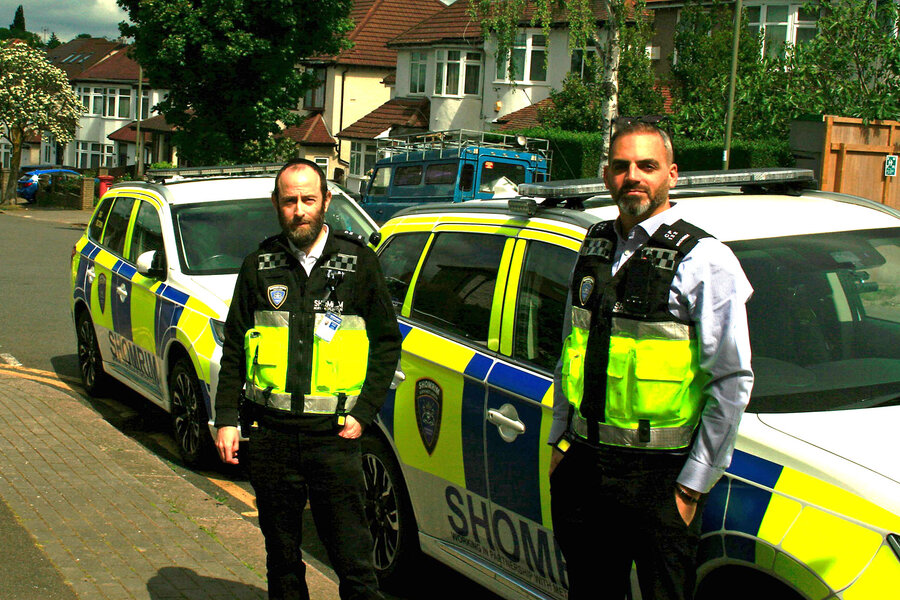
Mr. Ball is a member of Shomrim North West London, a small Jewish neighborhood watch group, the likes of which have been set up in several cities worldwide. They provide 24/7 emergency response to local calls for help: robberies, burglaries, missing persons, accidents.
And of course, antisemitism. Last week’s double stabbing was just the latest in an unprecedented wave of attacks on Jewish people and property in Britain that has prompted a moment of national soul-searching. Just how safe are Britain’s quarter-million Jews from being scapegoated for what’s happening thousands of miles away in the Middle East?
“Jews are scared to go out, to go to their synagogue, to wear a kippah in the street,” says Stuart Polak, a Conservative member of the House of Lords who is himself Jewish. “This is Britain in 2026 and it’s shameful that it’s even remotely acceptable.”
Guardians on patrol
Shomrim North West London was founded in 2008, but many cities around the world have Shomrim (“guardians” in Hebrew). New York has had such groups for decades, and Shomrim sister branches also exist in European cities and Australia.
Britain’s surge in antisemitic hate crime has changed the lives of the 50-odd volunteers of Shomrim North West London. Volunteers, who have to fit their day jobs around answering the hotline, have recorded a fivefold increase in incoming calls since Hamas’ Oct. 7, 2023, attack on Israel.
“At the moment, we are averaging around 40 calls a day,” says Mr. Ball, noting that not all require a response. “Recently, with the amount of calls coming through, we are always on.”
That could mean dropping everything to dash to a stabbing in the street (April 29), or to a bus where verbal abuse has been directed at school kids. It could mean responding to an arson attack on a synagogue (April 15), or picking up the phone in the middle of the night to learn that four local community ambulances have been torched (March 23).
Shomrim volunteers pledge to get to any incident within minutes, because they are local, trusted, well-connected, and very well organized via an inevitable Google spreadsheet.

Sometimes things can get perilous.
“Danger is something that we are aware of,” says Ben Grossnass, a furniture salesperson who has volunteered with Shomrim for 15 years. “Volunteers are not armed; we have only stab-proof vests and regular training in self-defense.”
“We will come and help you”
On a chilly morning this week, Mr. Ball and Mr. Grossnass took The Christian Science Monitor around the neighborhood to give a sense of their mission.
On the surface, Golders Green looks like many other London districts, with double-parked residential roads teeming with narrow Victorian housing, and an exhausted main street somehow managing to survive the age of online shopping. But unlike most other districts in the British capital, people here know one another, and greet each other in the street – some in Hebrew, others in the flat, chewy accent endemic to north London.
“It’s been a very easy place to live, and it’s the first time in my life now that I don’t feel comfortable,” says local resident Frances Green. “I am wary. In the last year, things have changed unbelievably with all the attacks that we have had.”
During patrol, a call comes in. Mr. Ball answers it. It is a man whose bag has been stolen from his car. “We will come and help you,” says Mr. Ball. It is not obviously an antisemitic incident. But Shomrim does not discriminate.
“We respond to anyone in distress – we will attend it,” says Mr. Grossnass. “It’s not about whether they are Jewish, Christian, Muslim. It’s irrelevant. We respond 24/7. We take calls when a call comes through.”
Shomrim has other branches in northern cities like Gateshead and Manchester, where last October a man killed two people in a synagogue attack on the Yom Kippur holiday, in what was probably the worst antisemitic attack in the United Kingdom since 1945.
Shomrim North West London gets no state funding, but argues that it deserves some, given how much police time it saves through its efforts.
A community under threat
Unsurprisingly, local residents approve of the group.
“Shomrim are amazing,” says Hannah, who did not wish to give her last name. “They are always there straightaway; come to help you and make sure you are OK.”
Even the police, who might normally be hostile to the idea of community vigilantes taking matters into their own hands, are full of praise. After last week’s attack, London’s top police officer, Mark Rowley, thanked Shomrim by name and said officers would work more closely with the group.

No other community in Britain has such a system of self-defense and self-protection. Arguably, no other community needs it. According to government data, Jewish people in Britain are five times more likely to be victims of hate crimes than any other group.
“It is pretty much unique,” says Daniel Allington, an antisemitism expert at King’s College London.
“Jewish communities across Europe need these organizations because they are perpetually under threat,” Dr. Allington adds. “Originally the threat came from the far right and neo-Nazis. That gradually diminished, while the threat from Islamists is growing.”
Recent attacks have been blamed on either Islamist terrorists or on criminal elements possibly acting at the behest of Iran. In another recent Golders Green attack, a memorial to the thousands killed in the Iranian uprising earlier this year was firebombed. Their common enemy in Tehran appears to have brought London’s Jews and Iranian exiles closer together.
“We stand shoulder to shoulder with anyone in crisis no matter the race or religion,” says Mr. Grossnass. “We stand for peace and love and do as much as we can for anyone. We have had great conversations [with Iranian exiles] and there have been joint demonstrations.”
Hard to pinpoint responsibility
As for who is to blame, that depends who you ask. Some – even some Jews – point to Israel’s brutal response in Gaza to the Oct. 7 attacks for unleashing a global wave of hatred toward all Jewish people. Some warn that antisemitism is becoming normalized, with most people barely registering when the grim details of another violent attack are reported in the media.
Others point to things specific to Britain. Many Britons are hugely sympathetic to the plight of Palestinians. But some say extremists have latched on to this pro-Palestinian sentiment, particularly at demonstrations, to spread hatred of Jews, calling for things like “globalizing the intifada.”
“Tolerant Britain has become a bit too tolerant,” says Lord Polak, who is honorary president of the Conservative Friends of Israel parliamentary group. “When people call for globalizing the intifada they are calling for Jewish blood on the pavement. That is what we saw in Manchester and Bondi Beach and north London.”
“We need people to wake up,” he adds. “We’ve had killings in Manchester and the Jews of London are scared to go out. We have police in the synagogues.”
“The bottom line is that the state and the police need to come together with the silent majority, who need to be not so silent.”