This article is taken from the April 2026 issue of The Critic. To get the full magazine why not subscribe? Get five issues for just £5.
What does it mean to earn a university degree? Not just that you have passed through a course with some competent understanding of the curriculum. It should also indicate how well — or not — you have fared amongst your cohort: the existence of classifications, of grades, reveals the degree to which you have succeeded amongst your peers.
It was not difficult to deliver this. All that was required was for those who were expert in a subject to examine students, ideally at the end of their studies, by asking them questions. In the early centuries of the English university this was done through individual oral examination. From the 18th century onwards, however, the timed, invigilated, closed-book written exam became the dominant form of assessment.
Its virtues were obvious: candidates could only call upon what had been already internalised in their own heads; their real-time response, to unprepared questions on prepared topics, would test whether they could deploy their knowledge critically and constructively; cheating was practically impossible, so a strong performance was a real indicator of genuine learning and productive intelligence.
Yet, in the eyes of many, there were several downsides, and some of their objections ring true. Poorly-chosen questions can lead to rote regurgitation; answers can be too hurried to allow for deeper analysis; rhetorical flair can disguise genuine merit and even distract the unwary examiner.
However, other criticisms miss the mark. Traditional exams really do put candidates in the challenging, and often stressful, situation of needing to think fast on their feet, draw on memory, make new connections on the spot and produce coherent and complete responses whilst the clock is ticking. That is a reflection of what life in the wider world, especially in the workplace, often requires of us. As any member of the public would concede, those abilities carry a premium.
AI has forced British universities to roll back the decades
The pushback against the closed-book examination reached its peak during the first two decades of the present century. The cult of kindness, the pursuit of student satisfaction and the uncritical and increasingly political obsession with “accessibility” and “diversity”, drove academics to find every way possible to obviate, and ideally eliminate, poor performances from students.
Yes, syllabuses could be pared back, examiners could be more lenient and ignore errors, whilst grade boundaries could conveniently be redrawn.
But the real driver of grade inflation was the decision to move assessment away from the invigilated exam towards coursework: material produced over weeks or months, often with significant input from instructors and based upon open (often imperfectly acknowledged) consultation of published materials.
Once work of this form is completed, it proves very difficult for it to receive a lower-second or third-class mark.
An even more material problem is that it becomes very hard to establish — without the addition of a separate oral examination — how much knowledge a candidate possesses, as opposed to what has been successfully reproduced from the complete corpus of published scholarship.
The progressives shrug their shoulders and point to the improved data for student performance. Coursework, it seems, can support and reward all kinds of learner.
In 2020, the battle looked to be well and truly won. When the Covid-19 pandemic made closed-book examinations impossible in an invigilated room, submitted coursework became “the new normal” at even the leading universities. Those who complained about the decline in standards and the rise of cheating were told to stop living in the past and start embracing the future.
Now though, things are reversing in a remarkable way. The eye-wateringly rapid rise of artificial intelligence has forced many British universities to roll back the decades in tactical retreat.
For if coursework can be written, in its totality, by AI, and if the AI detection tools are always several steps behind the technology, what can give any confidence that students’ work is their own? What employer — and indeed what university — would value a degree certificate which may bear very little relation to the talents of its holder?
As a result, many universities have sought to restore integrity and trust to their degree system by returning to invigilated, closed-book — and, to the bemusement of many students, handwritten — exams.
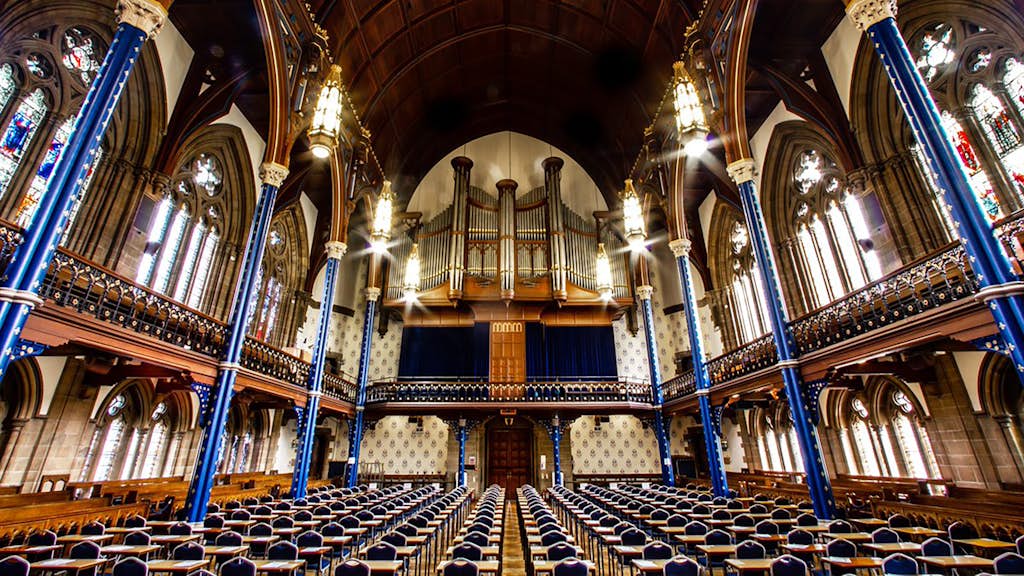
The University of Glasgow restored in-person exams for Life Sciences in 2024, “so that we can assure all students — together with the quality bodies that accredit degrees, as well as future employers — that the Life Sciences exams are reliable and the grades awarded are too”.
Similar moves have happened across the country, including at both Oxford and Cambridge — to the delight of some and the dismay of others.
Exactly so: exam satisfaction should vary by degree.