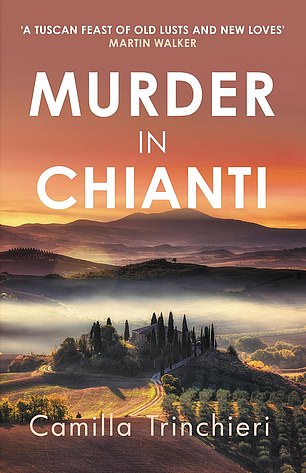
Murder in Chianti is available now
Murder in Chianti by Camilla Trinchieri (Allison & Busby £9.99, 352pp)
A former New York homicide detective resettles in Tuscany where his late wife spent her childhood. But however hard Nico tries to forget his career, crime continues to disrupt his life. A rich expat American with a complicated love life is murdered close to his home. Called in by the local police chief to help solve the crime, Nico finds himself with conflicting loyalties as friends in his rustic community fall under suspicion.
While keeping up the tension, Camilla Trinchieri weaves Italian cuisine into the rich cast of characters led by an elderly hobo whose acute observations are laced with revelatory quotes from Dante’s Divine Comedy. It’s all adds up to an irresistible treat.
The Spirit Guide by Bridget Walsh (Pushkin Vertigo £10.99, 304pp)
For their third appearance in what promises to be a long-running series, Minnie Ward, proprietor of a Victorian palace of varieties, and Albert Easterbrook, a hard-nosed private detective, take up the challenge of exposing fake spiritualism.
Building on the efforts of an investigative journalist who died in suspicious circumstances, the risks of inciting a notorious charlatan and his devoted followers are all too apparent. But never daunted, the indomitable Minnie takes time out from showbusiness to infiltrate a remote country house where vulnerable women suffer mental and physical abuse.
When she finds out more than is good for her, it is thanks to the timely appearance of her other half that Minnie is saved from a gruesome death.
With more than a touch of gothic melodrama, Bridget Walsh offers an addictive mix of mysticism, murder and music hall.
Not to Be Taken by Anthony Berkeley (British Library Crime Classics £9.99, 288pp)
This is one of the most ingenious murder mysteries of the last century. Originally published in a journal, readers were tasked with anticipating the ending after reading all but the last chapter. Not one got it right.
The plot is deceptively simple. When the leading citizen of a tiny village dies unexpectedly, the cause is put down to an undiagnosed gastric disorder. That is, until a sceptical relative demands a post-mortem which reveals traces of arsenic.
But who could have administered the fatal dose? Or was the death unintended, the result of a muddle over medicine bottles?
With no shortage of false explanations, the challenge is to spot the clues in some brilliant character studies. It is for the narrator, an unpretentious fruit farmer, to demonstrate that common sense is the fastest route to the truth.