The Supreme Court agreed Monday to throw out racial gerrymandering in Louisiana’s congressional districts, triggering a war of words among justices.
The court ruled last week that districts drawn to enhance the power of black voters under the auspices of the 1965 Voting Rights Act are no longer legitimate, as noted by NBC News.
That means Louisiana, which has six congressional seats, will redraw lines that currently protect two majority-black districts. That process is likely to reduce the number of Democratic seats in Louisiana from two to one.
The ruling caused a procedural train wreck, because until the court issues its final order on the decision, that process cannot start. As it is, Louisiana’s primary elections are on hold until new maps are drawn.
That led the state to ask that a longstanding rule allowing a 32-day period between the decision and the order enforcing it to be waived so the state can continue with its elections.
Justice Ketanji Brown Jackson wrote a fiery dissent, saying “principles give way to power” and trashing her colleagues for allowing the ruling to take effect.
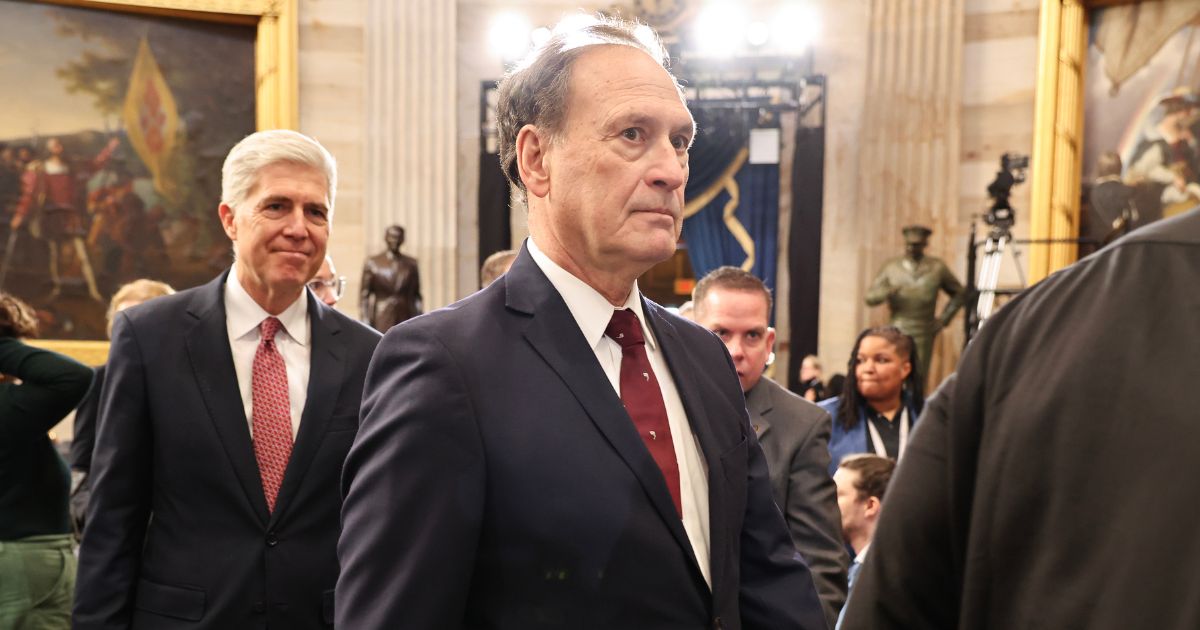
Justice Samuel Alito, stung by Jackson’s attacks on those who hold different opinions from hers, filed a response supporting the order to allow the ruling to take effect immediately.
In the response to Brown’s dissent, Alito wrote, “The dissent would require that the 2026 congressional elections in Louisiana be held under a map that has been held to be unconstitutional.”
“The dissent does not claim that it is now too late for the state legislature or the District Court to adopt a new map that complies with the Constitution. Nor does the dissent assert that it is not feasible for the elections to be held under such a map,” Alito wrote.
“Instead, the dissent offers two reasons for its proposed course of action. One is trivial at best, and the other is baseless and insulting,” he added.
“The first is compliance with the 32-day default rule set out in this Court’s Rule 45.3, but as the Court’s order ex- plains, there is good reason to depart from the default rule here,” Alito wrote.
“The second reason offered by the dissent is that we should allow the 32-day period to run out in order to ‘avoid the appearance of partiality,’” he continued.
Alito said Jackson’s leap of logic was faulty.
“But the dissent does not explain why its insistence on unthinking compliance with Rule 45.3’s default rule does not create the appearance of partiality (by running out the clock) on behalf of those who may find it politically advantageous to have the election occur under the unconstitutional map,” he wrote.
“The dissent goes on to claim that our decision represents an unprincipled use of power,” Alito said, adding, “That is a groundless and utterly irresponsible charge.”
“What principle has the Court violated? The principle that Rule 45.3’s 32-day default period should never be shortened even when there is good reason to do so? The principle that we should never take any action that might unjustifiably criticized as partisan?” he wrote.
“The dissent accuses the Court of ‘unshackl[ing]’ itself from ‘constraints.’ It is the dissent’s rhetoric that lacks restraint.”
Advertise with The Western Journal and reach millions of highly engaged readers, while supporting our work. Advertise Today.