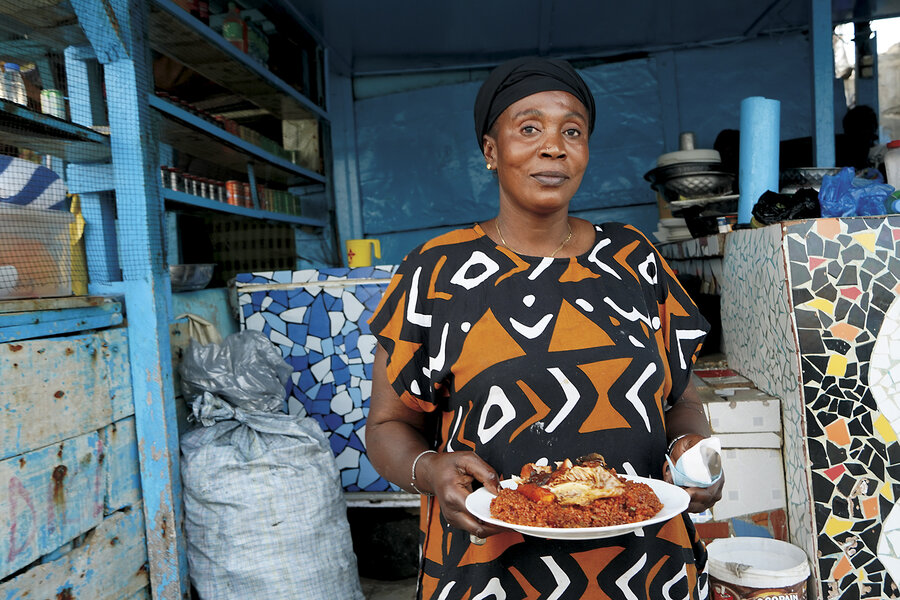
The sun slowly begins to set over the island of Ngor, off the northern coast of Senegal’s capital, Dakar.
As residents and tourists lounge on the beach, the smell of frying fish wafts from a nearby restaurant, mingling with the salty air. Inside, Aminata Mbengue slices onions with quick, confident movements.
On tonight’s menu is thieboudienne, Senegal’s national dish. It’s made from fish, rice, cabbage, carrots, cassava, eggplant, oil, and chile, all of it stewed in a rich, tomato-based broth. Traditionally eaten with one’s hands from a communal plate, thieb is seen as a culinary reflection of one of Senegal’s core cultural values, teranga, or hospitality.
Why We Wrote This
The cost of food is rising quickly in Senegal. Nowhere is this more evident than the price of the country’s national dish, thieboudienne.
The dish is so iconically Senegalese that, in 2021, UNESCO added it to the list of the world’s most important pieces of “intangible cultural heritage.” But nearly all of the ingredients Ms. Mbengue adds to her pot tonight are shaped by forces far beyond the country’s borders.
Right now, that means one thing: Her costs are rising.
As in other nations around the world, Senegal’s government has expressed concerns about cost of living because of the war in Iran. Food inflation here predates that conflict – with local challenges ranging from overfishing to rising imports – but war could exacerbate it further.
“Everything has gone up in Senegal,” she says.
Fish and rice
Thieboudienne’s name comes from the Wolof words for its two core ingredients, ceeb (rice) and jin (fish).
Traditionally, the jin is a flaky white grouper, a type of fish known locally as thiof. But in recent years, overfishing by locals, coupled with added pressure from foreign industrial fleets, have begun to empty Senegalese waters of thiof.

El Hadj Moustapha Diop, a fisher since 1977, says he barely ever sees thiof in the water anymore. “Ten years ago, in one day, you could catch 15 or 20,” he says.
As a result of the shortage, many thieb chefs have turned to a fish once associated with poverty, sardinella – or young sardines. But even they are becoming scarce. Mostly foreign-owned fish-meal factories are driving a massive reduction in the population. In the 2010s, between 100,000 and 250,000 tons of sardinella were caught each year, but since 2020, catches have plummeted to approximately 10,000 tons annually. Scientists say the population is now teetering on the brink of “collapse,” meaning the fish population could soon be too low to replenish itself.
Then there is ceeb – rice. Though it is a Senegalese staple, at least 40% of the country’s supply is imported. Between 2020 and 2024, the price shot up nearly 40%, driven by global shocks including the COVID-19 pandemic, rising shipping costs, and export restrictions from major rice-producing countries such as India. The government introduced subsidies to reduce the price in 2024, but the reductions are unevenly applied, so many Senegalese are still paying more for rice than before the crisis.
“Now, I think twice”
At Dakar’s neighborhood thieb eateries, rising costs are evident.
Five to 10 years ago, thieb “was the most affordable meal,” says Ibrahima Fall, a mechanic. On a recent afternoon, he was sharing a communal plate of thieb with his colleagues at an informal restaurant in the neighborhood of Virage. The chef here raised the price three years ago from 600 CFA francs (about $1) to 1,000 ($1.80). In Ngor at the same moment, Ms. Mbengue began charging 2,500 CFA francs ($4.50) for a plate instead of 1,500 ($2.70).

“Now, I think twice before buying it,” says Mr. Fall. “Sometimes, I choose a sandwich instead.”
For chefs, however, there is little that can be done.
“People think we raise prices to earn more,” says Fatou Sarr, who makes thieboudienne in the central Dakar neighborhood of Ouakam. “But … it’s just to survive.”
Even the prices of the locally-grown veggies in thieb aren’t stable. They fluctuate with harvest quality, transport costs, and demand.
Shopping for ingredients on the island of Ngor on a recent morning, Ms. Mbengue picked up a cabbage. Five years ago, one cabbage was 100 CFA francs. Now, it’s more than double, at 250 CFA francs. Chiles, tomatoes, peppers – they’re all up, too, she says.
Still, she has customers to serve. Back at the restaurant later in the day, she lifts the lid of the pot where her thieb is cooking. A thick steam rises, filled with the smells of fish, onions, and chiles. The rice has turned a deep red.
Ms. Mbengue dishes the first plates, as more customers queue up to order. With practiced hands, she lays the fish gently on a bed of rice stained deep red by the tomato sauce, then arranges the vegetables around it – a piece of carrot, a wedge of cabbage, a strip of cassava, softened from hours of simmering. A spoon of sauce follows, soaking into the grains.
The dish might be more expensive than ever, but a good thieboudienne is still hard to refuse.