The puberty blocker trial shows that outsourcing policy choices to experts isn’t working

This article is taken from the April 2026 issue of The Critic. To get the full magazine why not subscribe? Get five issues for just £5.
If you want to see democracy in action, you could do worse than join a “lobby day” — a date on which voters visit Parliament en masse to talk to their MPs about a specific issue. You write beforehand asking to meet; if you’re lucky you get an appointment and if not you turn up anyway and “green card” them — fill in a form (white, not green, I don’t know why) asking for an impromptu conversation.
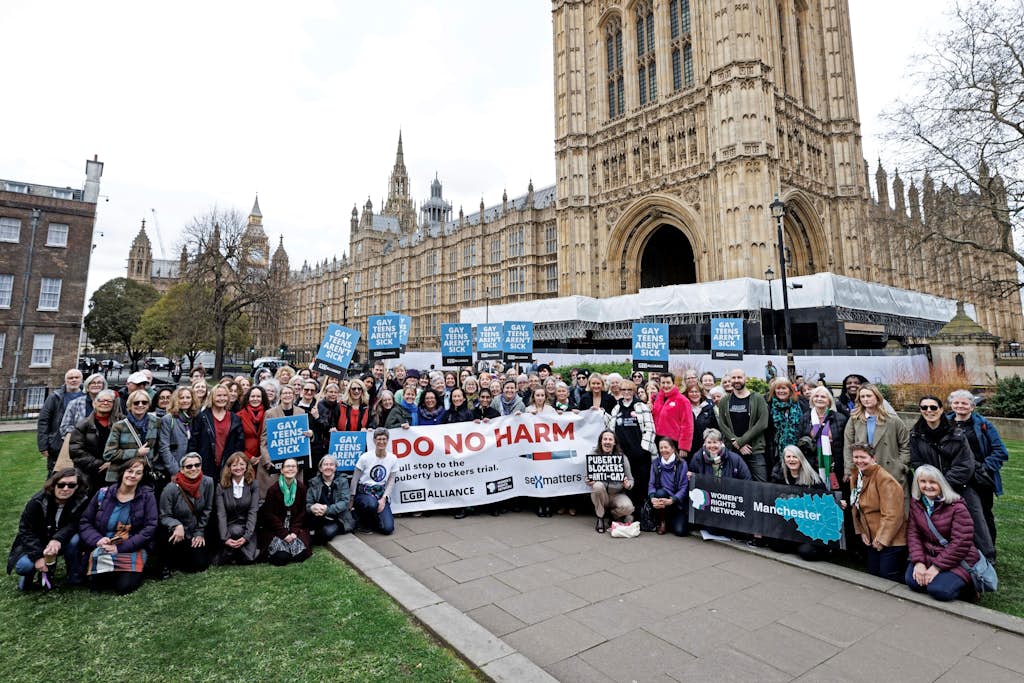
This is how I spent 10 March, with around 200 people coordinated by Women’s Rights Network, LGB Alliance and Sex Matters, the charity for which I work. We milled around Westminster Hall, our conversations punctuated by announcements that this or that MP was present and ready to talk.
Our topic was the trial of puberty blockers given permission to go ahead last year, only to be paused in February whilst regulators ask further questions about safety and ethics. We had three requests for MPs: that they call for data on children who have already taken puberty blockers to be analysed before any more are exposed; that they attend a parliamentary debate on the topic on March 23rd; and ultimately, that they agree that puberty blockers harm children and should be permanently banned.
A lobby day is a way of ensuring MPs register the strength of feeling on an issue. It’s one thing to sign a petition (one launched last January calling for the trial to be scrapped blew past the 100,000 signatures needed to trigger a parliamentary debate in just a couple of days). It’s quite another to trek into Westminster, queue for entry to the Houses of Parliament and hang around for hours, more in hope than expectation that your MP will come down to talk to you (mine didn’t bother).
A couple of hundred people willing to spend a day like this is a strong signal that the issue matters to a far larger cross-section of voters.
◉ ◉ ◉
A lobby day is not just a way to ensure MPs hear what their constituents are thinking; it’s a way to hear what MPs are thinking, too. Judging by the conversations I overheard, what they are thinking on this issue is that they cannot stand against the experts who support a trial.
Their instincts are the same as those of the general public, who oppose the trial by a margin of more than four to one. They know perfectly well that children are too young to know their own minds, and that adults should protect them from naive, impulsive decisions. As one MP said, he couldn’t understand how the trial had been approved, was delighted it had been paused and hoped regulators would bin it entirely. But if they didn’t, who was he to know better?
In part, this is because MPs are the quintessential generalists. If you talk to one, the person before you may have been complaining about rural bus services and the one after may be urging them to increase funding for special education. They must keep constituency activists happy enough that they are re-selected. And they must keep voters happy enough that they get re-elected.
But this is just an extreme version of a general problem. No MP can understand and pay attention to more than a tiny proportion of everything that must be decided. And so decisions are outsourced to institutions that are supposed to follow rules encoding widely shared and time-honoured preferences. What the puberty blocker trial shows is that, at least in health care, those institutions aren’t working.
An hour’s careful reading and some common sense is all it takes to understand that the puberty blocker trial is a scientific and ethical mess. It will keep tabs on about 200 children who disavow or dissociate from their sex for two years, with half starting on puberty blockers immediately and the other half starting a year later. Their progress will be tracked with a questionnaire designed to measure their day-to-day mood.
This design is in part because of the ubiquitous but false claim that puberty blockers are “life-saving”: the researchers feared that if the control group were denied blockers rather than merely made to wait they would drop out. But that propaganda is bound to create significant placebo and “nocebo” (reverse placebo) effects.
The children given puberty blockers immediately will be delighted; the ones made to wait will be distraught and then delighted. If the researchers had set out to create the largest possible difference in mood between those already on blockers and those still waiting, thereby making blockers look like a miracle cure for unhappiness, they could hardly have done better.
The researchers say that a trial is needed to disentangle the impact of blockers from that of cross-sex hormones, to which nearly every child who has already taken blockers proceeded. But that necessarily means looking only at short-term impact, when the serious worries — such as infertility and brittle bones — will not manifest for many years. That blockers are a gateway drug to cross-sex hormones is part of what makes them harmful: the effect of cross-sex hormones isn’t a confounder but an expected outcome.
In theory, the UK subjects medical research to rigorous scrutiny, with two national regulators, the Health Research Authority and the Medicines and Healthcare products Regulatory Agency (MHRA), plus 87 research ethics committees that examine individual proposals. So how did this elaborate set-up rubberstamp a trial so obviously flawed?
When responsibility is diffuse and the harms are delayed, people are more likely to do nothing
In part, perhaps, precisely because it is elaborate. When many bodies are responsible, nobody is. The famed “bystander effect” is often overstated — people do in fact come to the rescue of someone being attacked even when many others are watching. But when responsibility is diffuse and the harms are delayed, people are more likely to do nothing. Especially when acting means criticising your professional peers and putting your career at risk.
The puberty blockers trial is currently paused because Professor Jacob George, an eminent cardiologist who took over as the MHRA’s chief medical and scientific officer in January, raised the sorts of concerns his colleagues had previously ignored. Someone sent a handful of his old social media posts to journalists, in which he opposed the inclusion of trans-identifying men in women’s sports and praised J.K. Rowling. He was smeared as transphobic, and the MHRA recused him from further involvement in the trial.
◉ ◉ ◉
Just as ordinary people outsource their decision-making to institutions, those within institutions may outsource theirs to proceduralism. They do so trusting that the process is sound. But when trust is no longer warranted, the process may grind on.
The fringe belief that children can be born in the wrong body introduced a lie to the system for treating gender-distressed children, with the result that they get passed from GP to gender clinician to endocrinologist to surgeon, with everyone in the chain outsourcing their thinking to other people’s expertise and nobody taking responsibility for the catastrophic end point.
For blocking puberty is a unique proposition in medicine, in which the foreseeable damage is exactly the same as the intended outcome. For all the euphemisms about “gender affirmation”, the aim is to create eunuchs — eunuchs who will proceed from chemical castration to hormones and surgical interventions that make them look fairly like adult members of the opposite sex, but eunuchs all the same.
◉ ◉ ◉
Regulators in other sectors understand that ensuring costs and risks are explained clearly in ordinary language is part of their job. In finance, they insist that pension and mortgage contracts come with warnings that your investment may go down in value as well as up, and your home may be at risk if you fall behind on repayments.
If medicines regulation was working properly, puberty blockers would come with the warning that this product is designed to ensure that as an adult you will lack normal reproductive organs and be incapable of having children, and probably of reaching orgasm, too.
When institutions fail, Parliament is supposed to fix the rules that govern them. But too many politicians have lost faith in their moral intuition, or lost touch with it entirely. And so they listen to experts rather than the inner voice that their constituents hear loud and clear: the one that says adults who turn children into eunuchs are doing something monstrous.