This article is taken from the April 2026 issue of The Critic. To get the full magazine why not subscribe? Get five issues for just £5.
In late January, the Royal Institute of British Architects announced the winner of this year’s RIBA Gold Medal, awarded annually to a national or international architect — and an indication as to what type and style of architecture is most esteemed within the profession.

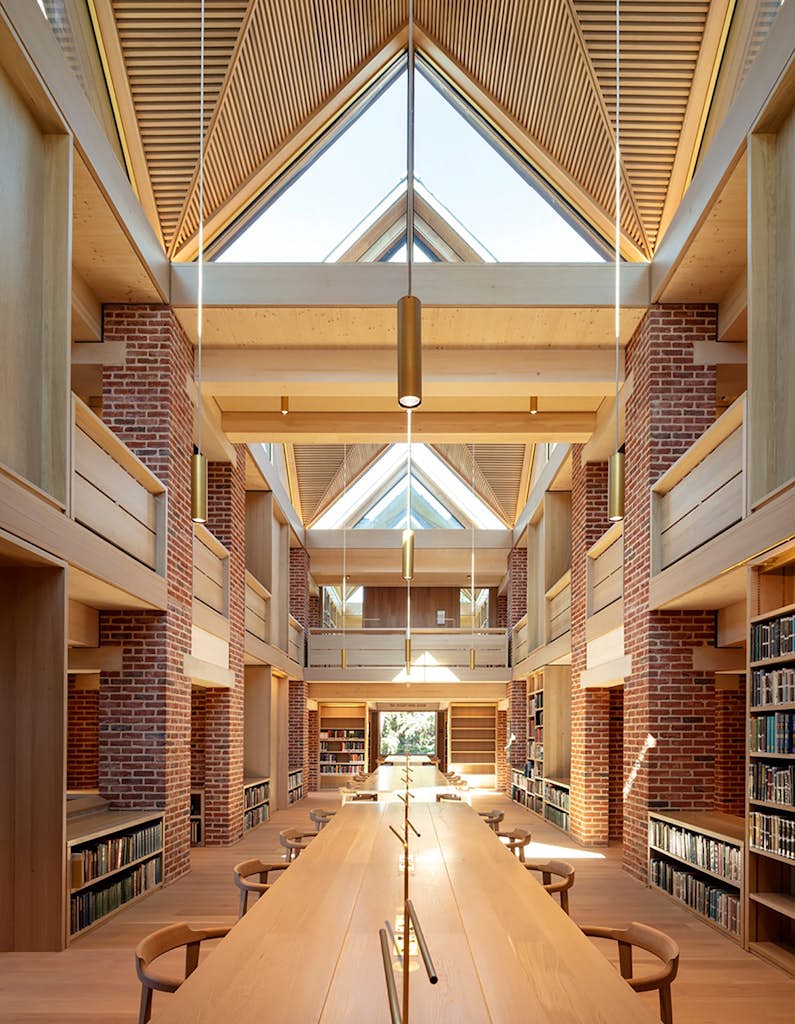
This year it was won by Níall McLaughlin, a softly spoken and independent-minded Irish architect responsible, amongst many other projects, for the wonderful brick-and-timber new library for Magdalene College, Cambridge, which opened in 2022 and won the Stirling Prize.
It is the third time that the Medal has been awarded to an Irish architect in the last eleven years. Sheila O’Donnell and John Tuomey won in 2015, the year after they had published a thoughtful book about not only their work, but their interest in Irish vernacular architecture and Italian rationalism.
As it happened, it was Níall McLaughlin, who had been taught by them at University College, Dublin, who wrote the citation for their award:
As a student, I remember hearing their declared intention to forge a new Irish architectural identity … the combination of Sheila’s quiet, studied rationalism and John’s fluent, rhetorical constructivism quickly made its mark. The best individual projects come as quieter reflections on their noisier ideas.
In 2020, the Gold Medal was won by Grafton Architects who also studied and have taught at University College, Dublin. Together with O’Donnell + Tuomey, they were involved with Group 91, responsible for the renovation of the Temple Bar district in Dublin in the early 1990s.
Like O’Donnell + Tuomey, they are deeply committed to using the highest quality materials in their buildings: “We have always been irritated by lack of respect for beautiful materials; people take ancient, incredible geology and use it in a cheap way that loses all its qualities.”
You get the picture. These Irish architects are much more interested in the materials of architecture and its history than those who have been trained in British schools of architecture.
McLaughlin wanted to be a writer before he decided to study architecture. As a student at University College, Dublin, he was not just interested in the work of Mies van der Rohe, but Seamus Heaney and Brunelleschi. At the time, this was a rebellion.
As he recalls: “My career as a designer began when I realized that Mies wasn’t the father I needed. He created a world in which everything was ordered according to a system of untouchable, universal truths. It reminded me of my Catholic childhood — you can’t be half a Catholic.”
After a short period working for Ireland’s biggest and most successful commercial practice, Scott Tallon Walker, he left to spend time, as he describes it, “just fecking about” which is probably what has contributed to the sense that he has a broad intellectual hinterland and that architecture is about ideas and symbolism, not just commercial practice.
For a long time he was a sole practitioner, teaching at Oxford Brookes University, a school of architecture which was unusual in not having a dominant orthodoxy, and at the Bartlett where he is still professor of architectural practice.
His early projects were experimental. He designed a photographer’s hide for bird-watching on an old US Air Force base in Northamptonshire which only cost £15,000 and has now been recommended for listing by the Twentieth Century Society.
In 1998, he won an award as Young Architect of the Year on the basis of a slender submission, but which caught the attention of the judges for its evidence of original thinking, his design for a tabernacle and sacristy for a Carmelite monastery in Kensington, and his attention to materials “from gold to Daz”. Three years later, he won a competition to design housing for the Peabody Trust in Silvertown.
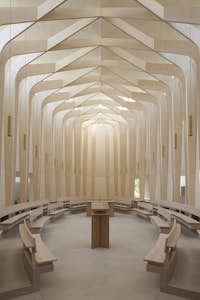
McLaughlin’s big break came when he won a competition to design a new chapel for Ripon Theological College in Cuddesdon outside Oxford, which required him to work closely with a small community of nuns attached to the college. This project enabled McLaughlin to give full rein to his interest in architectural symbolism.
He constructed an oval brick building on a lower slope in the grounds of G.E. Street’s theological college. Its exterior does not prepare one for the beauty and surprise of the complex, bleached-wood, lattice-work structure inside, which uses architectural complexity and light coming in from the attic storey to create a sense of the numinous.
The quality of McLaughlin’s work, its thoughtfulness, its attention to detail and quality of materials, has brought him to the attention of anyone who wants a seriousness of intent, a sense of longevity and a feeling for history in their buildings, including a great number of Oxbridge colleges and Jonathan Ruffer for his new Faith Museum at Bishop Auckland.
He won the competition to design the new library for Magdalene College, Cambridge in 2014. It is perhaps not an accident that his client at Magdalene was Rowan Williams, the former Archbishop of Canterbury, who wanted the building not to feel like a university building but collegiate.
Now, the quality of McLaughlin’s work has rightly been recognised by the award of the Royal Gold Medal. But his award makes one ask: why does the RIBA recognise and celebrate the best-quality work when it is done by Irish architects, but not do more to encourage the same level of interest in the vernacular, an allegiance to history and a sympathetic attention to the quality of materials in British architects?