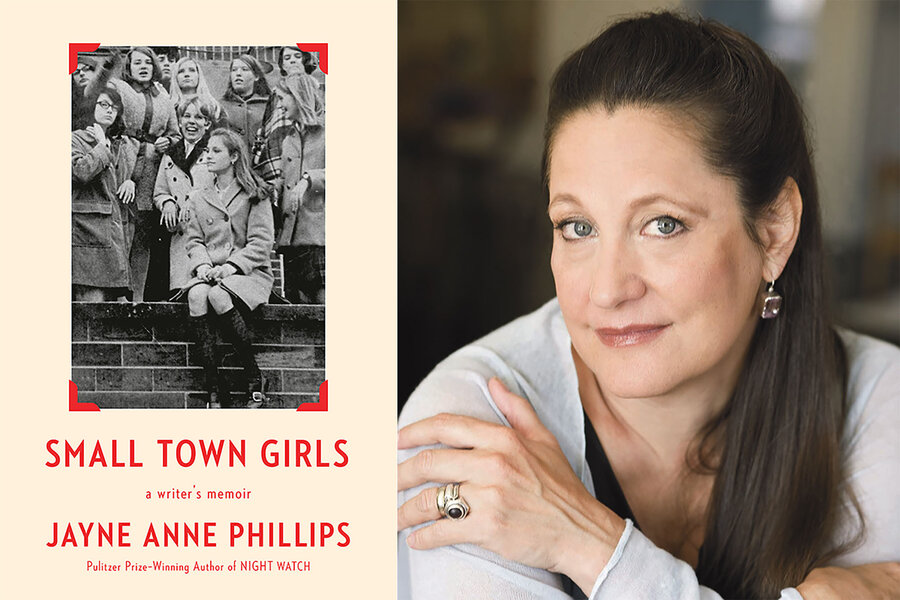
In her lovely, multifaceted memoir, Jayne Anne Phillips celebrates her hometown in the Allegheny Mountains of north central West Virginia. “Small Town Girls” offers a window into how her strong sense of place shaped her as a writer, and also pushes back against what she calls the “dark and dense” myths and stereotypes of deprivation that shadow the region.
“Hometowns are full of stories and memories rinsed with color,” Phillips writes in this radiant collection of 22 linked, autobiographical essays. “Understand: born and raised in West Virginia, you can never truly leave.”
Phillips grew up in the 1950s and 1960s in a brick ranch house designed by her father, Russell Randolph Phillips, on a rural road just outside the town of Buckhannon, the county seat of Upshur County. Relatives from both sides of her family had helped settle the area when it was still a territory. Her mother’s people, the Thornhills and Boyds, fought for the Union during the Civil War, while the Phillips men, who lived in Randolph County, just to the south, were Confederates. (West Virginia had seceded from Virginia to support the Union.)
Why We Wrote This
In the memoir “Small Town Girls,” Jayne Anne Phillips tells of the rural upbringing that set her on the path to becoming a writer. She also pays tribute to Southern authors who inspired her, such as Stephen Crane.
Both of Phillips’ parents made their mark on the town. Her father, a concrete contractor, built the sidewalks. Her mother, Martha Jane Thornhill Phillips, “a bit of a pioneer,” was a rare working mom who taught in the local elementary school while raising Phillips and her two brothers and taking classes toward a graduate degree. Phillips remembers her mother always grading papers and making sure her less fortunate students were fed and warmly clothed.
Phillips brings to this memoir the kind of resonant details and sharp insights that have enriched her fiction, from “Black Tickets” (1979) and “Machine Dreams” (1984) to her Pulitzer prize-winning 2023 novel, “Night Watch,” set in the aftermath of the Civil War. At once nostalgic and clear-eyed, Phillips’ mix of personal, family, and local history in “Small Town Girls” convincingly conveys why she finds Buckhannon “the perfect birthplace for a writer.”
Her father called her brothers by their names, but he called her “Miss.” She recalls puzzling over phrases like “Suffer the little children” in Bible school at their Methodist Church, and childhood summers that were “a long, spooled dream” shared with her brothers, who eventually moved deeper into the South as she moved north. They were physically active, while she “stood still, looking and listening,” a writer in the making.
Phillips brings understanding and empathy to her parents, whose “embattled” marriage ended as their children left home. She writes movingly, “The past is their story and their legacy.” She was her mother’s confidante and final caregiver, and recalls as an adolescent accompanying her mother to the beauty parlor for her mother’s weekly hair appointments. Later, she came to realize the importance of these rituals: “Girls need sanctums.”
Phillips’ gaze often extends beyond family; her roots are so entwined with local history that it is nearly impossible to disentangle them. In a chapter titled “Paradise Lost: West Virginia,” she traces how the isolated, verdant, mountainous land, long a “paradise for flora and fauna,” was compromised by the “mighty rivers” that fed it. “First came the timber barons, who finished cutting the giant trees and floated the wood to market on the rivers. Then came the coal companies, with their throbbing deep mines and company stores that turned men into indentured labor.” She particularly rues the desecration wrought by strip mines, mountaintop mining, and fracking, which began in the 1980s and ’90s.
A recap of the famous, long-running 1880s feud between the Hatfields and the McCoys is hard to follow, though Phillips makes clear that she finds the whole mess “yet another condescending variation of Appalachia bashing: observe the ignorant hillbillies killing one another over the ownership of a hog.”
There are multiple reminders of what drives Phillips as a writer. Her impassioned tributes to Breece D’J Pancake, from a small town in southwest West Virginia, and Stephen Crane, “America’s first rock-star writer,” are telling. Writers, she notes, are outsiders who “occupy a kind of border country, focused on the details that speak to us.” From this vantage point, they “defy time, writing words against the erasure of things and lives. We stand in an avalanche of forgetfulness, resisting the sway of disappearance.”
The payoff? “Writing, we cross the divide between self and others word by word.” With “Small Town Girls,” Phillips has once again crossed that divide – beautifully.