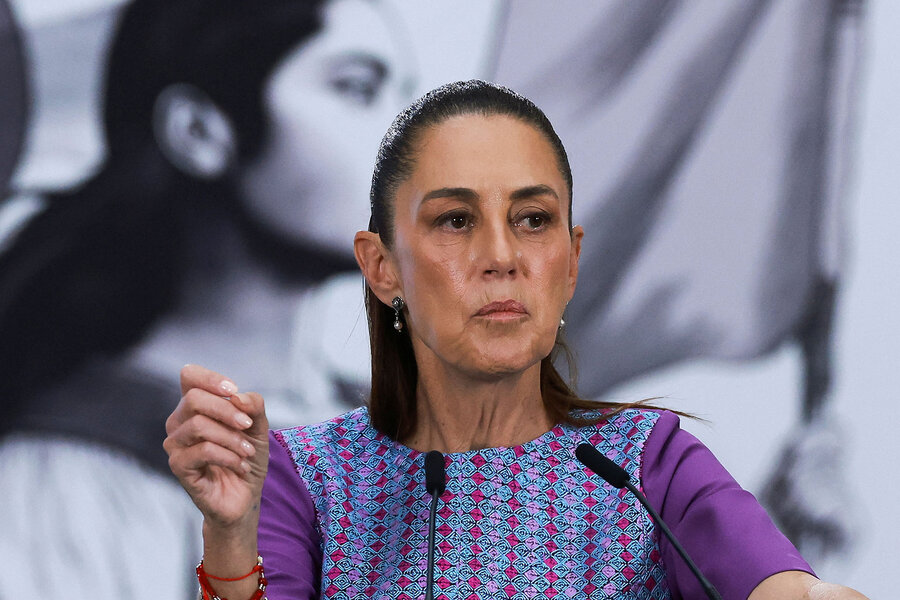
Mexico’s President Claudia Sheinbaum has spent the past year and a half since Donald Trump took office mastering a high-stakes balancing act, managing to satisfy both her constituents at home and her demanding neighbors to the north.
The United States’ indictment and extradition request for 10 Mexican government officials this week could throw that balance off kilter.
The charges from U.S. federal court in New York allege ties between the sitting governor of Sinaloa, Rubén Rocha Moya, and the Sinaloa drug cartel, which the U.S. designated as a terrorist organization last year. Nine other current and former Mexican officials are also named in the indictment on drug-related and weapons charges.
Why We Wrote This
The Trump administration has taken the rare step of charging a group of ruling-party Mexican officials in U.S. federal court. The move puts Mexico’s President Claudia Sheinbaum in a tough spot with her own political constituents.
On Thursday, Dr. Sheinbaum dismissed the idea of arresting or extraditing anyone named in the U.S. indictment, and she accused Washington of “meddling” in Mexico’s affairs.
The president said that Mexican prosecutors would conduct their own investigation to “determine whether there is evidence establishing that the allegations made by the U.S. authorities have a legal basis for requesting arrest warrants.”
If the evidence is not there, she added, it would be clear that these charges are politically motivated.
It is incredibly rare for the U.S. to charge a sitting Mexican official in U.S. court.
Mexican politicians frequently accuse their opponents of being “narco-politicians,” and last year a convicted Mexican drug lord Ismael “El Mayo” Zambada testified in U.S. federal court that he bribed politicians, police, and military officials to “operate freely” in Mexico. In June 2025, Reuters reported the U.S. had repeatedly pressured Mexico to investigate – and possibly extradite – politicians suspected of cartel ties, something that Mexico’s government has denied.
President Trump has called on Mexico to do more to confront the drug cartels that send narcotics across the border into U.S. cities and towns. He has even threatened to carry out U.S. military strikes against drug targets inside Mexico.
National sovereignty, particularly as it relates to the United States, is historically important in Mexico and plays a central role in the current government’s approach to foreign policy. Complicating matters in this case, Mr. Rocha Moya is a close ally of Mexico’s former president – and Dr. Sheinbaum’s political mentor – Andrés Manuel López Obrador. All three of them belong to the ruling Morena political party. Dr. Sheinbaum is now facing one of her most consequential decisions as president in how she responds to U.S. demands for extradition.

David Gaspar/Reuters/File
“There is no way out of this for Claudia Sheinbaum,” says Carlos Peréz Ricart, professor of international relations at the Center for Research and Economic Education in Mexico City. “Even if you give the U.S. what it wants, you can see from the past months that Trump will just ask for more. There is no limit.”
‘A shot across the bow’
Mr. Rocha Moya has been governor of the northwestern state of Sinaloa since November 2021. It’s a state that’s long served as a hub for drug trafficking – and more recently synthetic drug production – and the governor has faced accusations of ties to the powerful, home-grown Sinaloa Cartel since taking office.
The U.S. indictment alleges Mr. Rocha Moya was successfully elected governor with the help of the children of Sinaloa Cartel kingpin Joaquin “El Chapo” Guzman Loera. They allegedly kidnapped and intimidated Mr. Rocha Moya’s rivals in exchange for promised impunity for drug trafficking activities.
The governor denied the allegations on social media, writing they lack “any truth or foundation whatsoever.” He framed the indictment as an attack against the Fourth Transformation, as the ruling party’s leftist movement is known.
“The Sinaloa cartel, and other drug trafficking organizations like it, would not operate as freely or successfully without corrupt politicians and law enforcement officials on their payroll,” U.S. Attorney for the Southern District of New York Jay Clayton said in a statement on Wednesday.
Former Mexican Ambassador to the U.S. Arturo Sarukhan says he believes this indictment has been ready for months. “The U.S. government had likely been putting it on hold because they regarded their security cooperation with Mexico as inching forward and progressing,” he told The Christian Science Monitor via email.
What likely triggered the decision to indict, he says, was the Mexican government’s response to the death of two CIA agents in the state of Chihuahua in mid-April. The Mexican president questioned the legality of the presence of the officers during a successful operation against synthetic-drug labs.
“The indictment is a shot across the bow for the Mexican government,” says Ambassador Sarukhan, who expects other indictments could be forthcoming – targeting even higher-level politicians in Mexico.
A challenge for Mexico’s popular president
President Sheinbaum has made a name for herself as something of a Trump whisperer, repeatedly weathering his threats of new tariffs and possible U.S. military action. She has also managed to maintain strong support with voters, with some polls showing her with 70% approval ratings.

Observers say there is no doubt there are officials across the Mexican political spectrum guilty of corruption or who have ties to drug cartels, which exert outsized power in several Mexican states. But the political costs here of launching an investigation into her fellow party members are high. It could risk splintering the Morena party or jeopardize its success in future elections.
“It is very difficult for President Claudia Sheinbaum to convince leaders of her Morena party that political allies must be prosecuted,” even if it’s clear they are “bought off by the drug cartels,” says David Saucedo, a Mexican political analyst and public security specialist.
But, he says, it’s not unheard of. Between 2012 and 2018, former President Enrique Peña Nieto’s government arrested, investigated, and imprisoned several state governors – many from his own Institutional Revolutionary Party – on charges of corruption, embezzlement, and alleged links to organized crime.
A rapid poll by Mexican pollster Massive Caller this week found that more than 70% of respondents believe Gov. Rocha Moya is guilty of narco-trafficking. Almost 80% said he should be extradited to the U.S.
But Mr. Saucedo warns that the public’s desire to see tougher action against the drug cartels only goes so far. “When you ask Mexicans if they agree with U.S. intervention, they’re still against it … There’s love and hate toward Americans, it’s a strange mix of feelings.”
With the renegotiation of the U.S.-Mexico-Canada (USMCA) trade agreement coming up this summer, Dr. Pérez Ricart sees these indictments as a glaring power play.
“This is the Trump manual of politics: Leverage, leverage, leverage that can be used in all possible contexts,” he says. “It’s a chance to show Sheinbaum that the U.S. holds all the power … Though I do recognize it’s impunity inside Mexico that gives the U.S. the tools to intervene. Without impunity Trump would have less arguments to do these things.”
Some here believe the U.S. pressure on Mexico is the only way to create change around corruption and impunity, after so many years of the cartels stretching their tentacles into the political arena. But the tools for combating impunity aren’t provided through a U.S. extradition. And even if Gov. Rocha Moya ends up in the U.S. justice system, “they aren’t going to try him with Mexico’s interests in mind,” says Mr. Saucedo, who says he’d expect the politician to take a plea deal for a shortened sentence.
In a press conference this morning, President Sheinbaum said news outlets are reporting that the U.S. is “‘putting the president’s back against the wall.’ That’s false. In Mexico, it’s the Mexicans who decide.”
As Dr. Sheinbaum buys time with her pledge to investigate Mexican officials named in the U.S. indictment, her options for a quick resolution are limited, observers say. Allowing U.S. extraditions from Sinaloa could establish a dangerous precedent – and potentially sow chaos within Morena. But escalating a face-off with the U.S. is not likely to fall in her favor, either.
The path ahead as Ambassador Sarukhan sees it “means sacrificing Rocha for [Morena’s] greater interest and also Teflon-coating the on-going USMCA review.” But, he says, it’s a direction Dr. Sheinbaum “probably won’t take.”
“This means we are headed for a scenario where existing cooperation might collapse, and the Trump Administration decides to pursue unilateral policies without coordinating and engaging with Mexico.”