The small matter of a spike-topped embassy wall was never going to stand in their way. Not when, in the eyes of this group of desperate young African men, the 10ft-high wall represented the last remaining obstacle between them and staying in Europe.
Only months earlier, after all, they had overcome a more challenging hurdle. Namely, the perilous Atlantic.
And so, to ragged cheers and clapping at just after 10am on Tuesday, dozens of migrants invaded the Gambian Embassy in the quiet residential district of La Concepcion in Madrid.
Some scaled the wall with the ease of gymnasts, dropping into the courtyard below which, strictly speaking, put them not in Europe but in a little corner of their own West African country. No matter.
One young man, Bakary, would later complain of both breaking his finger on the wall and, more bitterly, of having paid the train fare from Seville only to be turned away without the paperwork he needed to legitimise his life in Spain.
Riot police were summoned and peace was quickly restored without arrests. Everyone settled down and an orderly queue formed.
If Bakary was inviting sympathy for his predicament, he found it in short supply in tree-lined Hernandez Iglesias Street, whose residents watched the extraordinary spectacle at the terracotta-roofed embassy with a mixture of awed wonder and mild disgust.
‘Everyone gets frustrated by the workings of bureaucracy,’ said Anna, an architectural engineer who was walking her daughter to school. ‘But these migrants have won the lottery. All they need to do is wait patiently for the prize, not behave like crazies. Normally, we rarely see any activity at this embassy. This is awful.’

This is the image that shows the folly of Spain’s socialist experiment to grant amnesty to 500,000 illegal migrants as dozens invade the Gambian Embassy in Madrid

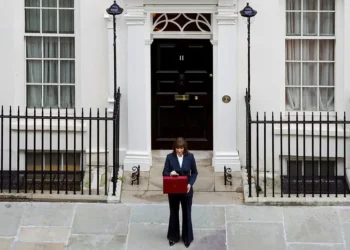
Spain’s prime minister Pedro Sanchez at a press conference at La Moncloa Palace in Madrid
The ‘prize’ to which she referred is socialist prime minister Pedro Sanchez’s controversial migrant amnesty.
For in an act of munificence causing something of a backlash here, Sanchez is granting residency status to half a million illegal and undocumented foreigners. He insists it will boost the economy and make Spain a happy place to live for everyone, whatever their ethnicity.
Well, that’s the plan.
The amnesty is in effect from April 17 until June 30 after Mr Sanchez made it law by decree, bypassing a vote in parliament. It offers a one-year, renewable residence permit to those who are able to prove they have been in Spain for five months and have a clean criminal record.
This was the paperwork Bakary and his friends were pursuing on Tuesday – only to be frustrated after queuing from the early hours, when they were told there were no more appointments that day.
To many Spaniards, the Gambian Embassy invasion was a vivid expression of an unworkable plan.
Miguel Angel García Martin, a spokesman for Madrid’s regional government, said: ‘We are concerned because we are giving an image of a country that is in complete chaos, a regularisation process that was flawed from the start.’ He added that the scramble was ‘overwhelming the services of many municipalities’.
Meanwhile, Alberto Nunez Feijoo, president of Spain’s conservative People’s Party, called the plan a reward by socialists for ‘illegality’.
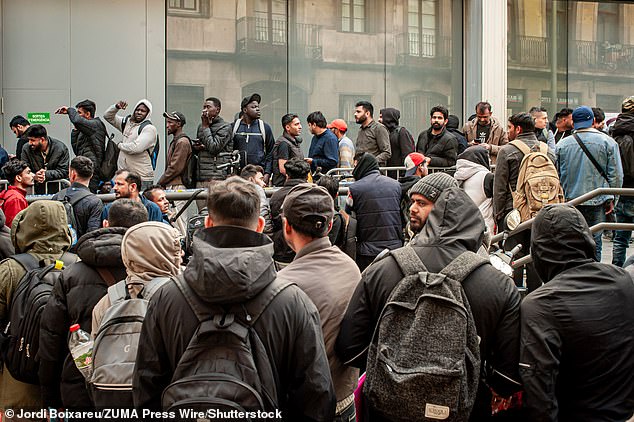
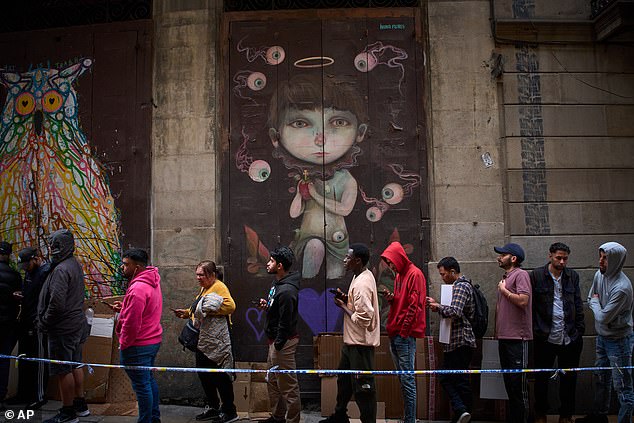
Migrants line up in the Gothic Quarter of Barcelona as they seek assistance with migrant regularisation documents and procedures promoted by the Spanish government
No sooner had police repelled the embassy invasion than reports surfaced of more trouble further afield as thousands rushed to finalise their paperwork.
Police struggled to contain a mass brawl among queuing migrants in Murcia on the southeastern coast, with officials blaming the chaos on an overburdened system. ‘We were expecting this, and now we’re starting to see the first problems,’ said a police spokesman.
It was also reported that hundreds of migrants might have obtained legal status without providing a criminal record certificate because clerks dealing with their applications used a training manual containing errors.
Municipal unions in Seville, meanwhile, warned that ‘extraordinary pressure’ and overcrowding are creating high tension among staff and public.
Unions are pleading for more staff, more security and compensation for workers forced to face the chaos.
‘We’ve gone from 1,500 daily requests at social services centres to 5,500. I think a hasty decision was made, perhaps even intended to create a collapse,’ said union representative Jose Fernandez.
He revealed that Mr Sanchez’s policy was launched ‘without consulting the relevant authorities’, adding: ‘The best course of action would be to withdraw this decree and implement it through consensus.’
The amnesty has divided opinion overall – with many concluding, somewhat inevitably, that Spain will now attract even more migrants.
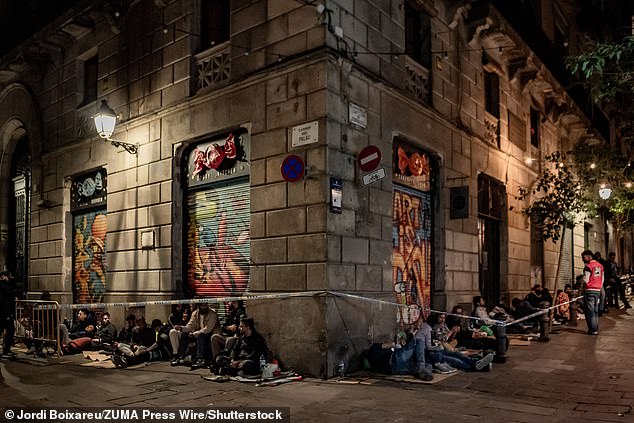
People wait overnight in line in Barcelona’s Gothic Quarter ahead of the opening of citizen service offices, seeking assistance with migrant regularisation procedures
Spain stands alone in accepting migrants with open arms, as other front-line nations struggle to stop the never-ending influx into Europe from North Africa, sub-Saharan Africa and the Middle East.
The country received a record 63,000 illegals in 2024, many arriving at the Spanish-owned Balearic Islands – Mallorca, Menorca and Ibiza.
Some of the newcomers hail from Spanish-speaking Latin American nations, such as Colombia, Peru and Ecuador. Now, of the country’s 49million population, nearly one in five was born abroad.
But while the Spanish public has traditionally taken a liberal approach to the incomers, a poll commissioned by the Left-wing El Pais newspaper found that 57 per cent currently believe there is ‘too much’ immigration.
While Mr Sanchez is lowering his drawbridge, other European countries are pulling theirs up, exploring and implementing increasingly tough measures to tackle the numbers of migrant arrivals.
France has more than 1,200 gendarmes stationed along its coast seven days a week to deter migrants – a measure partly funded by the UK Government.
Last year, a UK-France treaty came into force under which anyone entering Britain on a small boat can be detained and returned to France – the so-called ‘one in, one out’ scheme.
This is separate from the latest £662million three-year agreement with the French authorities, which aims to stop migrants in France boarding small boats in the first place.
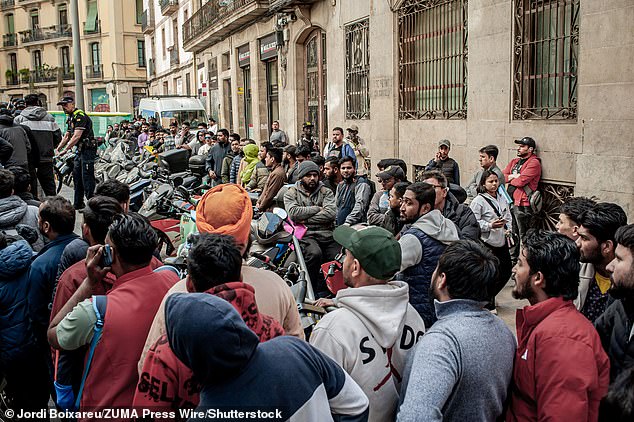
The Spanish public has traditionally taken a liberal approach to the incomers
In Italy, asylum seekers face restricted access to reception services – food, accommodation, legal help and healthcare – if they submit their applications more than 90 days after arriving in the country. And the high numbers of migrants arriving in Italy, where 158,610 people claimed asylum last year, have fuelled the popularity of the country’s far-Right parties.
In Greece, the parliament passed a law last September toughening penalties for rejected asylum seekers and speeding up returns to their home countries.
All this matters not a jot to Mr Sanchez who, relishing his outlier reputation, is banking on the amnesty to rescue his scandal-hit premiership before elections next year.
‘Some say we’ve gone too far, that we’re going against the current,’ Mr Sanchez said. ‘But I would like to ask you, when did recognising rights become something radical? When did empathy become exceptional?’
His allies claim the policy is admired by European counterparts, who cannot take similar steps because migration is so politically toxic.
They point out that those being offered the deal already work in Spain and once made legal will begin paying taxes as well as social security contributions. As such, they will supposedly benefit the economy.
Even if this is true, critics argue, there are more pressing matters to consider.
With the EU scrambling to tighten borders amid criticism from Donald Trump’s US administration, some have warned that those seizing the chance for residency will not stay in Spain but slip through to the rest of Europe.
In Spain, some 2.3million of the 9.4million foreign-born residents in the country arrived in the two years before 2025
Worried about the future consequences for free movement – amid mounting concern about its viability – EU officials have warned the amnesty is not a ‘blank cheque’ for living in other EU countries.
Hardening its stance on migration, the European Parliament voted to stop ‘asylum shopping’.
This is a cynical practice where the migrant chooses where they wish to claim refugee status instead of asking for asylum in the first EU nation they enter. The bloc plans to transfer these ‘cherry-picking’ opportunists back home or to third countries that ‘meet international standards’ outside the EU – naming Bangladesh, Colombia, Egypt, India, Kosovo, Morocco and Tunisia as options.
Here in Spain, however, the migrant traffic is all one way. Some 2.3million of the 9.4million foreign-born residents in the country arrived in the two years before 2025.
The People’s Party, which has recently made migration a key policy as it seeks to win back power in next year’s general election, called the rise ‘unsustainable’.
It also notes that since Mr Sanchez came to power in 2018, the number of asylum applications has risen 167 per cent.
In the same period, the number of expulsions of illegal migrants has fallen by 5 per cent.
Although the government says about 500,000 migrants could get legal status under the scheme, the Spanish police unit which deals with matters concerning foreigners estimates that 1.35million migrants could apply for regularisation.
‘It’s no surprise we are being swamped,’ a police source told the Daily Mail yesterday. ‘Or that tensions start running high. These people have a chance of a lifetime dangling before them and they are desperate to take it.’
The day after the embassy invasion, all was quiet on Hernandez Iglesias Street. Blue-and-white tape, turning in the light breeze, urged migrants ‘not to cross the police line’.
‘It’s quiet for now,’ said a man walking his dog, ‘but let’s see how long it lasts.’