Surender Singh Negi moved from a remote Himalayan town to Delhi in 1987 – young, energetic, and by his own admission, “somewhat clueless.” He was drawn to the big city – but also to a bigger paycheck. He landed a job as an accountant at a pharmaceutical firm, placing himself firmly inside a burgeoning middle class.
Mr. Negi, who didn’t attend college, was able to purchase a three-bedroom apartment in East Delhi. There, he and his wife raised three children and put each of them through college.
One of them, Akhil Negi, lives in that same family home. He works as a software engineer for an IT company, earning around 160,000 rupees ($1,700) a month – compared to the 7,000 monthly rupees his father made at the same age. In fact, his salary is almost double what his father earned before he retired after nearly 35 years working.
Why We Wrote This
Around the globe, many people in the middle class are earning higher salaries. But they’re also feeling like they can’t afford the things their parents once could, whether that’s in Europe, Latin America, or South Asia.
Yet buying a decent home in the Indian capital today feels like a distant dream for the younger Mr. Negi, who is getting married later this year. He and his wife plan to move into a rented apartment instead. “Apparently, I earn a huge salary compared to what my dad was earning at my age, but it’s simply not enough,” says Mr. Negi at the family home, a third-floor walk-up. “It will take me years to save for a down payment, and then I’ll be tied to a loan for decades.”
It’s a conundrum felt by members of the middle class around the world: From Nigeria to Venezuela, families feel they are struggling – not just to get ahead, but to simply make ends meet. Plenty of people in the United States, where rents and housing prices have climbed faster than median incomes, can relate. Lack of job opportunities drove recent youth-led protests that toppled governments in Nepal and Bangladesh. Now, the Iran war is driving up gas prices and transit fares in countries across the globe, exacerbating the affordability issue for millions.
In February, a first-of-its kind survey of 107 countries’ national priorities by the global polling firm Gallup found that a median of 26% of adults cited economic issues as their top concern. If you include respondents who said they are most worried about employment, the total rises to 36%. Economic worries outweighed political, security, social, and environmental issues combined.

But there’s a disconnect between these concerns over cost of living, and what economists are observing globally.
“In most of the world, the middle class is actually getting richer and can actually afford more things,” says Homi Kharas, senior fellow at The Brookings Institution and author of “The Rise of the Global Middle Class: How the Search for the Good Life Can Change the World.”
Global inflation has declined since its 2022 peak, and the global middle class is growing – with India and China leading the pack. By 2030, India is set to have up to 700 million people in its middle class, making the country a huge force driving the world economy.
Yet in India, where middle class incomes have risen sharply, financial security still feels increasingly elusive to many. A lot of Indians say they feel poorer than members of their parents’ generation, despite earning more.
“What the squeeze is showing is that the middle class is also increasingly worried about volatility and shocks. … They’re concerned about whether they’ll be able in the future to sustain the same kind of standard of living,” explains Dr. Kharas. “It’s [about] expectations, it’s stability, and it’s security.”

Vipin Kumar/Hindustan Times/Sipa USA/Reuters
What does it mean to be middle class?
The definition of “middle class” changes depending on who you ask.
Gallup allows people to self-identify their social class. The Pew Research Center defines the middle class in relative terms, as households whose annual income is two-thirds to double the national median. Dr. Kharas – who co-founded the World Data Lab, which forecasts detailed consumer and demographic trends – looks at spending rather than income.
“I actually think it’s easier to define what’s not in the middle class … because it’s such a heterogeneous group,” he says.
The rich have so much expendable income that they don’t really need to think about how they spend it. The poor simply don’t have the luxury, with most of their money going toward baseline necessities. “And the middle class are actually the people who are making what I would call ‘economic choices,’” he explains. “They have a certain budget constraint, they have some discretionary spending, and they basically are making constant choices about what to do with that discretionary money.”

More than half the world’s population, the global middle class makes choices that shape regional and global economies.
Yet it is a relatively new demographic. In his book, Dr. Kharas traces the global middle-class roots back to Victorian England, when the Industrial Revolution transformed the economy and created a need for middle-tier workers – such as factory managers, accountants, or engineers – that were neither laborers nor aristocracy. Post-World War II economic growth expanded the middle class in Europe and the United States, with many economists and historians describing the 1940s-70s period as the “golden age” of America’s middle class. But from a global standpoint, this was just the beginning.
Over the next few decades, the rise of the digital economy, urbanization, the globalization of trade, and economic liberalization propelled the middle class forward across the Global South – especially in Asia.
By 2030, two out of every three members of the global middle class will reside in Asia.
All are searching for what Dr. Kharas describes as “the good life.” And a fundamental part of that, valued across cultures and throughout time, is stable housing. But it’s getting harder to come by.

“Global housing mismatch”
In the Netherlands, Portugal, and other European countries, surging home prices have been linked to the rise of far-right populism. A lack of affordable housing in Seoul has been blamed in part for South Korea’s declining birth rates. Meanwhile, in the U.S., demand for housing is outpacing supply, pushing up costs and deferring home ownership. Last year, the median age of first-time homebuyers reached a record high of 40, according to the National Association of Realtors.
This is all part of what the World Economic Forum calls the “global housing mismatch.” And it’s apparent in cities such as Delhi and Mumbai, which rank among the least affordable housing markets in India. Home prices there cost an estimated 10 to 14 times average annual household incomes, according to a 2024 analysis by the Indian real estate platform Magicbricks. Their analysts say that’s more than double the globally accepted benchmark for affordable housing. Monthly mortgage payments can consume up to 40%-50% of household income.
“In India, housing is increasingly built with a speculative intent – it’s produced to sell, not necessarily to live in,” says Mukta Naik, a fellow at Sustainable Futures Collaborative, a research organization based in Delhi. Uneven urbanization and artificial land scarcities continue to push prices upward, she explains, pointing to large tracts held by public agencies and limited release for development.
Meanwhile, India faces an urban housing shortage of roughly 10 million units, which could reach 30 million by 2030, while new supply is increasingly skewed toward premium housing. Rents are also rising, adding to the pressure. Residential rents in major Indian cities have increased by about 7% to 9% in 2025, following even steeper annual hikes of 12% to 24% between 2021 and 2024.
Nowadays, people move to cities for better jobs, only to find that the cost of housing erodes much of their income gains. The system forces families into trade-offs between the costs of rent, commuting, and quality of life.
“It’s a nightmare,” says Mr. Negi’s father. “Had I known there would be such bad crises in future, I would have bought a bigger house, and I could have afforded it.”

Cost of living grows
Housing is just one pressure the middle class faces. In their recently released book “Breakpoint: The Crisis of the Middle Class and the Future of Work,” Saurabh Mukherjea and Nandita Rajhansa argue that the cost of living for India’s middle class is effectively doubling every eight years – far outpacing income growth for many households.
“When I look at my monthly expenses, I’m surprised,” says Mr. Negi, who is still paying off a Japanese SUV he bought two years ago. “Everything is costly.”
This is backed up by data. A home-cooked vegetarian meal now costs about 11% more year on year, according to a recent analysis by The Hindu. Medical inflation, at around 14% annually, is among the highest in Asia. Schooling has become yet another major expense as families seek better opportunities for their children in an increasingly competitive economy. Private school fees have risen by roughly 60% in just three years.
At the same time, household debt is rising. More than half of Indian families have taken personal loans, and a growing share of borrowers are under age 30. For many, debt servicing takes up a significant portion of income, leaving less room for savings or asset building.
These numbers haven’t significantly affected political polling. India’s Prime Minister Narendra Modi, in power for nearly 12 years, draws a significant share of his support from India’s middle class, which continues to express a degree of optimism about the economy. Many supporters attribute their financial strains to the legacy of previous governments or to global disruptions, rather than to current policy. But the pressures are reshaping how middle-class families allocate income.
“Earlier, housing was the one big investment households made,” says Dr. Naik. “Now it has to compete with spending on education and other aspirations.”
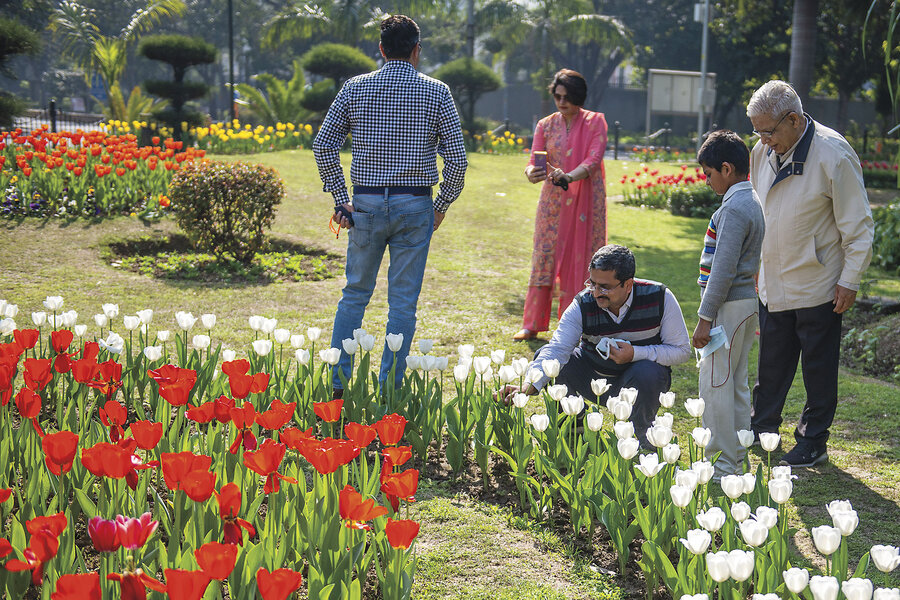
Adeeb Anwar, who is in his early 30s and lives with his wife and parents in a congested neighborhood in south Delhi, says even small apartments have become too expensive.
“My father managed to raise children and buy a house. For me, just having children and sending them to school will make things harder,” says the University of Delhi graduate, who works as a cinematographer.
After researching the market, Mr. Anwar estimates it would take him at least five years to save for a down payment at his current income level. Adding a mortgage on to that feels daunting to him. “It’s scary to think about the kind of stress that would bring,” he says.

Economic perceptions
Gallup found that positive, national growth statistics do little to assuage such fears – people in countries that were experiencing massive GDP growth were just as likely to name economic issues as their country’s biggest problem.
“This disconnect between macroeconomic indicators and public perception,” the report says, “suggests that people judge national economic progress based on whether they feel secure and able to live well on their household income.”
Within India, one of the world’s most rapidly growing economies, the data paints a complicated picture. A 2023 Gallup poll showed Indians were more optimistic about their economic future than people surveyed in comparable economies, like the U.S., Germany, and Japan. Recent consumer spending data backs that up.
But the 2026 Ipsos Happiness Report tells a different story. India dropped 16 percentage points from last year’s report, with financial insecurity being the top reason driving unhappiness.
A growing mismatch between education and jobs is adding to this insecurity. Nearly 40% of young graduates in India are unemployed, and fewer than 1 in 10 secure a stable salaried job soon after graduation, according to the State of Working India 2026 report by Azim Premji University. And the threat of artificial intelligence looms large.
“People are terrified by AI and what AI is going to do to the middle class,” says Dr. Kharas. “Historically, technological change has replaced what people have crudely called ‘brawn,’” or physical labor. Now, it’s coming after “brain,” too.
That’s rattled India’s IT sector, an engine of India’s middle class growth and the industry in which Mr. Negi, the son, works. It also has people questioning the value of education, which was once seen as a basic ladder to middle-class life, but is becoming increasingly expensive.
In many countries, students are asking: “‘Is this a good investment or not?’ And the answer to that, which 10 years ago was a no-brainer, is no longer a no-brainer,” says Dr. Kharas.
This uncertainty complicates long-term financial decisions. For an earlier generation, the senior Mr. Negi argues that the pathway to middle-class stability was relatively clear and easy: Secure a stable job, buy a home, educate children, and build modest savings.
For many younger Indians, including his son, the aspiration remains the same, but the economics behind it have fundamentally shifted. It has Mr. Negi thinking about his father’s hometown of Chinyalisaur, a quiet hamlet along the banks of the Bhagirathi river, en route to several Hindu pilgrimage sites. Most residents rely on farming, growing rice, wheat, and millets on terraced fields carved into the hillsides.
“With each passing day, it feels increasingly difficult for me to have my own house,” he says with a sigh. “Maybe I will keep a savings till I retire and then buy one affordable in some remote part [of India] and live there. Maybe in the town where my father came from.”