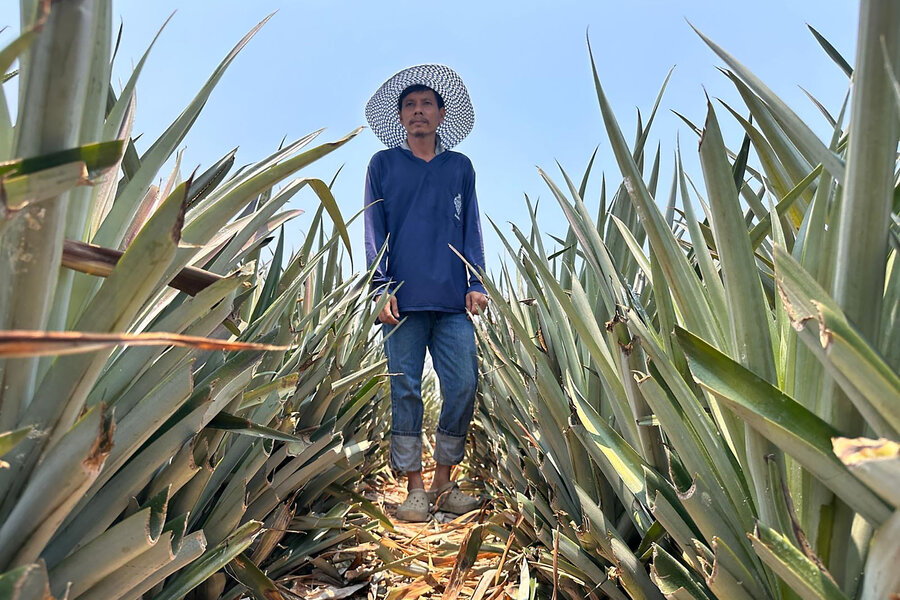
Pineapples that will one day become pizza toppings or sweeten morning smoothies for Americans begin life here.
They grow in Thailand’s sandy loam, tended by farmhands wearing industrial rubber gloves, lest they nick themselves on the fruit’s bladed leaves. Once harvested, they’re exported to the United States, which typically consumes more canned pineapple from Thailand than from any other country.
On a recent April morning, farmers walk these rows tossing ample handfuls of tiny white pellets called urea – the world’s most widely used chemical fertilizer. Each pellet is packed with nitrogen, which boosts photosynthesis to make plants grow bigger and faster. But the Southeast Asian croplands that feed the world now face a fertilizer crisis. Urea has become expensive and harder to find.
Why We Wrote This
American consumers buy many agricultural products from Southeast Asia, where farmers are dealing with a fertilizer shortage because of the Iran war. Crop yields are expected to suffer this year and eventually, U.S. shoppers will feel the impact.
The fertilizer’s nitrogen comes from natural gas, much of it drilled from gas fields in the Middle East. Factories in the region typically synthesize fertilizer, then ship it out through the Strait of Hormuz. Chaos in the strait, following the U.S.-Israeli war against Iran, is preventing millions of tons of fertilizer from reaching farmers across the planet. As urea prices soar as much as 50% higher than prewar levels, many farmers risk bankruptcy if they don’t improvise.
“Chicken droppings,” says Likit Maekayai, whose family owns about 80 acres of pineapple fields in Sam Roi Yot, a coastal district in Thailand. “We’re augmenting our remaining stockpile of chemical fertilizer with chicken droppings. That’s all we can do.”

Chaiwat Subprasom/NurPhoto/AP
Chicken manure does not come close to matching the potency of urea. This year’s pineapple crop will be stunted and Mr. Likit’s family is expecting lower profits as a result. But it could be worse, the farmer says. Because fertilizer can swallow up half of a farm’s operating costs – whether the crop is rice, coffee, bananas, or pineapples – many farmers in this part of the world are already underwater.
“I’m seeing people getting their trucks repossessed,” Mr. Likit says. If shipping traffic in the strait stays unpredictable for months on end, his family farm could suffer the same fate.
Pineapples are only a microcosm in this worldwide fertilizer crisis. About one-third of all fertilizer comes through the Strait of Hormuz. Removing it from the marketplace jacks up the price of all urea, no matter its origin. Roughly 2 billion people rely on food from small-scale farms, according to the World Bank, and the majority of those use chemical fertilizer to squeeze the most output possible from their tiny plots. The poorest populations in parts of the globe, who get by on razor-thin margins, will be at risk of severe hunger this year, according to experts.
The impact will be felt beyond the developing world, however. American supermarkets are chock-full of stuff grown by Southeast Asian farmers. Some goods are obviously from Asia – coffee from the Indonesian island of Sumatra, rice from Vietnam – but many are not. Few U.S. suburbanites are aware of the fact that their car tires, sneakers, and the elastic in their underwear all likely contain rubber tapped from Southeast Asian trees, which also rely on heaps of fertilizer.
But no Southeast Asian crop is more omnipresent than palm oil, found in nearly half of all packaged products: peanut butter, baby formula, hand soap, and much more. In Indonesia alone, palm oil plantations cover an area the size of Florida. These trees grow year-round and, to keep them flourishing, farmers constantly sprinkle white urea pellets at their base.
“No one expected this war to happen,” says Sathia Varqa, a Singapore-based palm oil expert and senior analyst with the Fastmarkets analytics firm. “That means palm plantations don’t have large stocks [of fertilizer]” and must ration what they have.
Palm is a plum-sized fruit, vermilion in color, that yields a thick oil when pressed. Less fertilizer means smaller fruit. Smaller fruit means less palm oil in the marketplace and inevitable price spikes.

Sutanta Aditya/Abaca/Sipa/AP/File
Corporations that need palm oil to make detergent, cookies, or other basic goods won’t be likely to eat the extra cost. “They will pass it on, of course,” Dr. Varqa says. And the longer the Strait of Hormuz remains closed, or even semiclosed, the higher grocery bills will rise.
Prices won’t shoot up immediately. Such disruptions travel through supply pipelines like slow-moving air bubbles. Dr. Varqa says he expects shoppers might see goods grow more expensive in “the first half of 2027.” For now, anxiety over the fertilizer crisis is felt principally in countries that grow what the world consumes.
Food shocks reverberate into politics, too, sometimes in unexpected ways. Suchart Pinthong is a Thai truck driver whose online video rants about postwar prices – of fuel, fertilizer, and basic essentials – have gone viral on social media. He doesn’t focus his rage on America or Israel but rather political forces closer to home. Thailand’s leadership, he says, should have anticipated the war somehow and built up stockpiles to protect the poor from bankruptcy.
“I pray all the time,” Mr. Suchart tells The Christian Science Monitor. “I pray to the spirits, to all that is holy, that we will see these rats driven out,” he says, referring to Thailand’s ruling party.
Mr. Likit, the pineapple farmer, is more stoic. “What is gained by casting blame? What’s happened has happened,” he says.
Instead, he spends his days obsessing over his pineapples. In a normal year, they cost him about 18 cents per head to produce; when that number goes up, he is in financial trouble. A prolonged fertilizer crisis, he worries, will drive him out of business.
“When farmers see operating costs go up and up with no end in sight,” Mr. Likit says, “they have to decrease the size of their farm until, eventually, they just quit.” He adds that his family has already abandoned about 15 of their 80 acres.
Mr. Likit and other farmers keep scanning the headlines about the Persian Gulf, hoping for some good news – anything signaling the Strait of Hormuz will open up soon and stay open. The timing could not be worse. In much of Southeast Asia, monsoon season is coming. Farmers need pounding rains over the next few months to nourish their pineapples, palm oil trees, and other crops – it’s all part of the agricultural business cycle.
But in what Dr. Varqa calls a “double whammy,” meteorologists predict weaker rains and hotter temperatures this year that will enfeeble many crop yields. Like the war thousands of miles away, it is yet another force beyond their control.