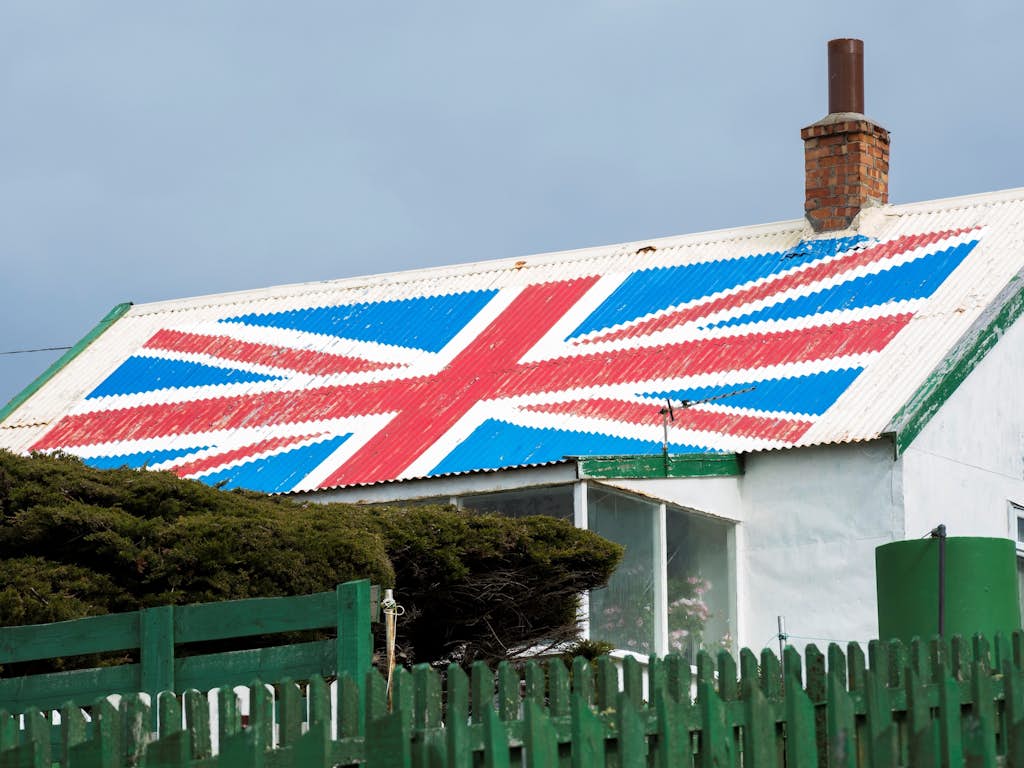
The Falklands are British. This is an assurance issued by nearly every major political figure in the United Kingdom in the past week, from Nigel Farage to Priti Patel to Keir Starmer and beyond. At last, the civic consensus of Great Britain discovers an overseas island possession that no one wishes to sell, trade, or otherwise abandon. Approaching half a century since her singular wartime victory, the mythos of the Iron Lady yet exerts its pull upon the reflexes of Westminster. Labour is willing to surrender points of vast strategic value, but not those of little to none, because Britons have bled for the latter — and only the Americans care about the former.
As with so much Westminster tumult now, it is reaction to the Americans that drives both the politics and their prominence. It is not that the Americans have any particular policy on the disposition of the South Atlantic possessions, nor even that they are about to adopt one. A leaked Department of War memorandum has suggested that the United States may “punish” European allies recalcitrant over the stalled Iranian war via a variety of means, including endorsing Argentinian claims to the Falklands. Even if adopted, this would not translate into positive American aid for action from Buenos Aires: rather, the fear for Whitehall would be diplomatic isolation and, should a crisis come, the absence of the sort of American help that was on offer in 1982. That aid, then, although not in itself war-winning — because the Britain of that era was still militarily potent on the global stage — was nonetheless significant. The Britain of 2026, enervated as it is, would probably find it much more significant in a revived fight.
The Argentinians, of course, are also reacting to the news, and eagerly affirming their perennial claims to own the islands. President Javier Milei tweeted an all-caps slogan on the topic, and his Minister of Foreign Affairs posted a lengthy discourse in the same space. Those claims are, by the traditional American metrics by which sovereignty is assessed, preposterous. In under a decade the Falklands will mark a full two centuries under British rule, and the political preferences of the native-born population of the islands are in no doubt whatsoever. To the extent that the Argentinian claims have merit, it depends upon the sort of politics of sovereignty to which one adheres. European powers of the eighteenth century would find Argentina’s case plausible: an offshore island rich in resources controlled by a competing power at a tremendous remove is as compelling for the Argentinian regime as Silesia was for Frederick the Great. However the American influence upon the twentieth century, in globalizing the politics of European romanticism, has taken root everywhere, and so now the insoluble problem for Argentina in the eyes of the world is the Falkland Islanders themselves.
The Argentinian proposition is to simply deny these people their existence and their preference. They too have a mythos about the place, and they will adhere to it. Fortunately for those Islanders and for peace in the Americas, the consensus is that the Argentinian military cannot now successfully invade the Falklands as they did once before. In an age of fatal cuts to British military power nearly everywhere, the garrison defending the Falkland Islands still exerts a reasonable deterrence. This is not to say 1982 could be re-run on the British side: it could not. The balance of power in the South Atlantic now rests upon the reality that Argentina is too weak to take the Falklands, and Great Britain is too weak to re-take it.
That balance won’t last. As both Ukraine and Iran have demonstrated before the world, the evolution of military technology and operations has thrust us into an era in which middle powers may contend with great ones, especially if they are willing to leverage asymmetric means. The United States of America has proven in the past sixty days unable to fully protect its own bases, including major-command headquarters, from Iranian drones, missiles, and even manned fixed-wing aircraft: it is hardly impossible to imagine Argentina investing in similar capabilities with an eye toward swamping the defenses of RAF Mount Pleasant. It is not in the offing. But it only needs a few years of Argentinian economic prosperity — for once, under Milei, a real prospect — and governmental reinvestment in capabilities to see it through. Perhaps this is the most-ominous signal for the Falklanders, in that a revivified Argentina is easier to imagine than a reenergized Britain.
The United States has a permanent interest in the United Kingdom, as both a creation of Britain — albeit against contemporaneous British wishes — and a direct inheritor of British politics and culture. Even absent that, the geography and economics of the British Isles commend themselves to an enduring American interest. There is nothing nearly so compelling about Argentina to the United States. America has neither any inherent conflict with it, nor any lasting ties across centuries to it. On these grounds alone, to which may be added plain sentiment — always co-equal with strategy in American statecraft — the United States has no objective interest in disadvantaging Britain’s position in the Falklands, and certainly not in endorsing the Argentinian claim.
This does not mean neither will happen, and this is the tragedy of the British position now. The Falklands are British. Yet Britain has by degrees surrendered its ability to enforce that proposition. It deprived itself of the Chilean strategic offset, so crucial in 1982 in tying down Argentinian forces, in no small part through its senseless Blair-era persecution of Augusto Pinochet. It deprived itself of its own hard power across decades, to the pitiful nadir at which Britain’s armed forces rest today. Finally, it deprived itself of American goodwill and charity through its blundering Starmer-era provocations of the Americans, from the insanity of the Chagos surrender to the denial of bases to the refusal of intelligence sharing and beyond. None of this was forced upon the Westminster class: they chose it all. The peril in which the Falklanders find themselves is one wrought in Whitehall’s corridors of power, in which the sinews and stuff of power were carelessly forgotten.
The Falklands may be British, for now, but if one day they are not, it will not be the fault of Washington, D.C., nor even Buenos Aires — but London.