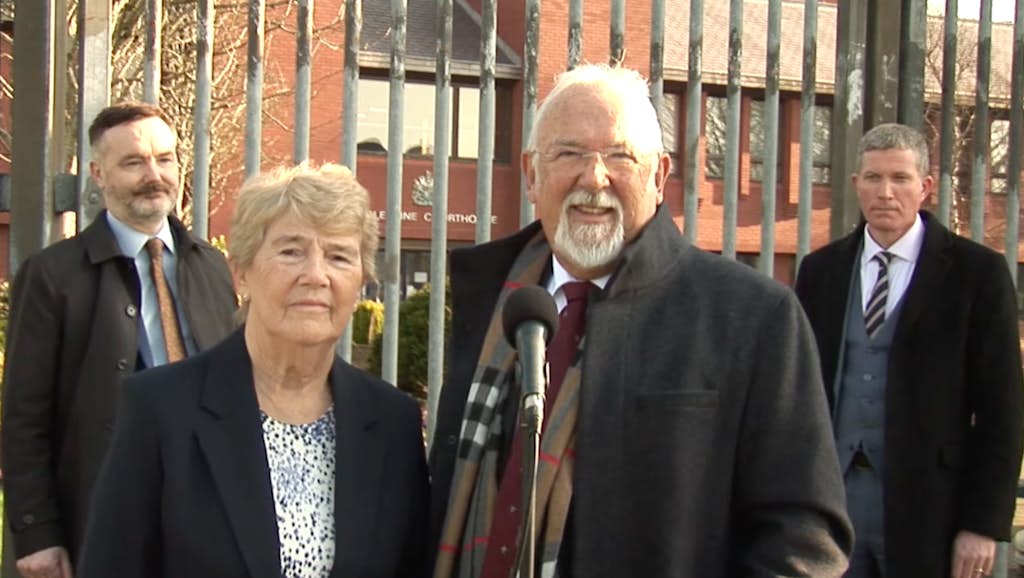
There are many troubling signs of Britain’s retreat from its historic commitment to free speech. But few are as stark — or as absurd — as this: a 77-year-old pastor standing trial for preaching the words, “For God so loved the world.”
That phrase is not a slogan. It is not even an argument. It is a verse from the Gospel of John — arguably the most famous sentence in the English language. Yet for this, Clive Johnston now finds himself hauled before the courts in Northern Ireland. The Bible is, quite literally, on trial in the UK.
Pastor Johnston, a grandfather of seven and former President of the Association of Baptist Churches in Ireland, is accused of breaching abortion “buffer zone” laws after preaching within 150m of Causeway Hospital in Coleraine. His alleged crime? “Influencing” people within the zone.
He wasn’t obstructing or harassing anyone. He wasn’t even speaking about abortion. If this sounds like a category error, that’s because it is. Laws designed to prevent aggressive action outside clinics are now being stretched to criminalise the peaceful expression of Christian belief.
The main problem lies in the wording of the law itself. “Influence” is an extraordinarily elastic concept. It seemingly does not require coercion, confrontation or even conversation. Such a vague and subjective standard would be recognised as an invitation to arbitrary enforcement. In other cases here in England, we’ve seen “buffer zone” legislation banning “influence” used to prosecute individuals for merely praying inside their own heads near a clinic. And in this case, we see them used to restrict Christians from talking about their faith — even if not addressing the matter of abortion whatsoever.
Of course, genuine harassment, obstruction and violent behaviour should rightly be prohibited outside a hospital or abortion clinic — and it is, everywhere in Britain, under pre-existing laws. But that kind of behaviour is not what is happening here. The law is being used not to regulate conduct, but to suppress content. The result is a profound shift in the relationship between citizen and state. We should be clear about the principle at stake. Freedom of speech is not merely the freedom to say what is popular or uncontroversial, but the freedom to express beliefs that others may or may not disagree with — even beliefs as peaceful and benign as “for God so loved the world.”
It is no coincidence that such cases have drawn international concern. At the Munich Security Conference in 2025, U.S. Vice President J.D. Vance described Britain’s buffer zone prosecutions as among the worst examples of censorship in Europe, citing the case of an army veteran prosecuted for silent prayer. The State Department has likewise raised concerns about restrictions on the peaceful expression of faith in the UK in its 2024 Country Report on Human Rights.
That should give us pause. Britain has long prided itself on upholding the principle of free speech. Yet we are being called out on the world stage for violating this right at home.
But the deeper problem is domestic. Britain used to be a country where liberty is secured not only by law, but by culture — a shared instinct that the state should not intrude unnecessarily into the lives and consciences of its citizens. Buffer zone laws cut directly against that tradition. They create areas of the country where certain forms of speech are effectively banned — not because they are unlawful in themselves, but because of where they occur and how they are perceived.
Political parties on the right often speak grandly about the need to cut down on state censorship and restore free speech. But here is a concrete test: will they stand up for the principle when the speech in question is unfashionable, or associated with religious belief?
Clive Johnston’s trial may seem like a small, local matter — but it is a warning
If any party wishes to be taken seriously as the champion of free expression, it should commit clearly and unequivocally to repealing these egregious “buffer zone” laws wherever they occur — in every corner of the UK.
Clive Johnston’s trial may seem like a small, local matter — but it is a warning. When the state claims the power to police mere “influence,” it claims the power to police belief. And when the simple proclamation that “God so loved the world” becomes caught in that net as a matter for prosecution, the ridiculous overreach of the law becomes fully exposed.