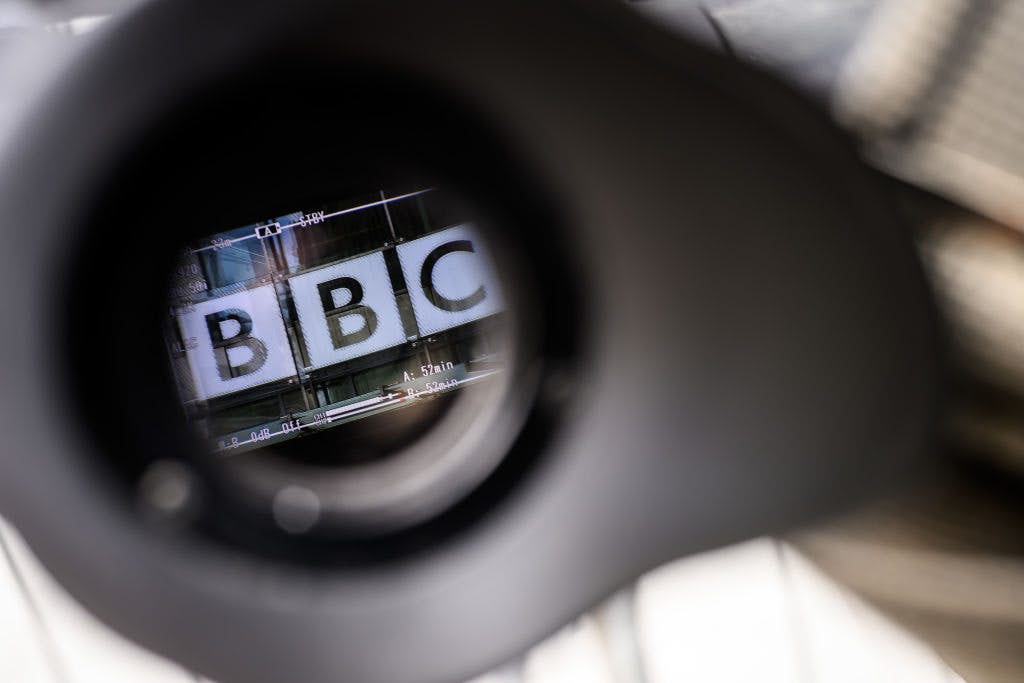
Like much of my generation, I have been falling out of love with the BBC. It’s a profound fall from grace. Only a decade ago, the Beeb was regarded as a national institution — a bastion of journalistic integrity, and the place to go for reliable news.
Yet trust is a fickle commodity. It takes years to gain, but it can be squandered by just a few poor decisions. Unfortunately for the BBC, there have neen far too many of them.
The Corporation has been busy curating its catalogue of calamities since 2023. It began with the Huw Edwards scandal. The man who had personified the gravitas of the Beeb for two decades was revealed to have none himself and was convicted of the unspeakable.
Well, one can find bad people anywhere (though Edwards was hardly the first, or the worst, at the BBC). But the crises didn’t stop here. 2025 saw confirmation of broken editorial guidelines over the Bob Vylan concert, an Ofcom sanction for a Gaza documentary narrated by the son of a Hamas official, and a Panorama episode in which editors mendaciously spliced the US President’s words to fit a predetermined narrative.
Given the scandals that have embroiled the BBC, readers might assume the Corporation’s coffers are emptying. They are not. Last year, BBC incomes swelled by 9 per cent. And license fee payers are right to start asking questions. Last year’s increase was not an isolated incident. Only last week, the license fee rose once more, leaving households across the country facing a bill to the tune of £180.
It is a steep price to pay for a service that younger people view as increasingly detached from their daily lives. In spite of youth-focussed rebrands and influencer-led marketing strategies, the corporation’s reach amongst the younger generation is declining. We are on Youtube for our documentaries, Netflix for our films, and social media for our current affairs. The days of sitting on the sofa and tuning in to the 10 o’clock news look seem numbered.
The question should be asked: where did things go so wrong? Of course, the income insulation provided by the TV license has a role to play effectively subsidising failure. But it is not the sole offender. New research from the Adam Smith Institute shows that the problem is systemic — UK broadcast regulation is fundamentally protectionist.
For starters, the act of broadcasting is treated as a privilege to be granted. Anyone wishing to broadcast must apply for a license. If they succeed, they must then adhere to a plethora of vague terms of reference, which can be found in the spiralling pages of Ofcom’s Broadcasting Code.
Take the prohibition against causing harm and offense. The sentiment seems harmless: no one wants to be offended. Yet the consequences are anything but. What constitutes “offence’ is subjective, firmly rooted in the eye of the beholder. Broadcasters choose to err on the side of caution, censoring perfectly legal speech in order to stave off the threat of an Ofcom investigation. In this climate of fear, small details matter. One broadcaster noted that the presence or absence of a word as trivial as “are” could be the difference between compliance and a potentially serious code breach. Uncomfortable journalism risks being traded for a safe, and ultimately boring, consensus.
However dysfunctional the framework, one would think they could draw solace from the fact the rules were applied equally. Unfortunately, they are not. While any independent broadcaster might face an immediate Ofcom “bolt from the blue”, the BBC remains sheltered by its unique ‘BBC First’ concession. This allows the Corporation to investigate complaints made against it before the regulator can get involved.
With the speed of communications in the 21st century, this policy seems designed for a different era. Ofcom issued its sanction to the BBC over its “materially misleading” Gaza documentary eight months after it was first aired and long after the damage had been done. What’s worse is that audiences cannot vote with their feet. Regardless of how they felt about the BBC’s coverage, if they watch any live TV, they cannot opt out of subsidising the ailing institution.
Somewhat counterintuitively, the remedy is not more regulation, but less. Where regulation persists, it should be applied equally, without fear or favour. Broadcasters must be free to screen legal content without the spectre of an Ofcom investigation hanging over every decision. The peculiar arrangement that is the “BBC First” clause should be abolished. At the very least, these provisions should be extended to every broadcaster equally. Most importantly, an institution that you and I are compelled to fund must be held to a higher standard of accountability than one that has to earn its audience. At present, the reverse is true.
I retain a modicum of affection for the BBC. Not for what it is, but for what it once was. For coverage of national events, the rights to FA cup games, and of course, the Proms. I truly believe there is something worth saving. Yet the scale of the crisis has gone beyond what the BBC can fix through internal reviews and rebrands. The British broadcasting market is broken. What it requires is something that institutions need and often fear. That is, true competition.