Last week, the Monitor reported that, over the past six months, all but three of the 4,499 refugees let into the United States were from South Africa. The Trump administration deems white Afrikaners (descendants mainly of 17th-century Dutch settlers) to be refugees, claiming they are subject to government-sponsored, race-based discrimination in majority-Black South Africa.
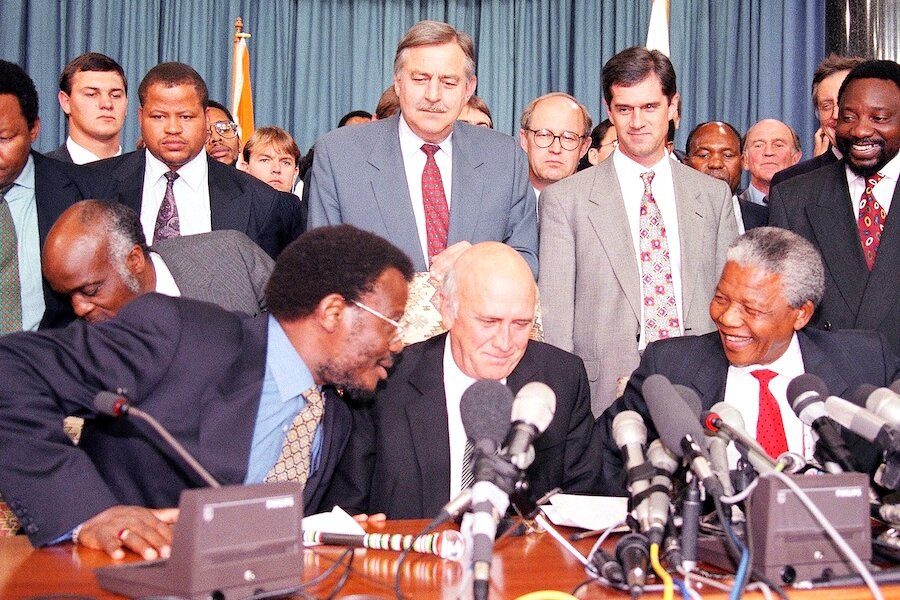
This week, South African President Cyril Ramaphosa named a new ambassador to Washington: Roelf Meyer, who is not only an Afrikaner but was also a member of the former apartheid government. The two men worked closely together in the early 1990s to negotiate their country’s transition from white-minority rule to multiracial democracy.
Mr. Meyer “will represent South Africa very well,” Mr. Ramaphosa said, noting the need to “recalibrate and repair” relations with the U.S.in a “respectful manner.”
Appointing a skilled negotiator who also epitomizes the continued role and relevance of white people in South Africa (approximately 7% of the population) is diplomatically astute. The U.S. has sanctioned and boycotted South Africa for the past year, alleging unproven “white genocide” and confiscation of Afrikaners’ land.
Yet the nomination also points to enduring national traits Mr. Ramaphosa highlighted – the willingness to “recalibrate and repair” – that have sustained South Africa’s democracy.
Post-apartheid leaders such as the late Nelson Mandela exemplified such readiness to engage in difficult discussions in the pursuit of reconciliation. Mr. Meyer this week recalled the many negotiating “skirmishes” he and Mr. Ramaphosa worked through decades ago. As he told eNCA television, they got to the point of agreeing, “There’s not a problem that we can’t resolve.”
“That’s very powerful,” Mr. Meyer pointed out, because it signifies trust and reliance on one another to jointly find answers.
Such values, Mr. Meyer indicated, are essential to support South Africa’s ongoing reckoning with race, privilege, and restorative justice and to complete a needed “social economic transformation.” In tough economic times, he says, people often tend to blame “the other. … It very easily gets a racial or a ethnic connection.”
The average Black household, research shows, owns only 5% of the wealth held by a white household. And the white population is still redefining its place amid social changes and affirmative action that seek to address historical discrimination against Black people.But decaying infrastructure and social services amid rising corruption and violent crime have heightened frustration and fear among South Africans of all races.
And prominent Afrikaners have pushed back against U.S. characterizations of them as victims of persecution. Last November, more than 1,500 signed a letter to the U.S. Congress. It asserted that “distorted narratives” about Afrikaners undermine international principles of refugee protection and harm the rebuilding process within South Africa.
Outspoken Afrikaner journalist Max du Preez last year issued a rallying call to South Africans “to show ourselves and the world that we can be a harmonious and successful country.”
Together, Mr. Ramaphosa and Mr. Meyer, the quiet architects behind South Africa’s historic transfer of power, might just be up to the task.