“Pick one concept and never stray from it” is the kind of advice that one may imagine being dispensed to art school students in the 1990s. If the Guyanese-British artist Donald Locke (1930-2010) heard the maxim when he studied at the Bath Academy of Art in the mid-1950s, he turned it to his advantage. His fixation with black, the colour synonymous both with the absence of any other and the deepest depth of colour saturation, gave rise to a compelling vocabulary which only grew with practice.
As narrated in Resistant Forms, a retrospective at Camden Art Centre, Locke’s oeuvre is remarkable in its conceptual restraint and firmness. The display, with clusters of canvases and ceramics from the 1970s, ’90s, and the 2000s, shows an artist testing the expressive limit of his chosen media. They, in turn, also test their subject.
Locke’s calling card is a cast of rich black ceramic obelisks, which resemble truncheons, phalluses, or artillery shells (depending on their environment and the viewer’s frame of mind), which he set in trophy cups or candlestick holders, embedded in his canvases, or simply posed at the roadside. These objects feature in a variety of assemblages, such as Trophies of Empire 1972-74), a wooden cabinet in which the items are displayed as though in a second-hand store on Portobello Road, and Redoubt (1972), which resembles the chassis of a high-end audio valve amplifier of the era.
There is no getting away from the biographical in Locke’s work. Sugar plantations remained a feature of the Guyanese economy long after the former colony gained independence from Britain in 1966. Works such as The Cage (1967), a black, square canvas in which patches of fur are bound by steel, establish the legacy as an unfading interest. Yet, despite these reverberations, Locke treats the subject of Empire with a studied ambivalence. Canvases from the Dynasty, The Birth of Empire series (1989), made just before the artist moved to the US, are veritable cryptic puzzles brought together to confuse a simple reading.
A recurring feature of these surfaces, primed with burnt sienna, is an expanse of black acrylic paint. Locke applied it to create high contrast textures on some, crusty fields in others, and uniform stains elsewhere. What is striking in these assemblages is their ability to incorporate other techniques and other messages within, and not merely against the black expanses. In one frame, the artist combined a photograph of a formal political gathering, a record from the early days of aviation, and photographs of his own ceramic works — confusedly shaped vessels reminiscent of those for which Locke’s tutor at Corsham, Kenneth Armitage, became known — only to once more break the image’s austerity with rectangles of fur.
Another canvas from the series arranges photographs of Locke’s early ’70s stoneware and aluminium Small Folded Forms in a manner that makes discerning whether they are shaped like life-giving commodity crop seeds contorted to resemble vulvas or the other way around. Such works echo a quality of Aby Warburg’s Atlas, because they make it explicit that any work’s meaning can become semiotically and historically contingent on the existence of others. The icons are, so understood, part of a conspiracy.
The point is not simply that artists are able to “subvert”, in today’s critical language, a historical legacy, or that Locke looked for perverse positives in Guyana’s past. (He rejected the interpretation of his work as political activism even as he lived in the American South in the ’90s, where such a reading might have been doubly advantageous.) No, the root of the judgment stemming from these assemblages is the material itself. If black paint can both play host to traumatic suffering and be the source of creation, is the same, but also the inverse, true of the subject the colour constitutes?
All this is conjecture until one notices colour in Locke’s work, in its primary red sense. Those shades are rarities in Resistant Forms. Portrait of Richard (1987), another of the acrylic and photo collages, for example, introduces a colour image of a densely patterned carpet and the bare feet of two people. The chromatic payload of this frame not only contrasts with that of the work’s other components (again, group portraits and photographs of Locke’s earlier works) but, despite them being black and white, casts a coloured shade on them and even the viewer.
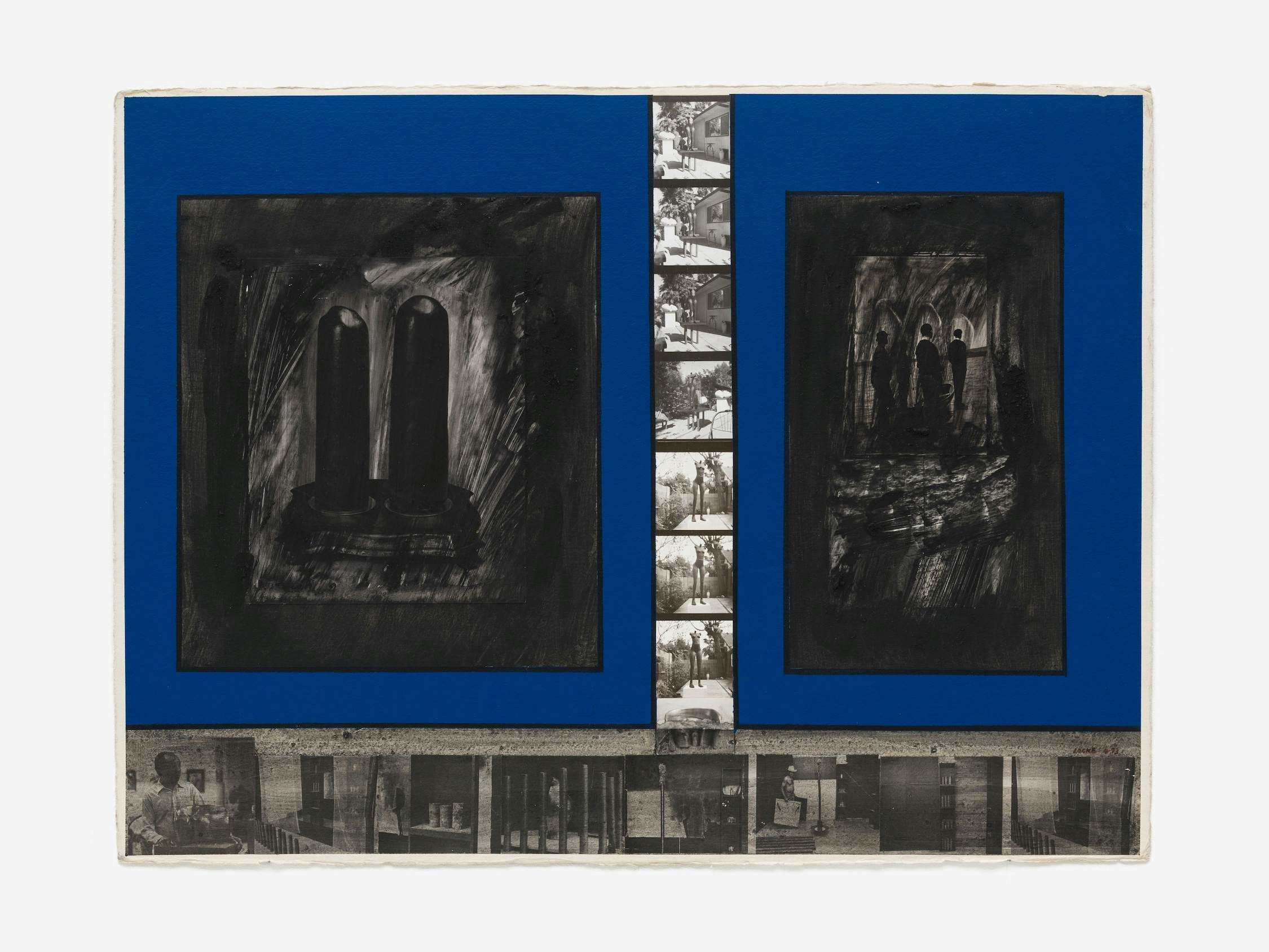
In later works, such as the paper photo collage Enigma Variations (1993), Locke lets colour take over. Bold blues become the altars for his trademark obelisks, here presented as objects of veneration to which no pictorial reproduction could do justice. What is striking about Locke’s output of this period, made while the artist lived in Arizona, is that it feels visually contemporary, sharing a graphic sensibility with that ’90s art school grad.
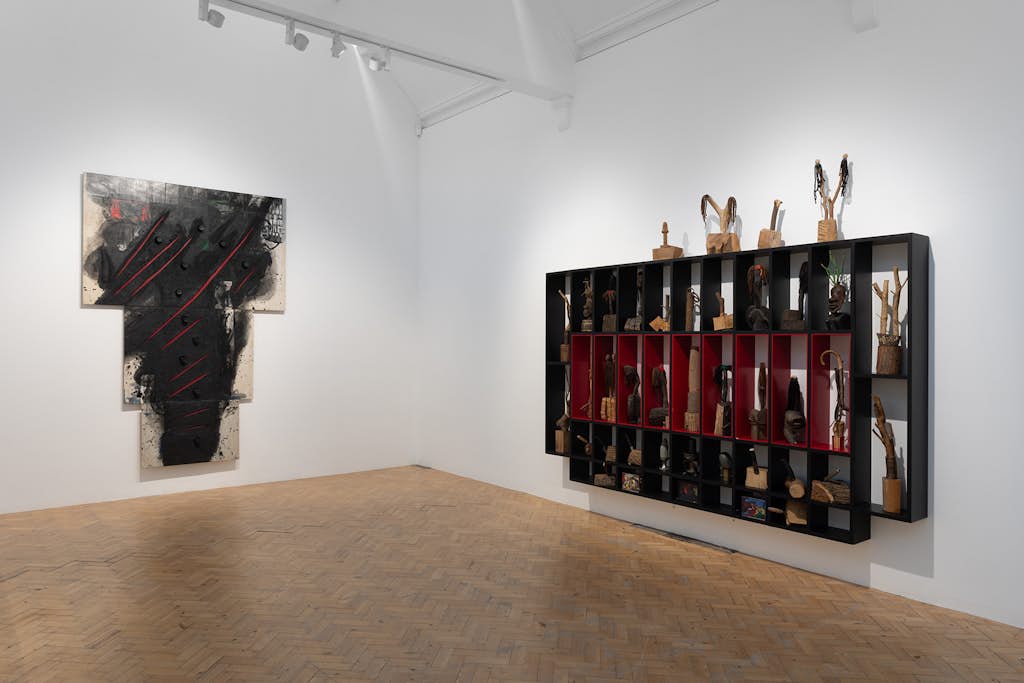
Frustratingly, this is not always to the advantage of Locke’s dialectical engagement with blackness and colour in their alienness to each other and simultaneous synonymity. The artist’s latter works fall prey to an exuberance, which, by necessity, uproots them from their established field of thought. In a reprisal of Trophies of Empire from 2006, for example, humorous assemblies of wood blocks take the place of the ceramic obelisks, and the display apparatus is lacquered with colour that is outright garish.
How much of this breakdown in discipline — or fidelity to that imagined singular idea — was the result of the artist’s interests developing with age, and how much the exhibition’s less-than-subtle commercial orientation is once more a matter of sociology. That is prone to dull misinterpretation. “Colour” and “blackness” radically changed register during Locke’s life, becoming the subject of far more explicit discourse than an artist mixing pigments in his studio may countenance. Resistant Forms, then, lays bare the tension in reconstructing past inquiries for today’s gain: what made Locke’s mythos ultimately undermined it. What’s left is a handful of shiny black trophies.
Donald Locke, Resistant Forms at Camden Art Centre continues until 30 August.