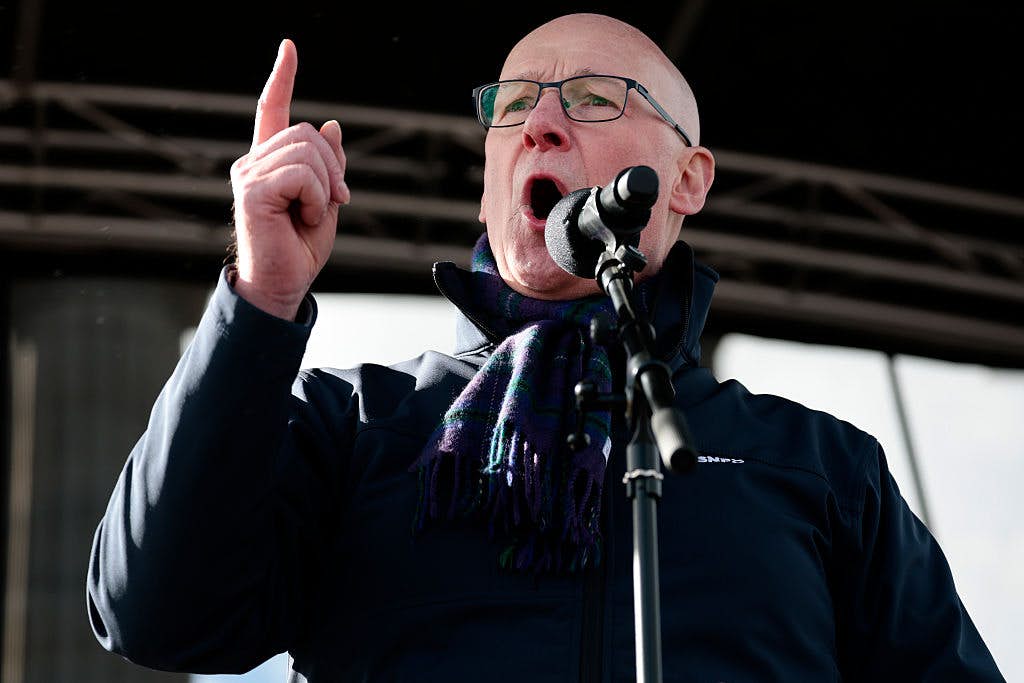
John Ramsay Swinney has been at the top of the Scottish National Party, in its high counsels, for over forty years. He is on his second outing as its leader, is one of the very few MSPs also to have sat in the House of Commons, and, when the dust settles after the Scottish Parliament election on 7 May, will be almost the last of the very first, endearingly naïve 1999 entry.
As every poll indicates and despite its erratic and at times deplorable record, the SNP will have secured an astonishing fifth term at the levers of devolved power — a feat that has eluded every Westminster party since the advent of universal adult suffrage.
Yet, arguably, Swinney’s first five years in the Scottish Parliament are far more telling than the many years he has spent since, largely as the dutiful deputy always two paces behind the First Minister.
May — that season of hawthorn, swallows, tea on the lawn and the first cuckoo — is, as Mandy Rhodes observed in a 2025 interview, rather a blessed month for the MSP for Perthshire North.
Swinney won his Commons seat on 1 May 1997 and his Scottish Parliament gig on 6th May 1999. This May — he retired to the backbenches with Nicola Sturgeon in 2023, and had advanced and happy plans for a second life beyond professional politics — he had fully intended to stand down.
But for one little local difficulty: on 7 May 2024, John Swinney was elected First Minister of Scotland. Unopposed, as it turned out, following the implosion of Humza Yousaf and once Kate Forbes, a professing Christian who actually and most inconveniently believed in God, realised that while she might just win the SNP leadership it would split the party.
Swinney and Forbes cut a quiet deal, ignoring noises-off from the Scottish Greens and others, and she returned with him to government before quietly quitting Holyrood.
Central to Swinney’s extraordinary career is his personality. He is unassuming, affable, rather jolly, self-deprecating and extraordinarily hard to dislike. More starkly, he became active — indeed, vigorous — in the SNP when there were very, very few rivals of his generation.
In 1986, before he had even graduated, the SNP crowned the 22 year-old National Secretary — as close as the party boasted to a CEO — and, a year later, he effectively directed its campaign in the 1987 general election, with scant resources and very little media interest.
As a young volunteer at party headquarters, I had practically a ringside seat, but the most striking memory is how, even then, bonds were forming that would endure decades — between Swinney, Peter Murrell, Kevin Pringle, and an Angus Robertson — forceful as he already was — so young he was still in school.
That fellowship was central to the extraordinary discipline — commanding the Nationalists was for long, notoriously, the stuff of herding cats — that has stamped the SNP since the second coming of Alex Salmond in 2004.
Swinney had signed up to the Scottish National Party as a 15 year-old in 1979, soon after nine of its eleven MPs returned in 1974 had been mown down like the clans at Culloden and Margaret Thatcher consigned the surviving rump to irrelevance.
Irrelevant it would remain, bar flash-in-the-pan by-election flares in 1988 and 1995, till the gift of devolution. Overnight, thanks to the new order’s generous electoral system, the SNP was cemented as the second party of Scottish politics and the chief Opposition.
It was odds-on, in time, as Brian Wilson has publicly regretted, that once the people of Scotland grew used to a Scottish Parliament, they would inevitably turn to the one party that could not conceivably be out-Scottished. In 2007, albeit by a sneeze, the Nationalists were in government.
As John Swinney joked in 2003, no one who had joined the Nats just after the 1979 debacle could be accused of doing it for ambition.
But, by then, he had not his troubles to seek. By a sort of ghastly accident, he had attained the SNP leadership in 2000 and everything Swinney touched seemed to turn to lead.
He suffered from many years as a sort of patronised party pet, from his very limited parliamentary experience and from personal travails.
No one has ever satisfactorily explained, either, why Alex Salmond chose to quit the SNP leadership in the summer of 2000, still but forty-five and the most assured Scottish politician of his generation.
The decision to walk off the pitch was one Salmond must have fast regretted. But walk he had, and, in September 2000, John Swinney rather easily beat Alex Neil in a two-horse race for command of the SNP.
Neil, fatefully, though the abler, was late to Nationalism. He was from a Labour background and had been central to an entertaining Seventies experiment by Jim Sillars, the short-lived breakaway Scottish Labour Party. The SLP did not long survive determined entryism by the International Marxist Group and, at its 1977 electoral peak, secured three district councillors.
Thereafter the Nationalists endured four years of defeat, retreat and retrenchment.
They went into the 2001 Westminster election with six MPs and emerged with only five. They lost a quarter of their MSPs at the 2003 Scottish Parliament polls and, a year later, even went backwards in Scotland’s European Parliament vote — a second-order contest in which, historically, the Nationalists had always done rather well.
Michael Russell now spoke ominously of the “men in grey kilts” — a remark which Swinney took years to forgive — and by October 2004 Alex Salmond was back, still in the House of Commons, but with a sparkling Nicola Sturgeon as his representative on Earth.
The SNP’s serious reverse in May 2003 was partly because we were amidst the second Gulf War, which generally filled the windscreen, but mostly because there was high public anger about the mounting and vertiginous costs of the new Scottish Parliament building, only at last completed in 2004 and vastly over budget.
For this, irrationally, voters blamed the SNP, returning a “Rainbow Parliament” thick with Greens, Tommy Sheridan’s Scottish Socialists, and some colourful independents.
But the SNP could readily have avoided this bear-trap had they insisted, in 1999, that the construction of the Holyrood premises remain the responsibility of the Scottish Executive. The key and dreadful decisions had, after all, pre-devolution, been made by Labour ministers at the Scottish Office.
Instead, they foolishly agreed that it now became the responsibility of the all-party “Corporate Body”, and, accordingly, their responsibility too.
Swinney had another problem. Internally, the SNP did not adopt candidates or approve major policy stances by one-member-one-vote. Instead, it operated on a caucus system — second-hand “delegates”, a game played with increasing skill by its most hardline, independence-nothing-less fundamentalists.
This had been of little account back when the SNP had only two MPS, Winnie Ewing MEP and vertiginous control of Angus District Council, but it was a serious liability as John Swinney faced the 2003 hustings with thirty-five MSPs — several of whom, including some of the ablest, were now dumped down to unelectable places on the regional list when the self-appointed faithful found them wanting.
The casualties included Irene McGugan, Margo MacDonald and Andrew Wilson — in his case, for the enormity of having made benign remarks about the Union flag — and, had he not snatched back the Ochil constituency by 296 votes (he had been MP in the Seventies for the predecessor-seat) the brilliant George Reid would have been defenestrated too.
Swinney was now on borrowed time. “I think he has a year,” one senior colleague murmured to me in May 2003, and events duly proved her right — though Swinney used that last, perilous year finally to enfranchise all ordinary members in candidate selection.
Flubbed elections apart, Swinney struggled to project any personality. He was never a household name. There were no tics or endearing traits to tempt a cartoonist and he had not then calmly embraced male-pattern baldness.
At the Scottish Press Awards in 2001, weeks after an election when he had hardly been off the telly, Swinney chatted affably with myself and a perky lad from Harris. Once he had moved on, the youth turned to me in some puzzlement. “Who was that guy?”
There was another low moment that November when — having seized the Scottish Labour leadership after the downfall of Henry McLeish — Jack McConnell celebrated by sacking what felt like most of the Scottish Executive. Occasion for a brilliant, mocking speech by the Scottish Conservative leader, David McLetchie. SNP MSPs glanced dolefully at their leader. It was the sort of bravura they wanted from him, and the Swinney of 2001 was simply not up to it.
If Nationalists love anything, it’s a sticker-in
When he was finally eased from SNP command in 2004, no one ever expected Swinney to lead his party again. Nor had he the least desire to. In 2008, in my hearing, he expressed amusement about Wendy Alexander’s shrill pleasure in attaining the Scottish Labour leadership. “I’ve been leader of the Opposition,” said Swinney to some Stornoway faithful. “It’s the worst, most awful, most sapping, most soul-destroying job in politics…”
But if Nationalists love anything, it’s a sticker-in. John Swinney, the ultimate loyalist, was duly rewarded — enjoying two stretches as Cabinet Secretary for Finance, later helming Education, and then two years as Cabinet Secretary for Covid Recovery, as well as nine years, under Sturgeon, as Deputy First Minister.
Not that one can readily point to some signal accomplishment. Bold 2016 plans to rejig Scotland’s schools — by, for instance, giving head teachers far more autonomy — were quietly canned the moment the main teacher’s union, the EIS, arched its back and hissed.
This is a reminder how, in the quarter-century of devolution, far too much public policy in Scotland is still “producer-driven” rather than consumer-driven. Alas, no one seems able to do anything about it.
These days John Swinney is a contented man. His second marriage to journalist Elizabeth Quigley has been supremely happy. The old Nationalist war-horse is today a serene soul, whose deft handling of the scariest man in the Western Hemisphere, President Trump, in a July 2025 Scottish drop-by awed many.
The man opponents mocked … as a mere “caretaker” has proved a surprisingly assured captain of devolved government
They cooed and schmoozed. Trump even complimented Swinney’s son’s “beautiful” golf-swing. “John Swinney is a terrific guy — and loves golf and loves the people of this country, and we really appreciate it,” gushed the leader of the Free World. “You’re really a very special guy. Thank you very much for everything, John.”
Swinney has to do two things in this Scottish Parliament election. Firstly, he has to prevail over Anas Sarwar’s line that only Labour can oust the SNP with the counter-argument that only the Nationalists can stop Reform.
By every measure, Swinney is winning that narrative. More audaciously, he is positioning himself as the “change” candidate — quite a feat, after two decades in office.
But the man opponents mocked, on his 2024 elevation, as a mere “caretaker” has proved a surprisingly assured captain of devolved government: steeled through decades, the cold and durable fire.
Familiar, avuncular, finally secure in himself — a welcome change from the drama of the Salmond era or Sturgeon’s fixation on sexual politics. After the rapids, the skipper now assuredly steering Scotland away from the rocks — and, if that perception holds till 7 May, Swinney’s achievement will be for the ages.
The trifling stuff in the in-tray — securing independence; wheeching Scotland back into the EU — apart, of course.