The 119th U.S. House has set records for its dysfunction. This congressional term has featured the longest government shutdowns in the nation’s history, the fewest votes cast in more than two decades (with the exception of a pandemic-induced low in 2020), and surprisingly few bills passed for a time of one-party control.
And the unusual midcycle redistricting arms race is poised to make all these problems worse.
Virginia and Florida are gearing up to potentially change their House maps next week. They follow Texas, North Carolina, Missouri, and California, all of which have already squiggled district lines, broken up neighborhoods, and displaced dozens of elected representatives to make districts more winnable for Republicans or Democrats. Ohio and Utah also redrew their maps within the past year after litigation.
Why We Wrote This
With Virginia and Florida poised to follow other states in midcycle redistricting next week, the partisan impact nationwide so far appears to be a wash. But by creating more “safe” districts, the new maps may make the next U.S. House even more polarized.
Thus far it looks like the partisan impact of all the redistricting in these states – which make up 30% of all congressional districts, even without Virginia or Florida – will be a wash, with neither party coming out significantly ahead.
But the changes are likely to have a serious impact on the House, as many districts’ shade of red or blue deepens. With more districts categorized as “safely” Republican or Democratic, these new maps seem likely to make the next House even more polarized, changing what it takes for candidates to win, and further reducing incentives for bipartisan cooperation in Congress’ lower chamber.
“We live in a world with a hyperpolarized House, and that is only going to get worse as a result of what’s happening,” says Michael Li, senior counsel at the Brennan Center for Justice, where he focuses on redistricting. Winning most of these new districts really just means winning the Republican or Democratic primary, and “primary voters of both parties are more to the extremes,” he says. For members, “that’s going to impact what they are willing to do [in Congress]. They are always going to be worried about a primary challenge.”

This cross-country tit for tat kicked off in July 2025, when President Donald Trump suggested that Republicans could pick up five seats in Texas with “a very simple redrawing,” and not wait for the normal redistricting process that takes place once a decade after the U.S. census. After pushback from Democratic state lawmakers, who temporarily fled Texas in protest, the new map was signed into law in late August. A few months later, California voted to redraw its map to favor Democrats, and negate the GOP’s Texas gains. Other states have followed, trying to give Republicans or Democrats an edge in the deeply – yet narrowly – divided U.S. House.
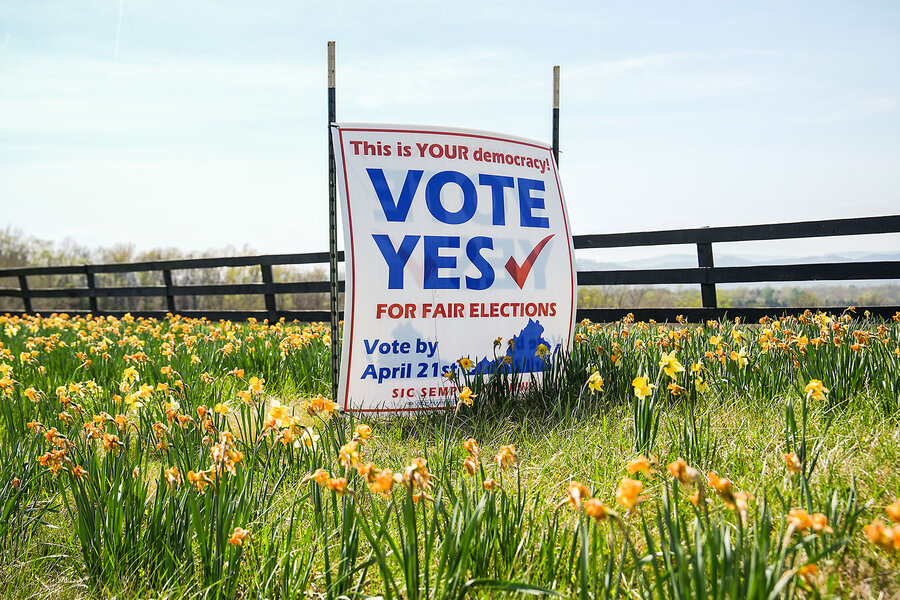
Next week, Virginia will vote on a Democratic effort to change the state’s current map (represented by six Democrats and five Republicans) to one that would favor Democrats 10 to 1. And Florida Republicans will have an opportunity to redraw their map (currently 28 Republicans to 20 Democrats) to one that will add as many as five more GOP-leaning seats.
Virginia’s redistricting referendum, set for April 21, has already drawn huge numbers of voters to the polls. By the end of March, early voting had surpassed turnout numbers in the 2025 governor’s race, which set a record for a nonpresidential year.
In Florida, Republican Gov. Ron DeSantis has called a special legislative session between April 20-24 for state lawmakers to draw new maps. But after Democrats unexpectedly flipped two state legislative seats in late March, one in the district that includes President Trump’s Mar-a-Lago home, some Republicans have grown concerned about a “dummymander.” In a year in which Democrats have the political wind at their backs, an overly aggressive Republican gerrymander could wind up spreading GOP voters too thinly and potentially lose seats.
In theory, if both Virginia and Florida pass new maps, the partisan advantages will largely cancel out. But if one state goes forward and the other does not, one party could wind up with an edge.
“That is all a question mark right now,” says Kyle Kondik, managing editor of Sabato’s Crystal Ball at the University of Virginia’s Center for Politics.

Although the more partisan maps have been pitched as temporary in Virginia and California, it’s difficult to imagine the members elected to these new districts later encouraging a return to the old maps, he adds.
Last June, before Mr. Trump pressured Texas to redraw its map, the nonpartisan Cook Political Report calculated there were 191 solid (meaning noncompetitive) Republican seats and 174 solid Democratic seats. Their most recent estimate has 185 solid Republican seats and 189 solid Democratic seats. Sabato’s Crystal Ball has a similar breakdown: What were 186 safe Republican seats and 169 safe Democratic seats before midcycle redistricting are now 187 safe Republican seats and 184 safe Democratic seats.
But while it may be close to “a draw” nationally, it’s “terrible” if you live in one of these redistricted states, says the Brennan Center’s Mr. Li, because the new map is very unrepresentative of the state’s actual composition. In Texas, for example, Republican Sen. Ted Cruz won reelection in 2024 with 53% of the statewide vote, but Republicans could soon represent almost 80% of Texans in the House.
In addition to the country’s new slate of congressional districts, other factors could further polarize the House, such as a record number of retirements (some of which have been driven by frustrations over partisanship).
The U.S. Supreme Court is also poised to release a ruling that could upend the Voting Rights Act by the summer, opening the door to further redistricting – although experts say it’s likely to come too late to impact November’s midterm elections. But it could very well lead to big changes in maps for 2028 – two years before the 2030 census is expected to bring seismic shifts to states’ allotment of seats.
“What’s happening right now is a foreshadowing of a long series of fights over representation that’s going to take place over the next 5 to 10 years,” says Mr. Li. “This is one battle within a big war of representation.”