Passengers on a cruise ship are trapped at sea after three people died and a British man was left fighting for his life following the outbreak of a rat-borne virus.
The World Health Organisation (WHO) confirmed six suspected cases of a hantavirus infection on the MV Hondius, travelling from Ushuaia in Argentina to Cape Verde in Africa.
A 70-year-old passenger was the first to die followed by his 69-year-old wife. They are both Dutch nationals.
A 69-year-old Briton was taken to Johannesburg, where he is being treated in intensive care.
The WHO said on Sunday night it was ‘aware of the cases of severe acute respiratory illness on a cruise ship sailing in the Atlantic’.
It confirmed three people had died onboard – with the British man the victim of a hantavirus infection – and said it was investigating six suspected cases in total.
Passengers have now told of their hell trapped on the ship – after being ordered to stay onboard while ‘awaiting approval’ to disembark.
A letter distributed to customers from cruise company Oceanwide Expeditions on Sunday, seen by the Daily Mail, informed them it was ‘awaiting approval’ for passengers to leave the ship.
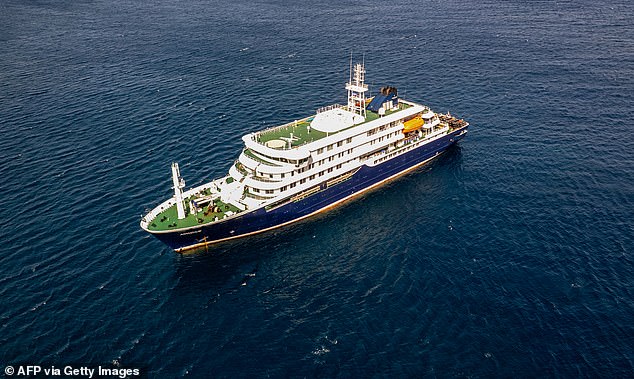
A British man was taken to intensive care after the virus spread onboard the MV Hondius (pictured), travelling from Ushuaia in Argentina to Cape Verde in Africa
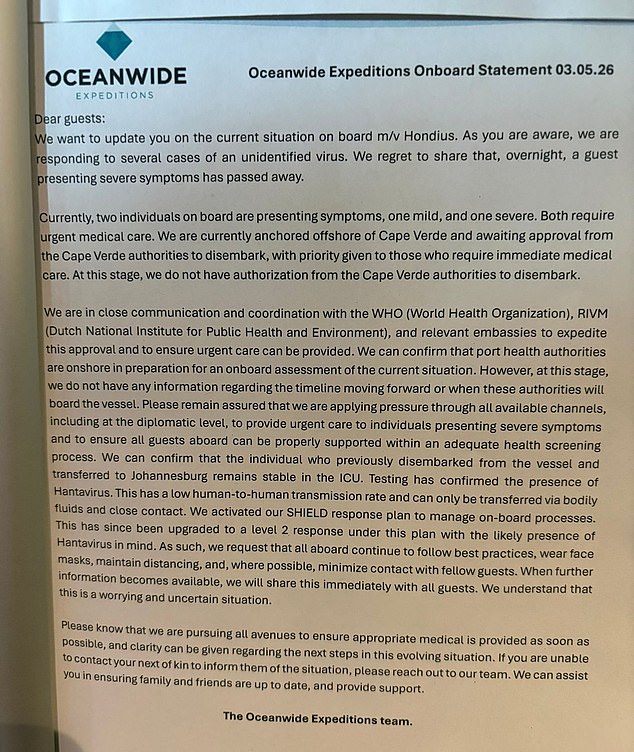
A letter distributed to customers from cruise company Oceanwide Expeditions on Sunday, seen by the Daily Mail, informed them it was ‘awaiting approval’ for passengers to leave the shi
The letter said: ‘As you are aware, we are responding to several cases of an unidentified virus.
‘We regret to share that, overnight, a guest presenting severe symptoms has passed away.
‘We are currently anchored offshore of Cape Verde and awaiting approval from the Cape Verde authorities to disembark, with priority given to those who require immediate medical care.
‘At this stage, we do not have authorisation from the Cape Verde authorities to disembark.’
The letter went on to advise that all those onboard continue to ‘follow best practices, wear face masks, maintain distancing, and, where possible, minimise contact with fellow guests’.
It added: ‘Please remain assured that we are applying pressure through all available channels, including at the diplomatic level, to provide urgent care to individuals presenting severe symptoms and to ensure all guests aboard can be properly supported within an adequate health screening process.’
One passenger, who wished to remain anonymous, told the Daily Mail: ‘We have not heard from Oceanwide at all. We still have friends on the ship.’
Last year, prices for a full trip on the vessel were between €12,500 for a bed in a shared cabin with other passengers and €40,000 for the most luxurious private cabin.
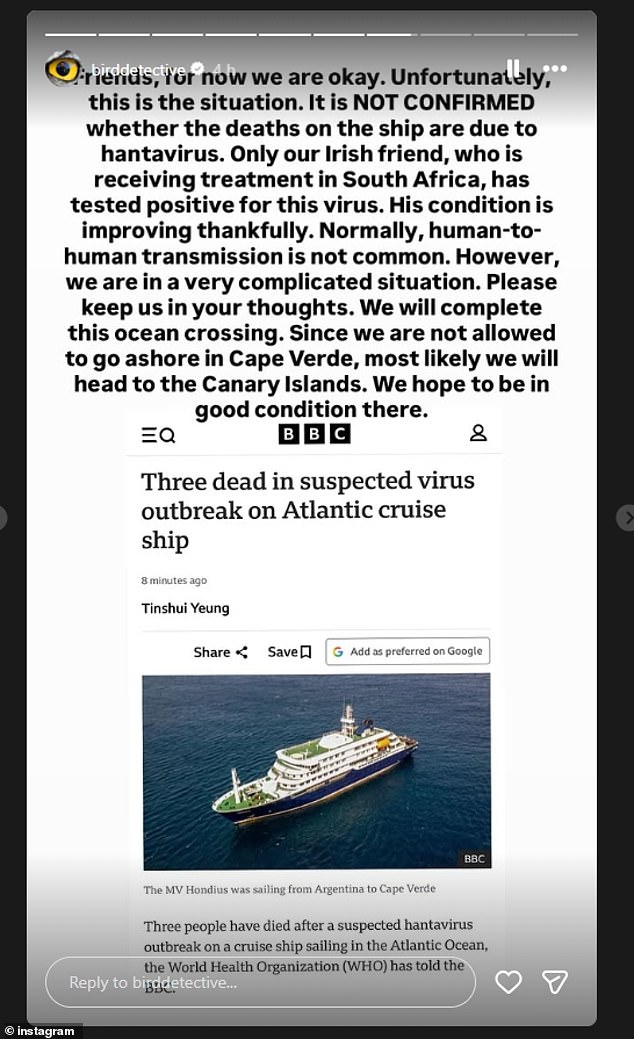
Speaking on social media, a Turkish passenger on the ship said his ‘Irish friend’ was receiving treatment in South Africa – but that fortunately, his condition was ‘improving’
Hantaviruses are typically spread by rodents (file image)
Hantaviruses are a family of viruses which can cause serious illnesses and death.
They are typically spread by rodents and are not normally spread person-to-person.
The viruses can cause two syndromes – hantavirus pulmonary syndrome (HPS) and haemorrhagic fever with renal syndrome (HFRS).
Early symptoms of HPS include fatigue, fever and muscle aches.
Intensive headaches, back pain, nausea and blurred vision are symptoms of HFRS.
Minimising contact with rodents at home, in the workplace, or in a campsite can help reduce the risk of exposure to hantaviruses.
A map shows the ship’s route starting at Ushuaia and passing by South Georgia and St. Helena before reaching its final destination at Cape Verde.
Hantaviruses – a family of viruses – are spread by rodents, in particular through contact with their urine, droppings and saliva.
They are not usually spread person-to-person and are typically only transferred via bodily fluids and close contact.
As of Sunday night, the WHO had laboratory confirmed one case of hantavirus infection and was investigating five additional suspected cases.
A spokesman said: ‘Of the six affected individuals, three have died and one is currently in intensive care in South Africa.
‘Investigations and a coordinated international public health response is underway. We will share more information as it becomes available.’
Laboratory testing and epidemiological investigations are now taking place – with medical care and support provided to passengers and crew.
The WHO confirmed ‘sequencing of the virus’ – to understand transmission and mutations – is also ongoing.
A source close to the case said the provisional toll was three dead, including a Dutch couple.
Speaking anonymously on Sunday, they added discussions were taking place to decide whether two sick passengers should be placed in isolation in hospital in Cape Verde.
They said the ship would then continue to Spain’s Canary Islands.
South Africa’s department of health confirmed a British tourist is being treated in a private health facility in Sandton, Johannesburg – adding his laboratory test results had come back positive for a hantavirus infection.
Speaking on social media, a Turkish passenger on the ship said his ‘Irish friend’ was receiving treatment in South Africa – but that, fortunately, his condition was ‘improving’.
He said: ‘We are in a very complicated situation. Please keep us in your thoughts.’
The South African Department of Health said the Dutch male passenger suffered fever, headache, abdominal pain and diarrhoea, and died in St Helena while his wife was taken to hospital in the Kempton Park area of South Africa after collapsing at an airport.
According to several online ship–tracking sites, the MV Hondius was just off the port of Praia, the capital of Cape Verde, on Sunday.
The vessel can accommodate around 170 passengers and has some 70 crew members.
The Foreign Office told the Daily Mail: ‘We are closely monitoring reports of a potential hantavirus outbreak on the cruise ship Hondius and stand ready to support British nationals if needed.
‘We are in touch with the cruise company and local authorities.’
Hantaviruses are known to cause a range of diseases in humans ranging from mild, flu-like illness to severe respiratory illness or haemorrhagic disease.
Early symptoms can include fatigue, fever, muscle aches and intensive headaches.
The risk of contracting the illness can be reduced through minimising contact with rodents.
Oceanwide Expeditions has been contacted for comment.