Less than two hours after arriving on Harley Street for cosmetic surgery, I am in a taxi home with 50 tiny stitches in my upper eyelids and already a more wide-awake look.
I’m a positive, energetic person, but my hooded eyes were telling a different story – ‘sad, grumpy, unimpressed’.
I was tired of looking tired. So I booked in for a ‘lunchtime’ eye lift – the USP of award-winning oculoplastic surgeons Dr Rachna Murthy and Prof Jonathan Roos, the only team in the UK to offer both upper and lower blepharoplasty (where skin is removed to tighten the lids) under local anaesthetic, while the patient is fully conscious.
It makes for not just a speedy procedure, but rapid healing. My upper bleph took just 30 minutes. A lower bleph only takes an hour.
Blepharoplasty is one of the most popular cosmetic procedures right now, because, in my opinion, it can instantly knock a decade off without a full facelift. Apparently, we’re in a ‘bleph boom’. Dr Murthy, who has operated on thousands of eyelids over 20 years as a consultant surgeon and has worked alongside Prof Roos for more than a decade, says that demand shot up after relentless facial self-scrutiny on pandemic Zoom calls. Now the procedure is becoming more accessible – no need for a full surgery suite and anaesthetist – and more acceptable.
‘More people are getting it done, both men and women… It makes a difference not just cosmetically in appearance, but in the way people feel – having that weight eased,’ says Dr Murthy.
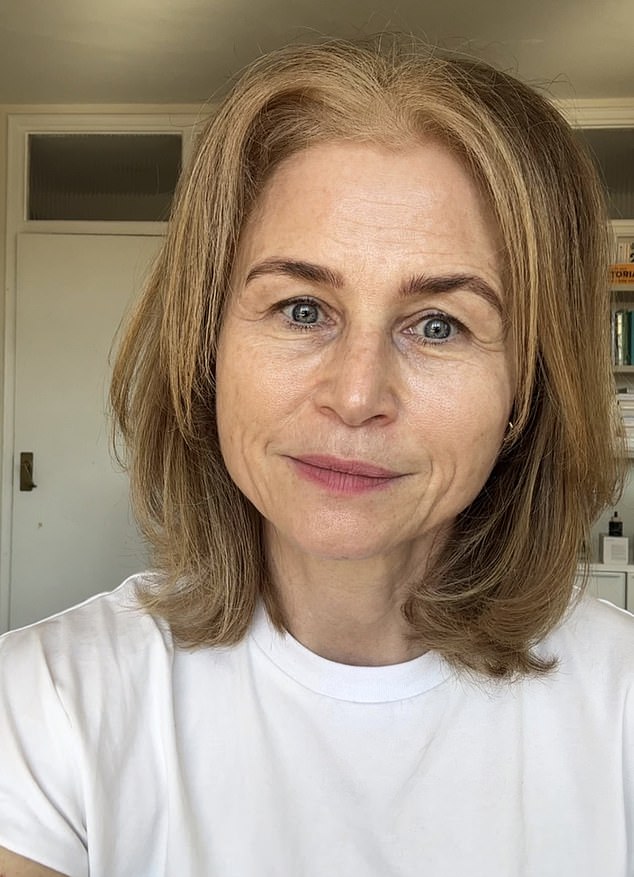
Victoria was unhappy with her eyelids making her look tired all the time
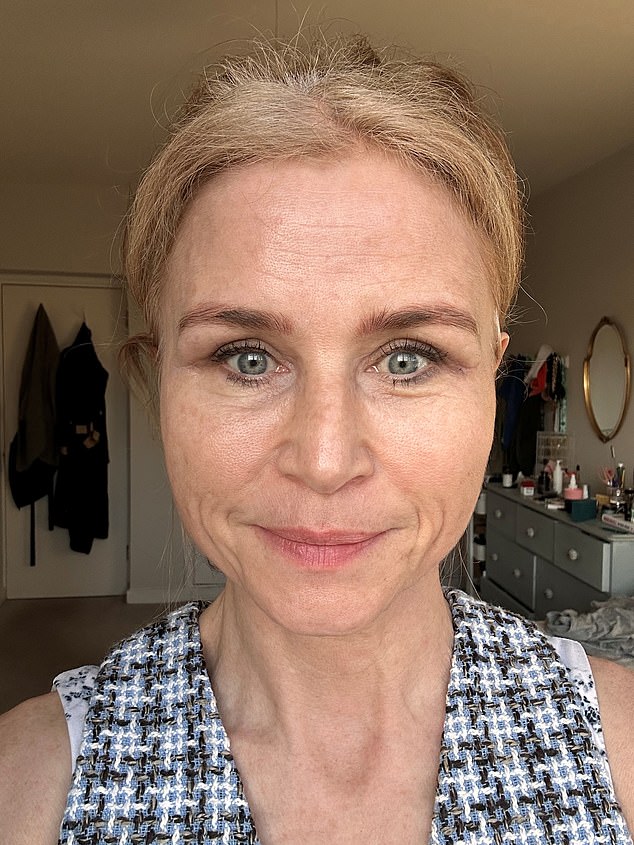
Ten days after the procedure the improvements were visible
While appearance was my main motivator, unbeknown to me, my heavy lids would have been making me feel tired too, Prof Roos tells me. ‘People also get headaches, even migraines from heavy lids,’ he says. It’s true – especially at night I’d feel like my lids were made of lead.
While cosmetic tweakments have come a long way, there’s still no laser or injectable that comes close to the face-freshening results of a blepharoplasty. As efficient as this lunchtime bleph is, it’s not a production line.
‘We never do more than four in a day,’ says Dr Murthy. ‘It’s a very bespoke procedure.’ Plus, ‘you get double the expertise in half the time’. Mercifully, this doesn’t mean twice the cost. Prepare to part with around £7,000, which is comparable to a single-surgeon price in London.
Not all blephs are equal, though. I’d seen pictures of people who’d had it done elsewhere looking like they’d been in a fight, unable to close their eyes properly, or left with a hollowed-out look — tell-tale signs that too much skin has been removed and fat simply stripped away. It’s crucial to choose your surgeon well.
I always knew that eyelid surgery was coming for me. I come from a genetically ‘low-browed’ family – we all have an exceptionally small gap between eyebrows and lashes – and both my grandmother and mother had it done in their 50s (in the Seventies and Nineties). The flat shape of our brows worked against us too. ‘Anybody who has a very flat eyebrow is more likely to have hooding naturally,’ explains Prof Roos.
I told the surgeons that all I wanted was to look less tired. I was fed up with my mascara constantly printing on my droopy brow and of having to put on a permanent expression of surprise just to open up my eyes. Years of compensatory ‘eyebrow hoiking’ had carved deep expression lines in my forehead, making me look worried and older than I felt at the age of 58.
I was told I’d need a ‘lateral’ or ‘extended’ bleph to rejuvenate the outer corners of my eyes, as my hooding went quite wide. I’d have a scar of about five centimetres, which would fade in three months, and with the tail hidden in my natural crease to avoid that winged look that can scream ‘I have had my eyes done’.
A care package arrived a few days beforehand with probiotics and microbiome-friendly skincare by Awvi ( awvi.life) and their own Purifeyes antimicrobial, anti-inflammatory spray to strengthen my skin barrier and reduce the underlying inflammation, which they spotted on a Visia skin scan during my pre-surgery consultation.
I also took prescription tranexamic acid tablets to reduce bleeding and set my skin up for the best recovery. A good night’s sleep before surgery was also prescribed. Indeed, the surgeons Facetimed me the night before to make sure I was having an early night. I booked half a day off work and looked forward to the transformation without trepidation.
Having popped diazepam for calm and paracetamol for pain in the waiting room as instructed, I was happy as Larry while they spent half an hour marking me up, asking me to sit up and lie down so they could gauge how their incisions would be affected by gravity. I wasn’t worried that my eyes would suddenly spring open and I’d see a big scalpel coming for me; it never occurred to me to open them as I listened to their gentle commentary – the joys of Valium!
The room was filled with their own relaxing aromatherapy blend while meditative alpha wave music played. ‘All these marginal gains before, during and after surgery make a big difference to recovery,’ says Dr Murthy.
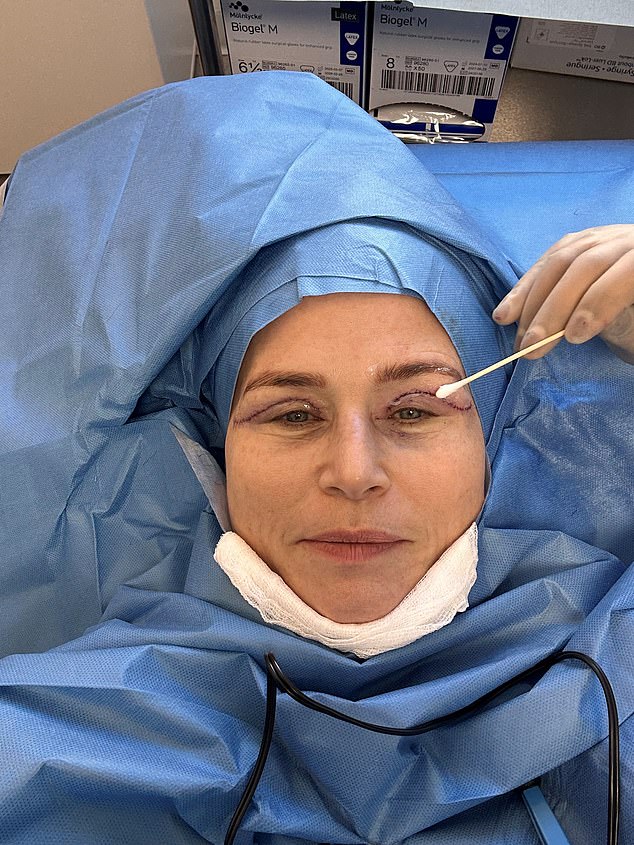
The treatment can be done in a lunch break, adding to its appeal
Thirty minutes later, having felt no pain, and still a bit giddy, I was sitting up admiring my new lid scars, peppered with spidery purple stitches. Lying discarded on a swab were two seven-millimetre-thick slivers of skin about five centimetres long. They looked like lost anchovies.
Prof Roos handed me a ‘going home’ bag with antibiotic ointment to put on several times a day to keep the scars moisturised and protected, a cooling eye mask and another bottle of Purifeyes spray for rapid wound healing. I wouldn’t need to sleep upright or wear eye shields because the ointment would keep my sutures protected and I could immediately close my eyes.
It all seemed very fuss-free. I’d return in a week to have the stitches removed, when I’d be given a dose of yellow LED light for lymphatic drainage, as surgery can cause fluid build-up (oedema), plus antibacterial blue light. After that, I’d be able to wear makeup again.
The next day I had several Zoom meetings from home with my glasses hiding any trace of surgery, and I didn’t need a single painkiller. By days two and three, the stitches began to feel tighter – which was mildly uncomfortable and called for paracetamol – and I had a tiny yellow bruise on one side, but that was it.
As the healing progressed, my lids did feel heavier and I made sure to cancel my plans and take it easy. The surgeons requested pictures every day on our WhatsApp group and sent back encouraging words.
On day six, I went to a work event with my stitches in, and everyone who I’d told was keen to have a good look and marvelled at the healing – quite a few confided that they’d love to have it done. Those who didn’t know, didn’t notice.
The 30-minute bleph is not so much geared towards saving time in your busy schedule, although that’s a happy by-product – it’s all part of helping you recover faster. ‘The less time you have with the tissues disturbed, with two of us working side-by-side, the less trauma,’ says Dr Murthy.
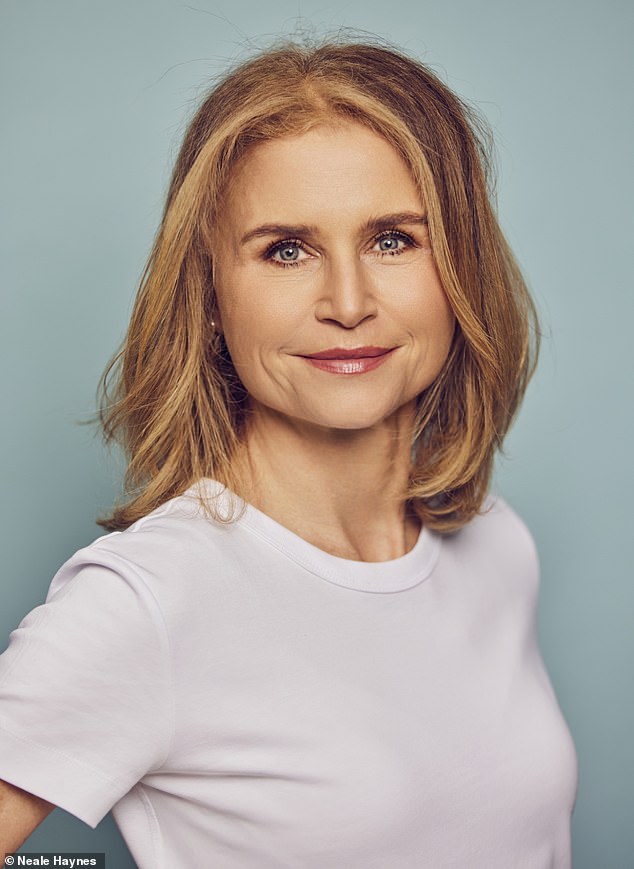
A delighted Victoria feels that the results of the treatment speak for themselves
Would I need a second operation years later? I’d heard that some people did, but Dr Murthy and Prof Roos want this to be my first and last time on their operating table. To maintain the results, they suggest Botox three times a year to prevent a re-droop (‘Botox can lift the brow by about three millimetres,’ says Prof Roos, who did my first session on day seven when the stitches came out). I was told to and continue with microbiome-friendly skincare to keep skin healthy. The better my skin barrier, the better my ongoing recovery would be.
It’s a joy now every day to look as energised and happy as I feel. I remember when my mother came back from her bleph in the 1980s, bruised, puffy and with Jackie-O sunglasses. Then, I was a judgmental 25-year-old – the horror! The vanity! Sorry mum, I’m eating my words now.
* Upper blepharoplasty at Facerestoration.com costs around £7,000