Complaints about right-wing “fake news” have obscured the biggest misinformation problem
About a decade ago, talk of post-truth politics and misinformation became all the rage. As the political class grappled with the rise of national populism and its victories in the form of Brexit and MAGA, they converged on a convenient narrative to explain how movements that rejected their worldview and tastes so wholeheartedly had garnered such appeal.
Yet as endless panels were held and books published on the Right’s supposed growing detachment from reality, a similar phenomenon on the other side of the political spectrum went quietly unnoticed. Aided by people’s engagement with politics increasingly shifting to social media, political truisms of dubious veracity have gained widespread exposure and have been internalised by much of the Left.
Unlike the decidedly déclassé tropes associated with the Right, these misinformation ideas are subjected to next to no social or media scrutiny, and so are freely shared by those who otherwise consider themselves politically engaged, be they colleagues, friends, or, increasingly, politicians themselves.
These views are often reducible to a soundbite or slogan, which frees them from the burden of producing evidence for their claims. They sound intuitively plausible, and present a strong explanation for why the country seems to be in such a mess. Take the frequently repeated sentiment that “there’s always money for war, but never for our public services”, as Jeremy Corbyn put it. It might sound plausible, given the tens of billions spent on defence, and presents an obvious explanation for why public services are in such poor conditions. Yet it bears no grounding in reality. Britain’s defence spending is around £60 billion per year — around half of what is spent on education, and just a quarter of annual spending on healthcare. Clearly, there is a hell of a lot of money always found to fund our public services, and far more than defence could ever hope to get.
Perhaps that misunderstanding around the relatively small proportion of state finances spent on defence compared to public services stems from another common trope: spending on the NHS has been slashed, leading to chronic underfunding. The truth is the inverse: spending on the NHS has consistently risen, in real as well as nominal terms. Just over £200 billion is spent by NHS England annually, double the roughly £100 billion it spent a decade ago (which is just under £150 billion in today’s money). That represents an increase in funding for NHS England of around £1 billion per week, three times the figure proposed by Vote Leave on their infamous red bus a decade ago. Remarkably, this funding surge has done little to dent the perception of the NHS as being the public sector’s biggest pauper, leading to a painfully circuitous debate about healthcare in Britain that remains stuck in discussing funding, too incurious to interrogate the other issues leading to the NHS’s consistently poor record.
Sometimes these truisms are used to explain complex phenomena — wedging them into a moral narrative that makes them more digestible, and that makes political action more justifiable. Economics is a notoriously difficult discipline for the layman to intuit given its many abstractions, so in its place have emerged morality tales about prices rising due to “greed”, and inflation being a corporate conspiracy to rinse the rest of us. Complex supply chains and monetary policy are ignored in favour of a far more intuitive tale about the perennial human vice of greed causing the weekly shop to get a bit more expensive.
Not only is our understanding of the present deeply distorted, but myths about Britain’s past have become foundational to how many on the Left understand our own pas
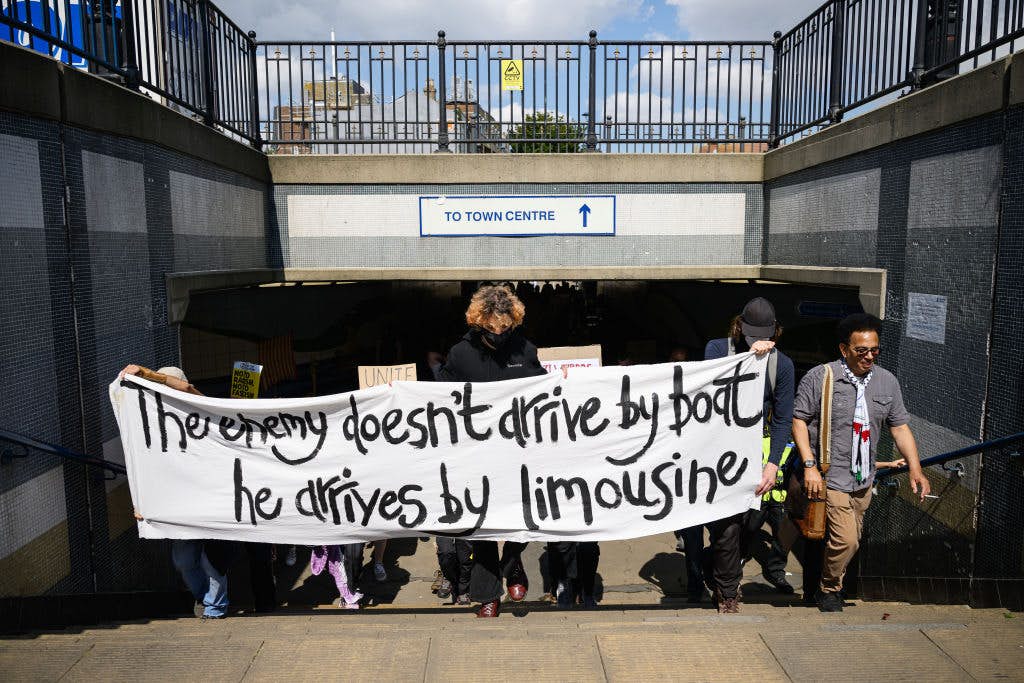
Then there are those truisms that are adopted as post hoc justifications for existing beliefs. No topic attracts more of this genre than that of immigration, support for which has become a prerequisite for acceptance into the Left and a moral marker of being “a good person”. Tropes abound about migrants being needed to pay for our pensions, putting more into the system than they take out, being the backbone of a long list of sectors, being less prone to crime than natives, not being allowed to claim welfare, and so on. In reality, the low-skilled migration that has predominated in the last few years takes more out of the Treasury than it puts in, and migrants have a much higher arrest rate than natives, account for millions of benefits claims, and still make up a small minority of the workforce in the NHS and social care, even after dedicated visa routes were introduced for these sectors that dominated the recent unprecedented surge in immigration.
Not only is our understanding of the present deeply distorted, but myths about Britain’s past have become foundational to how many on the Left understand our own past. As documented by Wilf Solfiac, there is a common misconception of Britain as having been a complete backwater before colonialism, which is assumed to be the means through which it became wealthy and powerful. This couldn’t be further from the truth. It is precisely because Britain was already wealthy and powerful that it was capable of assembling an empire that spanned the globe. The other pillar on which Britain is said to have built its wealth is the post-war migration that supposedly rebuilt the country, creating everything from the NHS to our transport system. Likewise, this historical reading is a fantasy, buying into an inclusive fairytale deployed by the British state to give its more recent arrivals a sense of belonging to a country that, in truth, sought to stop them from ever settling here.
A few misunderstandings here or there about government finances, or the odd misapprehension about the price mechanism, or a muddled view of history — each on their own is forgivable and relatively harmless. But when they are all mashed together and become the basis of an increasingly common worldview — which erects a system of irrational grievances that points people towards oikophobic and redistributive solutions — we end up in our current predicament, with voters making demands that are self-defeating, and politicians ceding due to their own detachment from reality. Unchallenged kooky conspiracies about prices rising for no other reason but greed is how we end up with the party governing Scotland pledging to introduce supermarket food price caps. It is how we end up with the Green Party, pledging a manifesto stacked full of tried and discredited ideas, rising to second in the polls.
Misinformation, as we have always been warned, has a dangerous cost, and our society’s unwillingness to address the many, many examples of popularly held leftist misinformation is set to burden us with some very onerous costs indeed. Somehow, though, one doubts that this misinformation will inspire a moral panic about Russian bots and social media algorithms.