This article is taken from the April 2026 issue of The Critic. To get the full magazine why not subscribe? Get five issues for just £5.
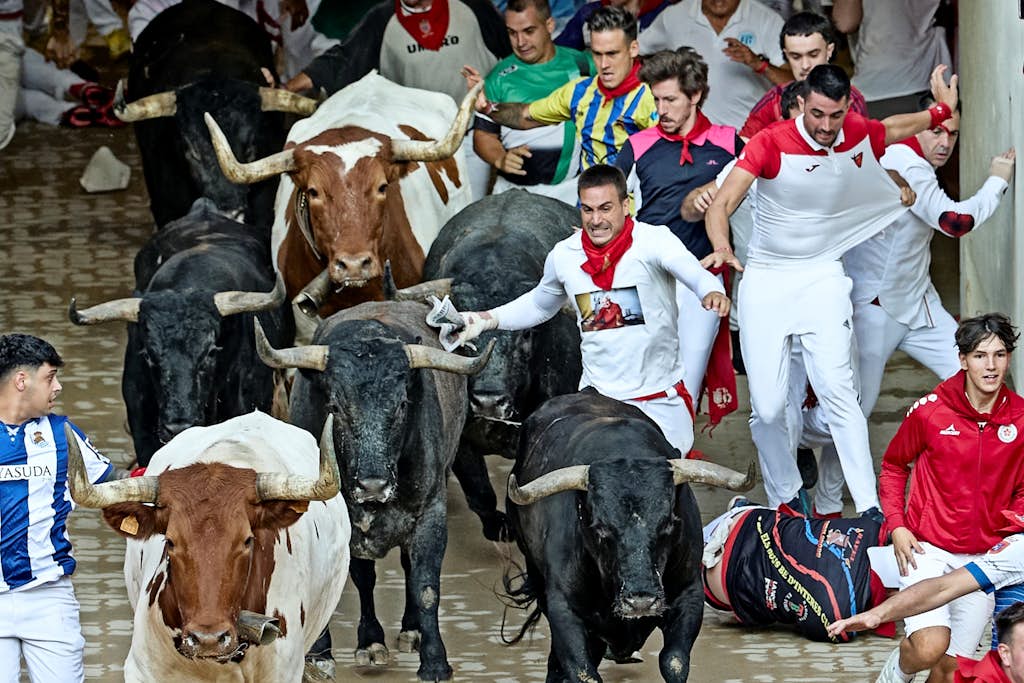
It was the bull-running in Pamplona that captivated Alexander Paul. At the age of seven, newly arrived in Spain, he badgered his parents into taking him to watch the annual San Fermín spectacle.
If you have seen a Spanish fighting bull in motion, you will understand. When he lowers his great crown to charge, his shoulder-muscles bunched for an upward thrust, you feel that you are in the presence of something immense.
Alexander wanted to see more. He began to go to capeas — village festivals in which local teenagers cape young bulls in temporary rings or fenced-off squares. Capeas make up in excitement what they lack in artistry. The animals are in touching distance. Your nostrils are filled with their smell. The fence on which you are perched shakes when they slam into it.
In an age of screen addiction, of AI images and online symbols, it is perhaps the most rank and real thing you can experience outside war. The young expat was enthralled, going alone to local festivals. His parents, being conventionally British in their outlook, never sensed the delicate tragedy being played out in the ring, and saw only the gore. Alexander soon found it easier not to mention his passion to them.
✺
But that passion was deepening into the obsession that most aficionados experience in their early years. When Covid halted all popular festivals — Spain was one of the few places to lock down harder than Britain — he felt the loss physically. As soon as formal corridas resumed, he bought a season ticket to Las Ventas, Madrid’s gorgeous neo-Moorish bullring.
It was during the 2022 season — the season of Andrés Roca Rey’s double puerta grande — that a neighbour in the stands told Alexander that he had a torero’s physique. Bullfighters have a body type, no less than rugby players: slim, almost girlish, but with hard, knotted forearms. It was the first time that Alexander thought about performing rather than just watching.

In 2023, aged 17, he joined the Club Taurino of London, which brings together 400 of the most cussed, brilliant and devoted aficionados on the planet. He devoured the biography of Frank Evans, the Salford matador, who was still appearing in rings in his eighties, despite a quadruple heart bypass and a metal knee. Frank, the sweetest-natured of men, became something of a mentor. But Alexander had an advantage that had not been available to the older man. He could receive formal instruction.
Taurine academies have transformed the spectacle over the past half century. Before they became widespread, it was almost impossible for an aspirant torero to train unless he had family connections. His only chance to get hands-on experience was to sneak into the pastures and cape by moonlight; or else to jump into a bullring during a formal corrida and squeeze in one or two passes before the Guardia Civil dragged him from the ring, usually with a good kicking thrown in. Try-hard youngsters, espontáneos, were a regular sight even in the 1960s, when Orson Welles, Ava Gardner and Francis Bacon were gracing the amphitheatres.
Bullfighting academies made espontáneos otiose. A young novillero now begins with hundreds of hours of study and practise behind him. The prestigious Madrid academy where Alexander studies has been renamed for its famous alumnus José Cubero Sánchez, “Yiyo”, whose heart was cloven in two by a bull’s horn in 1985. It has 70 students, mainly teenage boys, under the eye of the recently-retired matador Fernando Robleño. They pay no fees, because the school is funded by the Madrid region, whose leader, Isabel Díaz Ayuso, is the most impressive politician in Spain.
The course is exacting. Three hours a day, six days a week. There are theory lessons, exercise classes and sessions with the banderillas (the barbed sticks). Every day ends with toreo de salón — practising the movements that you will make in the arena. To turn your body and the cloth into a kind of musical sculpture is no easy thing, even when there is no bull present. To stick to those balletic movements when every nerve is screaming at you to get out of the way is perhaps the most challenging art in existence.
Alexander was not just the only Briton amongst the ambitious Spanish teens. He was also alone in having no family backing. Happily, his school arranged training sessions, tientas, on the breeders’ ranches, allowing him to find his style.
✺
It is worth taking a moment to explain how tientas work. A fighting bull should never before have faced an unmounted man. So, unable to test their bulls, breeders intensely test their potential mothers. Sometimes, they will reach an arrangement with a taurine school to let its students cape their cows; indeed, for the right fee, they will let anyone have a go, even middle-aged British magazine correspondents.
To say that you have caped a two-year-old cow sounds deeply unheroic — though, believe me, a vaca brava resembles a dairy cow only in the sense that a she-wolf resembles a bichon frisé bitch. It is in these practice sessions that you discover your aesthetic, and Alexander is finding his: poised, vertical and still. “My style is more de valor than artista,” he says, slipping unwontedly into Spanish for want of an equivalent English phrase.
No one can aim for a paused and upright style without channelling the most enigmatic living bullfighter. “I want to stand still like José Tomás, not to give an inch. You have to teach yourself how to move your arms without moving your body.”
Alexander’s first time in front of an animal was like everyone else’s. “In my mind beforehand, I was going to stand still and be slow. When the moment came, my feet went one way and my hands went the other.”
Then the lessons began to kick in. He learned, in theory and in practice, that an animal fixed on the cloth will pass you if you do not shift the position of your feet. “I became optimistic, and that’s how I learned to keep still. I knew that the cow would go past me.”
This is the first time that I have spoken to a torero in English. Alexander may have lived in Madrid for over a decade, but he has British tastes and sensibilities. In late 2024, Frank Evans arranged for the youngster to join him at a tienta in Seville. This time, things went to plan.
“I just applied everything I had been learning at the school.”
How different is it in real life?
“You realise how incredibly sensitive the animal is. The slightest touch, the tiniest angle, everything matters in terms of where you want to take it.”
The 2026 season is Alexander’s opportunity to perform in front of paying audiences for the first time. A young torero begins with what is called a novillada without horses — that is, with younger bulls and no picadors. How is he preparing?
“At the core, you just have to be a good torero, you have to surround yourself with people who live it 24/7. However much running and training you do, it’s your mind that counts in the ring. You need to have space to think, to drown out the noise, to focus. When I drown out everything else and feel the intensity of what I’m doing, when I make it all-consuming, that’s when I perform. What makes a figura is always knowing where to take his mind on the day, even in a small village ring.”
Is it awkward being the only Brit?
“People are curious. Sometimes, there are low expectations, as if you’re a tourist. You have to prove yourself. As well as Frank, I’ve been reading about Vincent Charles Hitchcock [a cockney bullfighter in the late 1940s]. I have been lucky enough to start out much younger than either of them had the chance to do.”
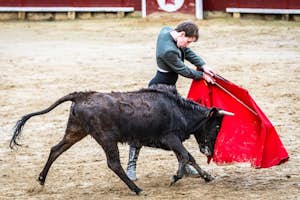
Alexander will be the third torero to be styled El Inglés, but the first with a realistic shot at being able to make a living from it, something very few Spanish toreros manage.
He hopes that his nationality might give him an edge. Bullfighting is the most competitive of careers and, at the beginning, anything that makes you stand out is valuable.
Alexander revels in the freedom of being his own man, with no sponsors, no weight of family expectations.
“The individual has always had to struggle not to be overwhelmed by the tribe,” wrote Nietzsche, the guiding philosopher of the great matador Morante de la Puebla. “If you try it, you will often be lonely, sometimes frightened. But no price is too high to pay for the privilege of owning yourself.”
✺
In Alexander’s case, the price has been unusually high. His mother wept when he enrolled at the school. His parents hate what he is doing.
In the unlikely event that they are reading this column, I hope they will forgive me if I address them directly as a father of similarly aged children. To do what Alexander is doing takes profound courage. I don’t mean recklessness: most teenage boys have that, and most outgrow it. I mean discipline, self-control and commitment. From a British perspective, Alexander’s passion might seem eccentric. But he is submitting himself to the rites and norms of an ancient culture, one that generates exquisite beauty, deep friendships and utter moral seriousness. Antonio Lorca called it “the last serious thing”.
I would be proud to have such a son. So should you be.
¡Suerte, torero!