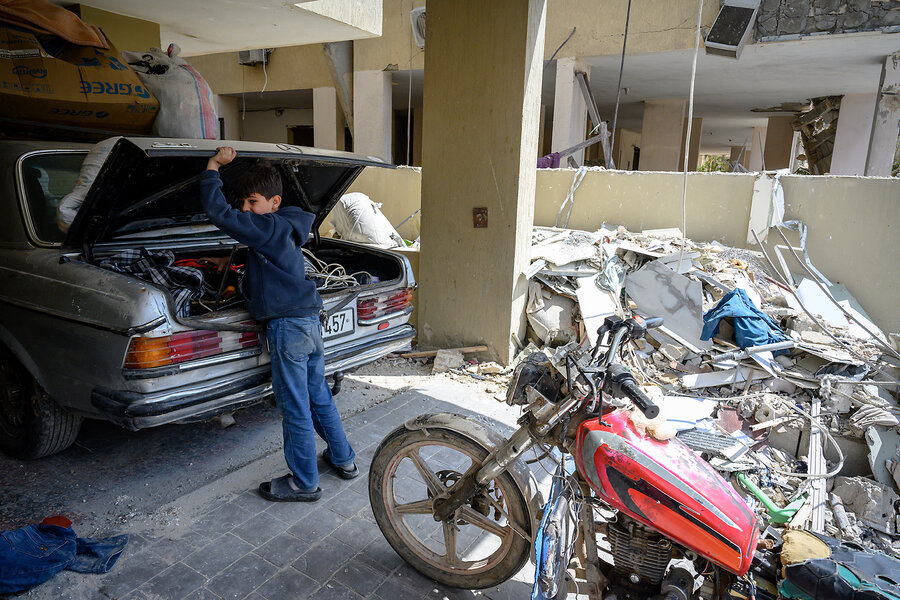
Displaced by war but hungry for home, Faiz Hilal’s family squeezed into their decades-old car and drove from relative safety in eastern Lebanon to their apartment near the southern Lebanese port city of Tyre – only to find their street wrecked by Israeli airstrikes.
They were undeterred by the piles of rubble and mangled metal, and cleared a dust-free path through the ground-floor car park. They hung their washing lines, and made one room habitable for their family of six.
Buoyed by hope that a fragile ceasefire will hold in Lebanon between Israel and the Iran-backed Hezbollah militia, the Hilal family is making a calculated gamble faced by many of the 1.2 million Lebanese residents forced from their homes by two months of war.
Why We Wrote This
Lebanese people displaced by war have been on an emotional roller coaster. A ceasefire has been extended, but fighting in the south hasn’t ended. Even as families yearning for home prepare to return, despite the uncertainty, they are warned not to take the risk.
In the wide spectrum of circumstances of Lebanon’s displaced, each family or individual must decide whether the risks of returning – whether their home still exists, and is accessible – outweigh the deprivations of continued displacement.
Part of the equation is that the Israeli army, in a bid to prevent both Hezbollah attacks and residents’ returns, now occupies a six-plus-mile-deep swath of southern Lebanon, thereby cutting off some 67 towns, which it continues to systematically demolish.
Mr. Hilal’s family reckons that Israel’s airstrikes against Hezbollah targets won’t resume in full force, and that coming “home” to rubble is preferable to sleeping on the streets elsewhere.
“We came back to the same house, but lost everything in it,” says Mr. Hilal, a laborer, pointing with a work glove to the single wire that provides electricity as he carries coils of plastic pipe for water. On the street, beside cars destroyed by explosions, city workers fix power cables. Some say a Hezbollah office was nearby.
“Yes, we are scared, but we need a place,” says Mr. Hilal. “We overcome our fear, to stay.”

Scott Peterson/Getty Images/The Christian Science Monitor
The latest war in Lebanon began on March 2, when Hezbollah launched rockets into northern Israel to avenge the assassination in Tehran, days earlier, of Iran’s supreme leader, Ayatollah Ali Khamenei.
After 46 days of battle, U.S. President Donald Trump brokered a 10-day ceasefire, then extended it an additional three weeks. The result has been an emotional roller coaster for Lebanon’s displaced.
Back-and-forth migration
When the ceasefire extension was announced late last week, for example, convoys of vehicles with mattresses tied on top drove south along the coastal road from the capital, Beirut, past a billboard near the city of Sidon that read: “This land is ours. We are on our way back.”
But Hezbollah had been warning people not to return yet to the Shiite militia’s strongholds in Beirut’s southern suburbs, or to southern Lebanon, where it has had forward positions.
“Why are they going back? Just so they can get hit again next week?” says one resident of the southern Beirut neighborhood of Dahiyeh, as he observed the traffic moving south. “The Israelis are hitting everything.
“Hezbollah is begging people, ‘Don’t go [south]! It’s not finished,’” he says. “Hezbollah is going door to door every night in Dahiyeh, saying, ‘What are you doing here? The war is not done.”
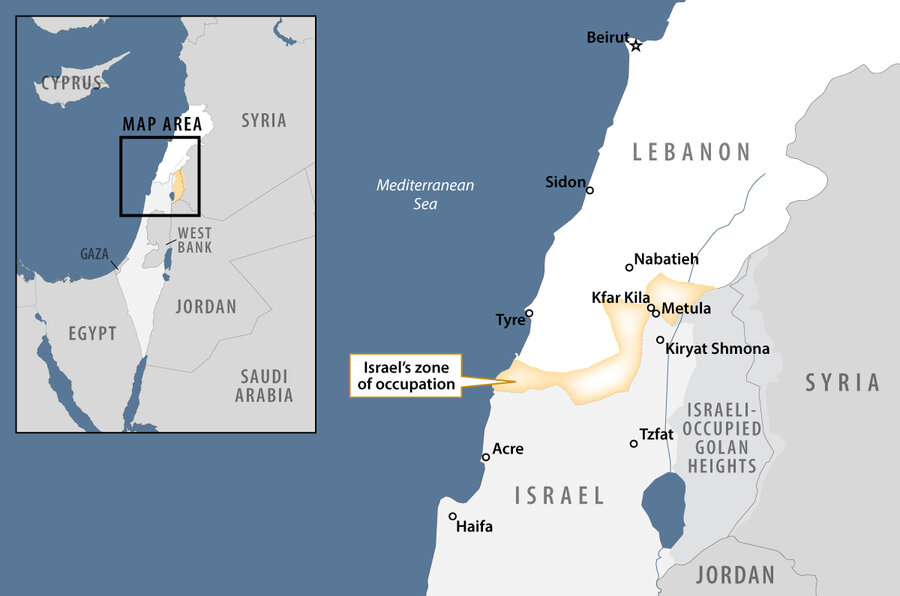
Indeed, early this week, a reverse migration began, clogging highways from southern Lebanon north toward Sidon and Beirut, after Israel declared an evacuation zone and stepped up attacks in some southern districts.
“As you can see, everyone has already left. This is the third round since March 2,” says Shafik Fouani, medical director at the Nabatiyeh Hospital in southern Lebanon, of people who had returned from Beirut, then were gone again.
“People act like that because this is their land, and they don’t want to wait in Sidon or somewhere else for one second longer than they have to,” Mr. Fouani says. As he spoke at the hilltop medical complex, smoke could be seen from Israeli airstrikes to the southwest. The sound of occasional demolition blasts echoed as well.

Scott Peterson/Getty Images/The Christian Science Monitor
Returnees had hoped to take advantage of spring weather to plant tomatoes and other vegetables, said Mr. Fouani. The hospital prepared to “only work with war injuries again,” he says.
“I don’t understand what is happening – nobody does,” says Mr. Fouani. “This is not a ceasefire, because Israel is not stopping its bombing or airstrikes.” Hezbollah, too, has retaliated and caused Israeli casualties, especially with drones.
“We can’t lose hope”
Heeding the call not to return are those living on mattresses on the balcony level of the Lebanese National Theater in Beirut, which was renovated by the TIRO Association for Arts in 2025 and has opened its doors, once again.
The cinema is one of three run by TIRO in Tyre, Beirut, and Tripoli, in northern Lebanon, which housed 150 displaced people at the peak of the conflict. In Beirut, the number has dropped from 40 to 16 or so, but many more come for daily movies at 4 p.m., daily drawing at 1 p.m., and stage performances at night.
Before one recent performance of “Waiting for Hope,” almost entirely performed by displaced residents, scores of children and adults laughed and played – temporarily forgetting their worries – as they waited for the curtain to rise. One recent event attracted 600 displaced children.

Scott Peterson/Getty Images/The Christian Science Monitor
“‘Waiting for Hope’ has the message that we can’t lose hope for the country, for the future,” says TIRO founder Kassem Istanbouli, who led the theater’s renovations.
“The cinema has a lot of respect from the displaced,” he says. “It is important to support the children, to give joy to them, to give them the stage and movies.”
The Israel-Hezbollah wars since late 2023 have taken the lives of a half-dozen members of TIRO, including Amal al-Khalil, a close friend of Mr. Istanbouli and a well-known Lebanese journalist, who was killed during Israeli strikes last week.
One family left the Beirut theater last week to return to the south, but came back immediately after seeing the state of their house – and its proximity to the fighting.
Their home “doesn’t exist anymore”
Not even bothering to return south is the 14-member family of Salah Sheet, from the majority-Shiite village of Kfar Kila, which abuts the Israeli border to the south and east. The family has seen videos posted by Israeli soldiers on social media that show wholesale destruction of their village, houses, and olive groves.
“It doesn’t exist anymore,” says Mr. Sheet, when asked about his house. “They even bulldozed the cemetery.”
He is sitting in a semi-sturdy shelter made of pallet boards and tarps, with solar panels charging phones, and a makeshift kitchen attached. Family and friends come in and out. They are on a large paved space near the Beirut shore, surrounded by scores of other tents and hundreds of displaced people, including 40 from Kfar Kila.
A cardboard sign hung outside reads, “Kfar Kila welcomes you.” Inside, a drawing on the tarp wall includes the shape of a window – meant to symbolize a window back to their home village.
Israeli officials say they will occupy southern Lebanon “indefinitely” – similar to Israel Defense Forces’ control of a self-declared “security zone” in the south from 1982 to 2000 – spurring debate in Israel over whether such a policy is effective.

Scott Peterson/Getty Images/The Christian Science Monitor
Looting by Israeli soldiers across the zone is widespread, according to reports in the Israeli newspaper Haaretz. Those reports prompted the IDF’s chief of staff, Lt. Gen. Eyal Zamir, this week to reject the looting as a “disgrace” and a “moral stain on the entire military.”
Haaretz also reports that, as a military priority, directly fighting Hezbollah has given way to rendering southern Lebanon uninhabitable.
“The only mission is to continue the destruction. … There is no other mission,” one Israeli officer told Haaretz, which added that the IDF “believes this systematic destruction of Shiite villages will prevent villagers from returning home.”
That is the conclusion reached by Mr. Sheet, who says his Lebanese family will, nonetheless, never give up their land. Over the years, his family has lost a dozen members who fought with Hezbollah. Above his left elbow, the word for God is written with a tattoo that he made himself – with three needles bound together, and a bottle of ink – more than 30 years ago.
He says the name of his wife, Ikhlas, is “tattooed on my heart” – a line delivered with a big laugh, that makes Ikhlas laugh out loud, too.
Everyone smiles as the sea breeze keeps the shelter cool in the hot morning sun. Mr. Sheet’s daughter Nour says she misses home, and “the martyrs, and my toys.” And her school.
“This is very regretful, to see this destruction. We are not Gaza here,” says Mr. Sheet. “We will get every piece of sand and dirt, every piece of our land. We will go back. We will resist to the last.”