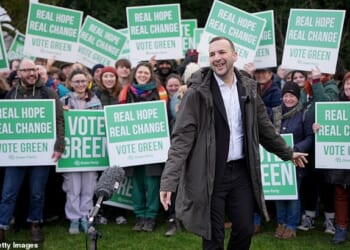
Keir Starmer, who has elevated the political U-turn to something approaching an art form, now appears ready to abandon his pledge to ban imports of foie gras and fur. The explanation, we are told, lies somewhere between trade negotiations and the lingering ambition to edge Britain back toward the European Union. Principle, once again, is invited to wait outside while pragmatism conducts its business.
At first blush, the specifics may seem surprising. Animal welfare is assumed to sit only within the modern center-left’s moral repertoire. Starmer, a North London pescetarian, seems almost comically well-cast for the role of animal defender. But contemporary politics has a habit of sorting moral questions into tidy ideological boxes, as though compassion were less a human instinct than a partisan accessory; we know that for many centrist Labour voters, Brexit and closer ties with Europe, seem, bizarre as it may seem, a more compelling moral issue than animal welfare.
Within this framework, concern for animals has been gently ushered into the progressive camp, where it sits alongside plant-based diets, environmental consciousness, and a broader skepticism of markets. The right, meanwhile, is cast as the land of conscience-free realism: steaks sizzling, markets humming, and a heroic indifference to the fate of dairy cows that live such abbreviated lives on UK farms. It is a convenient dichotomy—one that reinforces the familiar caricature of the left as naïve and the right as callous.
Convenient, but perhaps misleading. In fact, a serious conservative or libertarian philosophy bursts with the intellectual resources to engage deeply with questions of animal welfare. Indeed, it may be uniquely equipped to do so. Concepts such as responsibility, stewardship, and restraint are not decorative words to be trotted out at party conferences by the seaside; they are central to how power is understood and justified.
The question is not whether human beings exercise power over animals. That contest was settled some time ago. The question is what obligations follow from that power. A coherent conservative answer cannot simply be: whatever is permissible, or whatever proves profitable. To accept that logic would be to hollow out the very idea of moral responsibility.
Stewardship, a concept frequently invoked in discussions of land and institutions, is a very Middle England concern, with their traditional, nostalgic view of English heritage. But it applies no less to living creatures. It is not an imported sensibility from the political left but a principle embedded in religious and philosophical traditions long claimed by conservatives themselves. To be a steward is to care for what one did not create and to be judged by the manner of that care. Animals, no less than landscapes or cultural inheritances, fall within that domain.
Libertarian thought, too, emphasizes personal responsibility—the idea that individuals bear moral accountability for their choices. Yet this principle often seems to dissolve at the supermarket checkout. Purchasing decisions are treated as morally neutral, even when they sustain intensive farming practices that would be traumatizing if directly witnessed. But consumption is not passive. It is participatory. To buy is, in a meaningful sense, to endorse and perpetuate the conditions under which goods are produced.
At this juncture, the language of liberty is frequently invoked as a defense and any attempt to interrogate such choices is framed as an encroachment on personal freedom. But liberty, properly understood, is not license. It is freedom exercised within a structure of responsibility. The man who insists on doing as he pleases regardless of consequence is not a defender of freedom; he is merely its most tedious beneficiary.
There is also something distinctly un-conservative about the refusal to acknowledge limits. A society that cannot restrain itself—whether in consumption, industry, or its treatment of the vulnerable—is not demonstrating strength but decay. Restraint, after all, is a precondition of continuity.
Animals are, obviously, vulnerable. They possess no political voice, no capacity to organize, no means of legal redress. If the protection of the powerless is not a legitimate concern for conservatism, it becomes difficult to articulate what is.
So much for theory. How is this working in practice? In the United States, Robert F. Kennedy Jr. has floated plans to restrict or even eliminate certain forms of animal experimentation. Regardless of one’s view on the feasibility of such measures, their proposal within a broadly conservative or heterodox political context is noteworthy. It suggests that concern for animal suffering need not be confined to the left but can arise from a broader moral seriousness.
In the United Kingdom, the most recent figures indicate that millions of animal experiments are conducted annually. At MBR Acres near Cambridge, beagle puppies are bred for laboratory use. While operators maintain that they adhere to regulatory standards, investigative footage has at times raised troubling questions about the conditions in which these animals are kept.
One might expect such revelations to galvanize sustained attention from progressive media and advocacy networks. Yet coverage has been uneven. In some cases, it has been GB News and Talk TV, channels associated with the political right, that have been more willing to highlight these concerns. This is not because they have undergone a sudden conversion to animal rights activism, but because the moral terrain here is less comfortably mapped onto existing ideological loyalties.
The debate over halal slaughter offers a parallel example. Criticism of the practice has been more readily voiced on the right, while parts of the left have approached the issue cautiously, wary of appearing culturally or religiously insensitive. To be sure, some critiques are advanced in bad faith. But it does not follow that all are. For some, the concern stems from a genuine belief in minimizing animal suffering, grounded in principles of stewardship rather than hostility.
For conservatives here, there is a political as well as philosophical opportunity. Engaging seriously with animal welfare could help disrupt the simplistic moral binary that casts the right as indifferent to suffering. It could also resonate with the voters of Middle England.
Subscribe Today
Get daily emails in your inbox
There are caveats to the stereotype of the English as animal lovers but, like many stereotypes, it emerged from something true. The world’s first animal cruelty prevention legislation was introduced here in 1822. Two years later, it became the first country in the world to start a welfare charity for animals, the RSPCA. That heritage continues to shape the nation’s voters.
The challenge is not to frame animal welfare as a niche or sentimental concern but to recognize it as a reflection of broader societal values. How a society treats the most vulnerable—human or otherwise—offers a window into its character.
If conservatives and libertarians are committed to the principles they often espouse—responsibility, stewardship, and the disciplined exercise of power—then animal welfare should not be an afterthought. It is, rather, a natural extension of those commitments. And if the political right cannot articulate a compelling case for the humane treatment of defenseless creatures, it raises an uncomfortable question: what, precisely, is it seeking to conserve?