Dogs are a visible part of Ukraine’s war effort. They join assault units on the front and help detect mines and explosives. Some provide comfort to veterans. Others linger at checkpoints and gas stations, welcoming human contact and treats with wagging tails.
But the dogs of the “Antares” Pavlohrad canine unit are unique.
Antares is the only officially commissioned search-and-rescue team in Ukraine, combining trained dogs and civilian volunteers to recover both living people and remains. They crisscross the front lines searching for the casualties of the war, where expectations are sometimes held by the thinnest thread.
Why We Wrote This
Russia’s war on Ukraine has left many people unaccounted for, which is where the “Antares” Pavlohrad search-and-rescue canine unit helps. Its work has also proved essential for team members who are themselves dealing with the war’s tribulations.
It’s a critical job carried out by team members, both human and animal, who are overcoming their own obstacles to contribute to the larger Ukrainian war effort in a way that few others are able to.
“Our unit is called ‘the unit of last hope,’” says Antares founder Larysa Borysenko, taking a rare day off in between rotations. “If we cannot do it, no one else can.”
“I believed in Larysa’s dog”
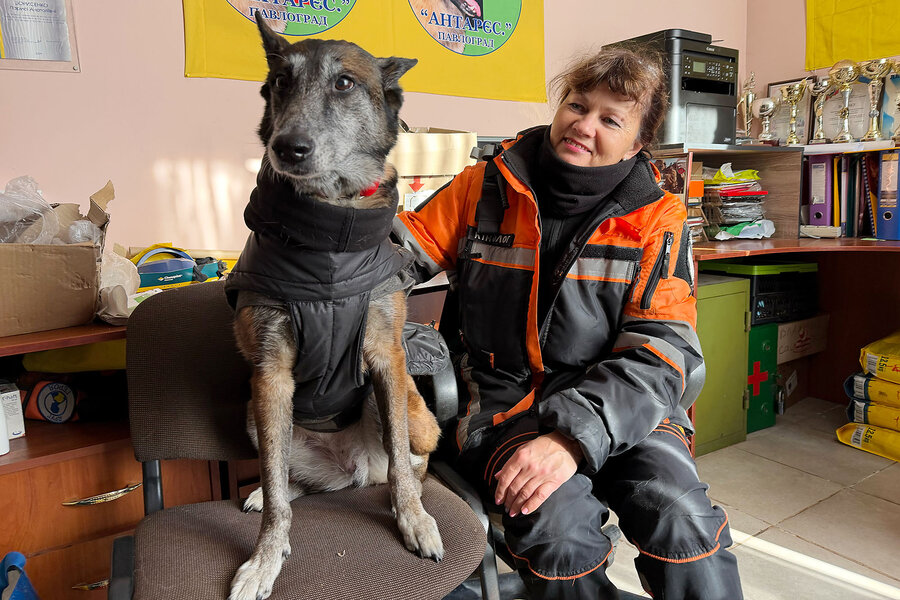
Ms. Borysenko started Antares in 2007, its name taken from one of her early canine partners. But the dog consistently at her side today is Babusia, Ukrainian for “grandmother,” who was named after a particularly successful rescue. Babusia sports a cherry-red collar and carries herself with the quiet authority of a veteran.
What sets her apart from the other sharp noses on her team is an uncanny ability to find both living people and human remains; most of the dogs are good at only one of the two. Ms. Borysenko developed a training program to spread Babusia’s skills to other dogs.

Initially, the Antares unit was focused on rescuing lost individuals, including older people who wandered off and children lost in remote areas.
That changed in 2014, with the outbreak of fighting in eastern Ukraine between government forces and Russia-backed separatists in the regions of Donetsk and Luhansk. By 2017, the volunteer unit had shifted its focus to finding and recovering the remains of soldiers killed in the east.
Since Russia’s full-scale invasion in 2022, the unit is almost constantly deployed, spending only a month or two at home per year. There are 33 human volunteers and 24 dogs on the team. They live, eat, and sleep together wherever missions take them.
The job has become much more dangerous.
“In 2022, working on the field was like a vacation,” says Ms. Borysenko. “Now, you have to keep an eye on the sky at all times. We need to move with military escorts and drone detectors actively scanning the sky.”
The nature of the sites has changed. Early recovery work unfolded in open, peaceful territories. By 2017, they were tackling skeletal remains. Their expertise now covers missile strike zones, burned-out vehicles, ammunition depots at risk of secondary explosions, and industrial sites.
“With the help of the dogs, we can find the smallest remains,” Ms. Borysenko says, recalling the case of a Russian attack that killed six soldiers. Remains of five were located by earlier crews. The dogs pinpointed traces of the sixth, a tank driver killed by a direct hit.
External assessments highlight the precision of the dogs, noting how they often surpass human judgment in complex recoveries. During one mission in the Donetsk region, a witness pointed to a burial site, but the dogs indicated another 20 meters (65 feet) away.
“I didn’t take the word of the witness; I believed in Larysa’s dog,” says Andrii, a Ukrainian officer who regularly partners with Antares in the field. Further investigation confirmed the dog’s finding.
“They are the most effective unit that can perform such operations in Ukraine,” Andrii says. “In so many situations, there have been many search groups working on the same site, until Antares comes and finds the actual remains. [When] it seems like we have used everything, … we call them and they find it.”
Strain, and comfort, on the job
This line of work can take a serious toll on health, but it is also healing.
Valentyna Val joined the unit after losing both her brothers on the front. Serhii and Oleksandr had been fighting against Russia since 2014, following Russia’s annexation of Crimea. They were killed in 2022 and 2023.

The family was left in emotional shreds. Ms. Val says that the situation pushed her to the brink, and it is her volunteer work with the dogs today that has pulled her back – while also honoring her brothers.
“This is the only way to keep depression at bay,” she says. “Dogs are incredible emotional support. They are fun to be around and take me out of the house. When there is a rescue mission, I am the first one in line to go because I can sublimate my grief into helping others and work. It brings me a sense of higher purpose if I can find someone alive or give the chance for a relative to bury a loved one. That is something to which I can relate.”
Nearly everyone on the team carries heavy burdens. Volunteers include soldiers discharged due to injuries, women who have men fighting on the front or who are missing in action, and veterans struggling to adapt to civilian life. Ms. Borysenko recalls being at a complete loss when a member of her team, 21-year-old Slava, had a post-traumatic breakdown while remembering fallen comrades.
Even the dogs show signs of burnout, with some receiving specialized veterinary care.
“Each one of us is fighting their own personal hell,” says Ms. Borysenko, referencing how many members of the team are facing serious physical and mental battles of their own, even as they work in the field. “We are complicated people. We are not easygoing. When we go on a mission, we understand that we are needed and that we have a higher sense of purpose.”
She speaks from firsthand experience. On March 26, 2023, near Izium, Ms. Borysenko triggered a booby trap while searching for remains. The blast left her with wounds so severe that doctors considered amputating both legs. When she regained consciousness, she couldn’t believe that Babusia survived.
The road to recovery was long. Colleagues, worried that they might lose her altogether, brought her back to the field when she could barely walk 150 meters (490 feet). Little by little, she regained both her strength and enough balance to train without getting knocked off her feet by unruly pups. Now, she can climb ladders while carrying a dog.
Central to that recovery were the animals themselves. She speaks affectionately of Besha, known as “the Terminator,” and Mara, a Belgian shepherd she began training in 2024 so that Babusia might eventually retire.
“Our dogs didn’t choose this life,” she says. “They did not choose these traumatic events and hard war. But they are top-notch professionals and very valuable. A lot of people depend on them.”