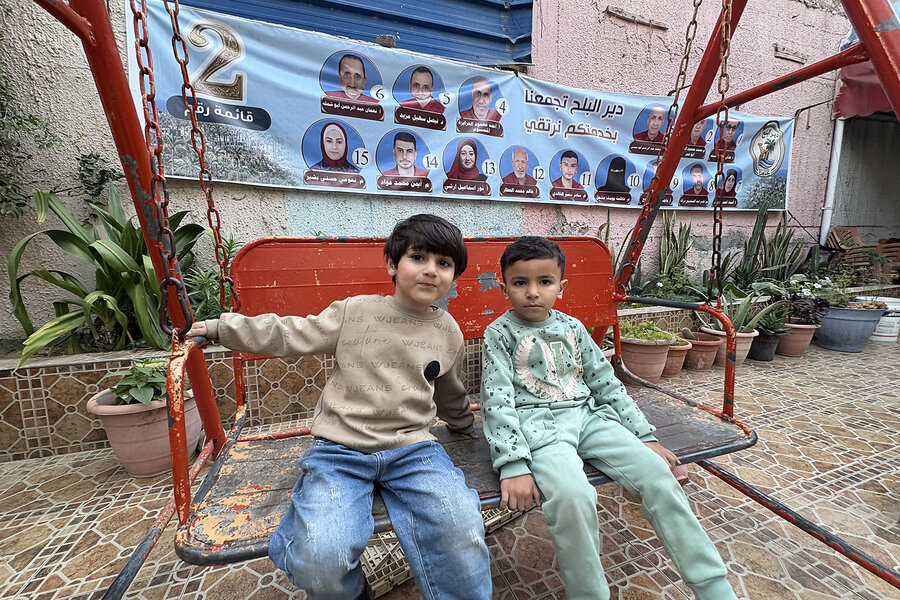
Campaign posters and stickers line the streets. Glad-handing politicians work their way through markets. And the talk of hope is in the air – all in war-weary Gaza.
Amid stalled cease-fire diplomacy, Israeli restrictions on aid and isolated airstrikes, water shortages, and poverty, something surprising is occurring in the central Gaza Strip this weekend: elections.
After nearly two decades, and amid a devastating war, Gazans in the central city of Deir al-Balah have the opportunity Saturday to elect local municipal council members.
Why We Wrote This
Municipal elections called by the Palestinian Authority and allowed by Hamas are being held Saturday in Deir al-Balah, Gaza, coinciding with voting in the West Bank. It’s the first time since 2005 that Gazans anywhere are able to vote. Water and sanitation are on the ballot, as is, symbolically, Palestinian national unity.
The elections – called for by the Ramallah-based Palestinian Authority (PA) and allowed by the ruling Hamas, its rival – are seen as a step toward self-governance and a post-Hamas future.
Polls are being held simultaneously in towns and villages across the West Bank, and organizers and candidates say the elections are more than progress toward democracy. They are a chance for Palestinians in the coastal enclave to be united with their West Bank compatriots, providing a step toward statehood and against attempts by Israel and others to isolate Gaza.
Detractors describe the elections as a “distraction” from more urgent needs: food, water, shelter, reconstruction, and an Israeli military withdrawal.
Yet candidates say better local governance is the path to improved services and daily lives in the central Gaza town.
“For the first time in 20 years, people are exercising their democratic right to elect a municipal council that represents them,” says Mohammed Reyati, a former official with UNRWA, the United Nation’s relief agency for Palestinians, who is running for office. “This process represents life, stability, and peace – away from political divisions.”

Palestinian Authority seizes an opportunity
Local elections in Gaza were last held in 2005. A 2007 schism between Fatah, the dominant PA faction, and Hamas saw the latter seize control of the strip. Elections have not been held since.
But with a cease-fire mostly holding after the death, displacement, and destruction of the Israel-Hamas war, and with the promise of a new Palestinian technocratic government in Gaza, the PA saw an opportunity to bring elections back to the Strip.
Hamas has not fielded a list, or slate of candidates, nor endorsed any candidate but said it would respect the results.
The polls are being organized by the Central Elections Commission, an independent PA-affiliated body formed in 1993 that runs elections in Palestinian territories.
Officials chose Deir al-Balah as the lone site in Gaza for elections as it is the community least damaged by the war, has seen the least displacement of its population, and has not been bulldozed or occupied by the Israeli military.
Up to 70,000 residents are expected to vote at 12 polling centers stationed across the city in less-damaged homes. Ten local and two international election-monitoring groups will observe.
Voters will go to polls Saturday in 420 towns and villages across the West Bank as well.
“Key needs [in Deir al-Balah] include providing water, improving sanitation, addressing cleanliness, and the lack of order in the city,” says Jamil Khaldi, regional director of the Central Elections Commission in Gaza. “All these issues require elected bodies that can act more effectively – both internally and externally – to secure funding and provide services to residents.”
Palestinians will be voting for electoral lists, rather than individual candidates. Four lists are competing in Deir al-Balah: Peace and Construction, Deir al-Balah Unites Us, Future of Deir al-Balah, and Renaissance of Deir al-Balah.
The lists present themselves as independent, apolitical, and service-oriented. However, Mr. Khaldi notes that some candidates have personal political affiliations, and observers say some lists are being backed by large families.
As part of a new electoral law passed by the PA, the minimum age for candidacy has been lowered to 18, and 25% of seats are reserved for women.
“We call on all citizens to participate in voting to achieve the highest possible turnout. These elections are very important as a political symbol linking the West Bank and Gaza,” Mr. Khaldi says.
With the polls, “Deir al-Balah is representing the Gaza Strip and linking it to the West Bank as a single geographic unit,” he says.
“We are here to serve”
The services crisis, particularly the water shortage, is a major factor influencing voters’ choices in Deir al-Balah.
Faten Harb, candidate for the Renaissance list, says many like her chose to run because they see it as a “duty” to serve their community.
“I chose to run for this position because I believe that serving the community is a collective responsibility,” says Ms. Harb. “Running for office is a responsibility and a duty. We are here to serve.”

Ms. Harb, who aspires to open a women’s center, has billed her candidacy as a chance to not only advocate for Gaza’s women, but to deliver on the services and issues that impact them the most.
“All women are demanding adequate access to water,” she says, adding that her “top priorities” are “ensuring water reaches everyone, improving cleanliness, and managing solid waste.”
“The advancement of any society begins with the advancement of women,” she adds.
Khalil Abu Samra, a candidate for the Future list, says he hopes the elections will lead to a local council that will directly engage not only the PA, but the international community and donors.
“If elections are successfully held, the goal is for Deir al-Balah to be treated in the same way as Ramallah, with equal engagement and support,” he says.
His list’s immediate plan is to “restore trust” with voters, Mr. Abu Samra says. It has a three-pronged strategy to help the city recover from war: “relief, recovery, and strategic plans” that will include cooperation with EU countries and engagement with foreign donors to restore and enhance municipal services.
Noor Ismail Irshy, a social activist and disability-rights activist who was 11 years old the last time elections were held in Gaza, says she decided to run for office for “change and reform” in Gaza politics and society.
“I want to deliver a message to society that persons with disabilities must be included and participate in all areas of life,” says Ms. Irshy, who has a disability. “Through these elections, I want to help ensure that this message reaches everyone.”
Holding the elections, says Mr. Reyati, the former UNRWA official, “sends a message to the outside world and to Western countries that we are a people who aspire to life, who value democracy, and who seek peace to improve living conditions in Deir al-Balah.”
Mr. Reyati says he hopes “these elections will bring about real change,” and says his list is pledging to organize and integrate displaced Palestinians in the city and tackle overcrowding.
“The city’s population used to be around 110,000, and today it exceeds 350,000,” he notes. “We aim to improve living conditions for displaced people who were forced to leave their homes and to better organize displacement camps.”
Many are skeptical
Candidates say they have not faced pressure or coercion from political factions, including Hamas, and do not fear for their safety.
But many war-wary, would-be voters remain skeptical.
Grocery store owner Hisham Ahmed says holding elections under these conditions feels “surreal.”
“We’re still living in a state of war. There’s no stability at all,” he says. “Why should we vote … when we could be bombed at any moment?”
The elections represent “a good step in the right direction,” he says, but adds he is doubtful that polls alone can solve Gazans’ crises.
Aya Abu Ghalwa, a doctor, says holding elections in one city is not enough.
“Elections should be replicated in other areas in Gaza to feel the real change,” she says.
Whatever the turnout, candidates expressed hope that Saturday’s polls mark the beginning of a democratic Gaza and united Palestinian state.
“We hope that this democratic experience will extend to the rest of the areas in the Gaza Strip,” with Deir al-Balah serving as a model, says Ms. Harb, from the Renaissance list.
“The decision to hold elections in both the West Bank and Gaza means there is no [Palestinian] state without Gaza, and no Gaza without the state,” says Mr. Abu Samra, from the Future list.
The elections are “a message that the homeland is one unified entity.”