Muhammad Hazrat Ali’s cramped village factory is a far cry from the mechanized garment plants of Bangladesh’s capital, where around 4 million workers churn out billions of dollars worth of apparel for export every year.
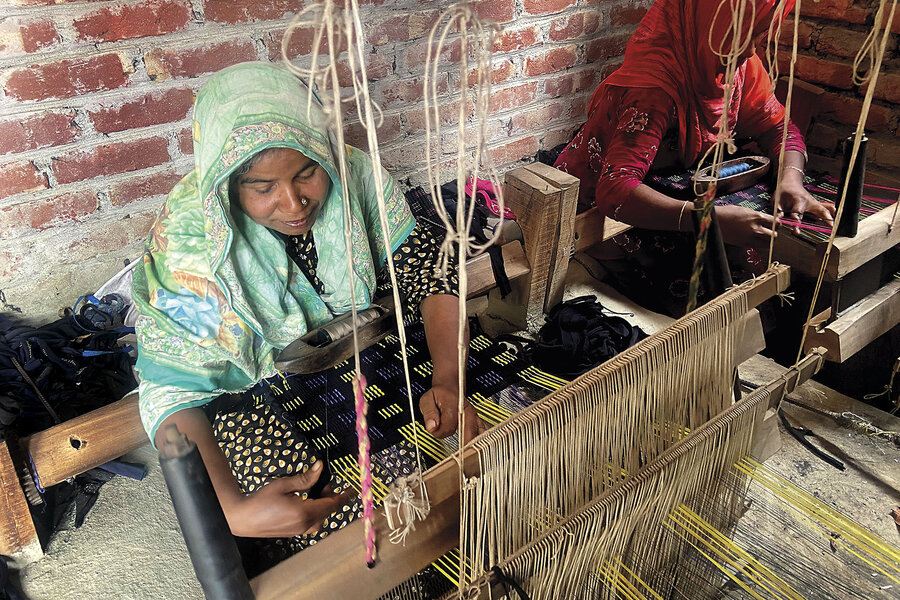
It takes all day to reach his business from Dhaka; the border with India is closer. Inside the modest cluster of buildings, the click and clack of handlooms, operated mostly by women, blend with barnyard sounds outside.
But this small business, surrounded by fields of rice and wheat, is tied to Bangladesh’s booming garment industry, as evidenced by the giant bales of cotton scraps stacked at the entrance. Mr. Ali recycles this fabric into handwoven rugs and mats, known as shataranji, a traditional Bangladeshi craft that has helped uplift rural communities. It’s a source of income for tens of thousands of handloom workers in northern Bangladesh, and has also put the region on the map for importers in Europe looking for handmade home decor.
Why We Wrote This
Dhaka is the beating heart of Bangladesh’s textile industry. But beyond the capital, rural weavers are bridging a traditional craft with modern markets, often with a focus on sustainability.
“It’s made by hand and people respect that,” says Mr. Ali, who employs 300 people in his factory and at nearby houses.
The craft evolves
Exactly what shataranji is, and how it took root here, is hard to pinpoint. Some claim the tradition dates back to the Mughal era – shataranji is a Persian word – when the thick-knit, artistic rugs supposedly adorned the emperor’s palace.
That artistry was evident to a 19th-century British colonial official known as Mr. Nisbet, who supported shataranji weavers in the northern city of Rangput. Thanks in large part to Mr. Nisbet’s patronage, shataranji rugs became fashionable to own and were exported to other British colonies, and a nearby town was later renamed Nisbetganj to recognize his role in promoting the craft.

Simon Montlake/The Christian Science Monitor
Throughout the 20th century, the craft evolved. Investors opened new factories in Rangput to produce more floor mats for export and for Bangladesh’s growing middle class, and the craft spread to other communities, including Mr. Ali’s. Nonprofits alighted on shataranji as a potential livelihood project for marginalized groups who could work at home on looms. And the booming garment industry had plenty of scraps to offload, so recycled-cotton shataranji rugs took off. You can now find them at Ikea.
At her home, Champa Bala turns cotton scraps into mats on a loom mounted next to her bed. She sits all day, working the loom with foot pedals in a hole dug into the packed-mud floor. By the end of the day, she’s produced around nine mats, netting her nearly $2.
Before she trained on the loom in 2019, Ms. Bala, who belongs to Bangladesh’s Hindu minority, had never worked. Her husband drives a van, but work is harder to find in the dry season, so her income makes a difference. “Now, we’re much better off. Before, we couldn’t eat three times a day,” she says. The family has saved some money and bought goats and a cow.
Her mats go to a trader who then sells them to Bangladeshi retailers, usually run by nonprofits to showcase national products – including those made by people who are trained by nonprofits, as Ms. Bala was. Her loom came from Eco-Social Development Organization, a group based in nearby Thakurgaon.
Demand for shataranji
Muhammed Shahid Uz Zaman, the founder and executive director of ESDO, says handicrafts can offer a path out of poverty for villagers who don’t own land. But this only works if there’s actual demand for handmade products, as there is now for shataranji. “In Bangladesh, the market is the main problem,” he says. “You can produce a lot but not have a market.”
Mr. Ali started his business in 2002 after three years working in India as a handloom operator. He began with four looms and a handful of workers at a single site. As the market grew, so did his business, and he borrowed money to invest in more looms and hire more workers.

Simon Montlake/The Christian Science Monitor
Today, he pays his loom operators $3 to $5 a day, depending on their experience and productivity, and hopes to expand operations.
“I want to create more job opportunities” in shataranji, he says.
While the types of mats that Mr. Ali produces are more functional than fine craftsmanship, Bangladeshi shataranji can be refined and distinctive, says Shawon Akand, an artist and curator who studies the industry. He would like to see young artists collaborate with weavers to incorporate new designs and styles, as well as to revive traditional designs. Art is more than paintings; vernacular weaving is also art, he says.
But despite the popularity of shataranji abroad, he hasn’t found any takers in the art world. “In Bangladesh, people don’t believe that textiles is an art form, especially the academicians,” he says.