Do you suspect your partner might be cheating on you but are unsure of what to do next?
Relationship expert at real-life dating app happn Claire Renier has revealed seven steps those in the uncomfortable position should follow – from leaning on your support system to communicating rather than confronting.
And if you do decide to take them back, there are five promises they must adhere to in order to for you to go on and enjoy a healthy relationship in the future.
Speaking to the Daily Mail, Renier said: ‘You know your relationship and your partner better than anyone, and if you feel that something is off, listen to your instincts and have a conversation with them about how this is making you feel.’
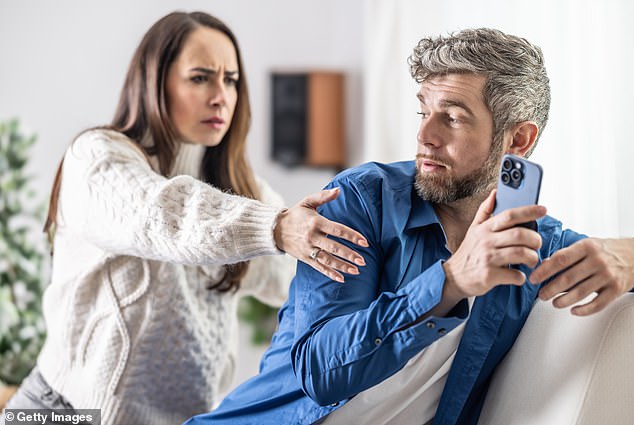
Relationship expert Claire Renier has revealed the best steps to follow if you suspect your partner might be cheating (stock image)
1. Communicate rather than confront
Communication is key but one must approach the discussion carefully.
Renier said: ‘First things first, talk to your partner about your feelings so you can broach the subject in a non-accusatory way.
‘You need to establish they actually are cheating first before the damage is done, and if you’re navigating an open relationship, you may not be familiar with the signs of cheating in a relationship of this type.
‘It’s tempting to dive into detective mode, but honest, calm communication can be more revealing.
‘Start with open questions like, “Is there something going on that we need to talk about?” rather than accusations that can shut down the truth or start an argument.
‘Or talk about how you feel about some of the red flags, like “When you act distant and cold, it makes me think something isn’t right”.’
2. Take time to make a decision
Next, there’s no need to rush when deciding what to do next.
She said: ‘If you’ve established your partner is cheating, it will be heartbreaking and a violation of your trust.
‘You need to assess what’s right for you in your relationship. Assess whether it was a one-off act, emotional cheating or did it involve anything physical?
‘If this were part of an open relationship, you’ll need to assess if it crossed the boundary of what was mutually agreed on as the terms for the open relationship.
‘Question whether you think you can move past the infidelity and rebuild trust. Don’t rush into a decision; instead, take a day or two of space to gain clarity, as finding out about infidelity can cloud your judgment.
‘Whether it’s ending things or trying to rebuild trust, your decision should come from a place of calm, not chaos.’
3. Clear the air and rebuild trust together
‘If you decide you can work through the issue, you need to discuss and clarify your feelings as a couple,’ says Renier.
‘Set expectations moving forward, and forgive and move on. You can’t hold it against them for every little thing or build resentment otherwise the relationship won’t recover.
‘Trust can be rebuilt, but only if both parties are willing, and some couples come back stronger after it, but only when the cheater takes accountability, and the betrayed partner genuinely wants to rebuild.
‘You could even go to couples counselling to help process and work through it with a professional.
‘Despite this, you will need to consider the ramifications of staying together. For example, knowing that your partner has cheated on you may mean that your friends and family may be less supportive of your relationship, particularly if they have been your shoulder to cry on.’
4. Or cut off completely and walk away
But that’s not the only option, Renier explained.
She said: ‘However, if you decide that you can’t move past the infidelity, or are unable to navigate the open relationship in the face of this, you need to leave the relationship and end it.
‘Walking away can be a form of self-respect. If your trust has been shattered, choosing yourself isn’t selfish; it’s self-care.
‘It’s not a reflection of your worth either as the cheating was their choice, rather than a reflection of your value.’
5. Allow yourself to feel your feelings
Next, Renier explained the importance of processing the emotions, saying: ‘Being cheated on is an emotional experience – often provoking feelings of betrayal, anger and sadness.
‘It may also cause feelings of low self-esteem and confidence, insecurity about yourself and your relationship, as well as bitterness and resentment for how they treated you.
‘Even if you choose to leave the relationship, the emotional impact of being a victim of infidelity can follow you into new relationships, and not only just the romantic ones, as you may find it harder to trust others.
‘With this in mind, it’s important that you give yourself the space to express your emotions – as bottling things up can be harmful in the long run.’
6. Think of the practicalities
The expert continued: ‘Relationships don’t just involve your feelings – with partners often being entangled practically through living together, having joint finances, and even shared assets or children.
‘When considering next steps, it’s crucial to know where you stand both financially and legally, and who you can turn to for advice – this could be someone from your bank, or even a lawyer who specialises in divorces or family law if this is relevant to your situation.’
7. Lean on your support system
She concluded: ‘Finally, throughout this really challenging period, it’s important to confide in friends, family, or even a therapist.
‘You should talk to people who can help you process what happened without judgement. Talking it through can help give perspective and make you feel less alone.’